On this page
The right primary packaging for a skincare formula is the container and dispensing system that can handle the product as intended, let customers use it appropriately, and be evaluated for the proposed manufacturing route. Start with the formula and the way it will be used—not with a photograph of a bottle.
A jar, tube, standard pump, airless dispenser, or dropper can each be a reasonable starting point. None is automatically the best choice for every moisturizer, serum, or treatment product. The useful comparison is between specific package assemblies for a defined formula, not between generic packaging names.
For a skincare brand preparing a manufacturing brief, the immediate goal is usually to narrow several attractive formats to one or two technically plausible sampling options. Final suitability remains subject to component specifications, formulation review, relevant evaluation, and the actual project requirements.
Define the product before comparing containers
A package that suits one cream may dispense another poorly, even if both are sold as moisturizers. Before requesting samples, write down the product information that would change the packaging decision.
- Formula format and behavior. Is the product a fluid, gel, lotion, cream, balm, or another format? Does it flow readily, require squeezing, contain particles, or show a tendency to separate or settle? Use observations from the actual formula or an approved development sample rather than relying on the product category alone.
- How much the user needs at a time. Does the product call for a small measured amount, a broad scoop, direct application, or repeated controlled dispensing? A pack should support the intended routine without making normal use unnecessarily difficult.
- Where and how the product is used. Consider one-handed use, travel, wet hands, direct contact with the skin, and whether an applicator or dispensing tip could be touched during use.
- Relevant exposure concerns. Ask the formulation team whether air, light, repeated opening, moisture, or contact with a particular material should influence the packaging shortlist. Do not assume that an ingredient description alone proves a particular pack is required.
- Proposed filling and assembly. A concept needs a feasible way to fill, close, assemble, and inspect the selected configuration. Ask about the proposed process rather than assuming all bottles with a similar appearance can run on the same line.
If the formula is still being developed, its texture and dispensing requirements may need to be resolved together. Rixin’s Formula Development capability explains the kinds of formulation, texture, filling, and packaging questions that can be reviewed during development.
Primary packaging is the container and relevant assembly that directly contains or contacts the cosmetic formula. A decorative outer carton may be commercially important, but it cannot answer whether a pump, seal, dropper, or bottle material works with the product. For EU cosmetics, the European Commission’s guidance on cosmetic product safety reports, section 3.4.3, discusses the characteristics of packaging material in direct contact with the formulation. That safety-assessment guidance is not a universal packaging-selection or testing procedure.
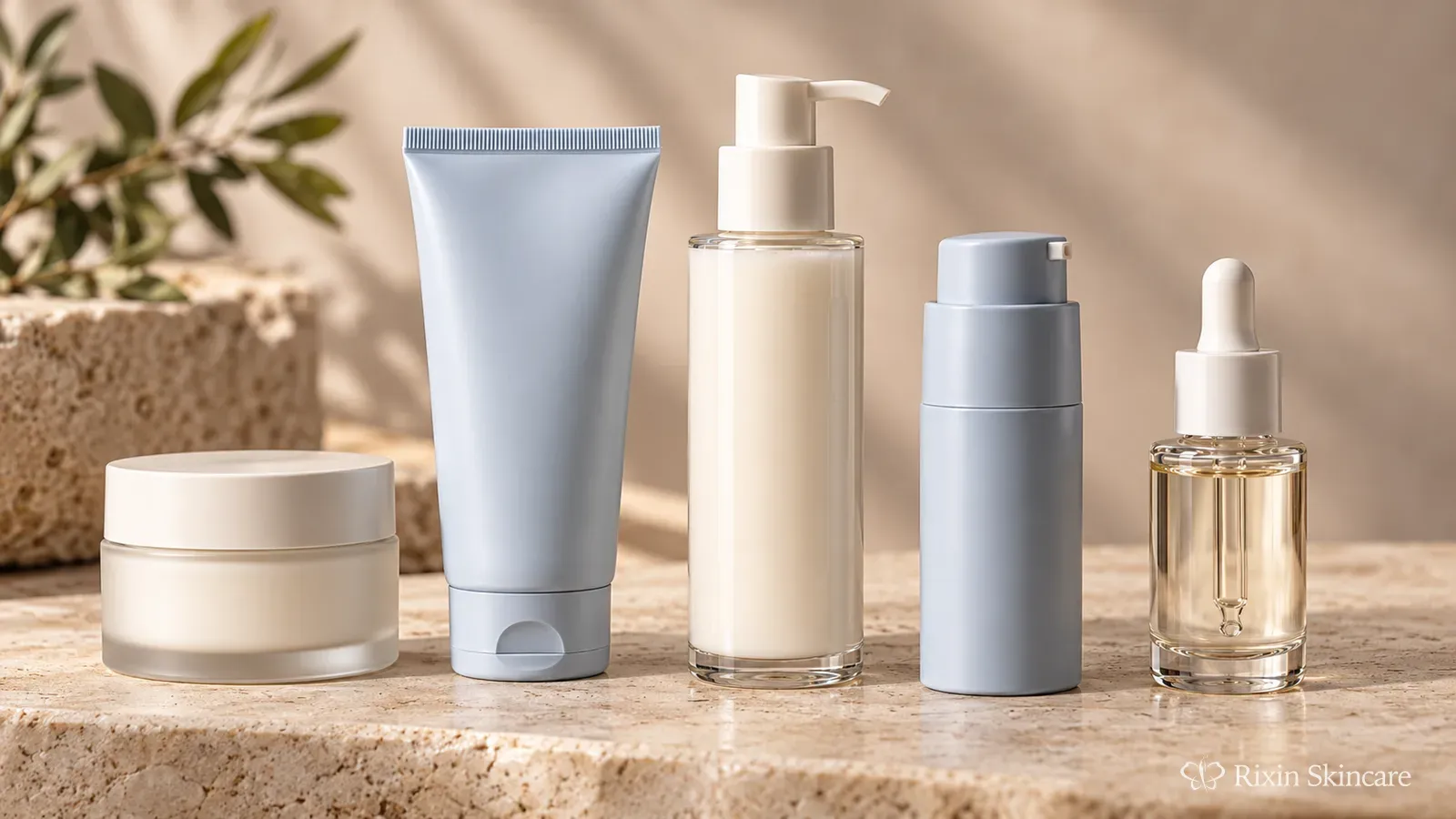
What changes when you choose a jar, tube, pump, airless system, or dropper?
Treat each format as a candidate to evaluate, not a performance promise. The broad comparisons below help identify which systems are worth sampling for your particular formula and use case.
| Primary packaging format | When it may be worth sampling | What to check with the actual formula and components |
|---|---|---|
| Jar | When the product is intended to be accessed directly, or its texture makes a pump or narrow outlet less practical | Access during repeated use; closure and seal; dispensing or removal experience; relevant product-contact materials and handling conditions |
| Squeeze tube | When direct squeeze dispensing, a compact pack, or a more restricted outlet fits the intended application | Whether the formula flows through the chosen opening; residual product; cap and orifice; filling and sealing feasibility |
| Bottle with a standard pump | When repeatable, convenient dispensing matters and a compatible pump configuration may suit the formula | Priming, dose consistency, dip-tube reach, actuator and spring/contact design where relevant, leakage and assembled fit |
| Airless dispensing system | When a particular airless mechanism may support the desired use and exposure approach | The actual piston, pouch, valve, or other mechanism; formula dispensing; residual product; supplier-specific claims and assembly requirements |
| Bottle with dropper | When controlled liquid application and a pipette-style user experience are relevant | Whether the formula can be drawn into and released from the pipette; bulb, pipette, wiper and closure materials; repeat opening and handling |
This is a selection framework, not a ranking. The same general category can include very different materials, dispensing mechanisms, and supplier specifications. A standard pump may be workable for one lotion and unsuitable for another; the name alone cannot settle the choice.
Jars: access is the defining trade-off
A jar gives the user direct access to the product. That may suit some thicker textures or application routines, but it also means considering how the product is handled after opening. Ask whether the intended use involves fingers or a separate applicator, how the closure functions, and what packaging contact and preservation questions need project-specific review.
A jar is not automatically unsafe. Its suitability depends on the actual formula, packaging design, use conditions, and relevant evaluation. Likewise, an opaque jar should not be presumed to solve every exposure-related concern.
Tubes: the outlet matters as much as the tube body
A tube can offer direct dispensing without a separate pump mechanism. But the chosen orifice, cap, tube structure, and formula behavior determine whether the user gets an acceptable amount with reasonable effort. A thick product may be difficult to dispense through a narrow opening; a free-flowing product may be difficult to control in a particular tube design.
A brand evaluating tubes should request a realistic dispensing sample—not decide from an empty stock tube or a visual mock-up alone. Filling and sealing should also be checked for the proposed construction.
Standard pumps: compare complete dispensing assemblies
A pump bottle is not just a bottle with a convenient top. The selected pump’s mechanism, actuator, dip tube, closure and potentially product-contact components can affect the product’s path out of the container. Dose consistency and priming should be observed with the proposed formula.
Do not assume that two pumps with the same visible shape work identically. Ask the packaging supplier for the specific component references and the project team for a sample assembled in the configuration being considered.
Airless systems: examine the mechanism behind the name
“Airless” describes a family of dispensing approaches, not one identical engineering design. A supplier may use a piston, pouch, or another mechanism. Such systems may be considered when the dispensing concept or product-exposure needs make them a worthwhile option, but airless does not mean sterile, and the label does not establish compatibility, preservation performance, or finished-product stability.
The useful question is whether the selected mechanism dispenses this formula acceptably and whether the supplier’s documented specifications and project-specific evidence support the intended use. Residual product, priming, filling, assembly, and relevant contact parts still need attention.
Droppers: decide whether the use experience justifies the assembly
A dropper may suit some fluid products and application routines. The buyer should test whether the selected pipette actually draws up the formula, releases it predictably, and works with the desired dose and user handling. Formula flow, the pipette opening, bulb, closure, and any relevant wiper or seal may all matter.
A dropper is not a universal recommendation for serums or active-led formulations. The familiar appearance of a glass bottle says little about the suitability of the complete dropper assembly or the evidence available for the finished product.
Compare dispensing behavior before choosing the appearance
A good-looking package can still create a poor user experience if the actual formula comes out unpredictably. For the shortlisted assemblies, compare how the product behaves across the use moments that matter to your brand.
First use. Does the consumer need to prime the dispenser? If so, does the mechanism behave as expected? For a jar or tube, does first opening and dispensing feel appropriate for the product?
Ordinary use. Can the intended amount be accessed without excessive effort or unwanted mess? Does the formula dispense consistently enough for the proposed application? The answer depends on the actual sample, not a universal pump-dose specification.
Later use. As the pack empties, can the user still access the product in a reasonable way? Observe relevant residue, reach and handling behavior in the sample rather than asserting a fixed evacuation percentage.
Between uses. How does the cap, closure, dropper, or dispensing tip behave during repeated opening and handling? Consider whether the way people will use the pack introduces questions for the formulation, packaging, or preservation review.
The comparison should remain practical: what does the user need this package to do, and did the actual sample demonstrate it under the conditions you examined? A short use trial informs the selection decision; it does not replace technical evaluation or establish shelf-life performance.
Evaluate the package as a connected set of components
Choosing a “50 mL pump bottle” does not fully define a primary packaging system. Two visually similar proposals may differ in container material, pump internals, closure fit, dip-tube material, seals, assembly, or supplier specification.
When discussing a candidate with a packaging supplier or manufacturer, distinguish the visible format from the defined assembly:
- Container: which exact structure and material specification are proposed?
- Dispensing parts: which pump, actuator, nozzle, pipette, or other mechanism is included?
- Closure and contact interfaces: which seals, liners, gaskets, bulbs, dip tubes, or other relevant parts may contact the formula?
- Assembly and filling: how are these components filled, sealed, fitted together, and handled in the proposed production route?
- Supplier identity: which drawings, part references, samples, and specifications identify the version being evaluated?
Not every package has all these parts. The point is to identify what is present, not to impose an identical component checklist on every design.
For brands discussing available, customized, or buyer-nominated packages, Rixin’s Packaging & Label Design page describes its project-level review of formula fit, dispensing systems, component specifications, and manufacturing requirements. This guide addresses the earlier buyer task of selecting which particular assemblies deserve that review.
How to shortlist one or two packaging routes for sampling
Rather than ordering a large collection of unrelated containers, choose a small number of configurations that solve the same defined product-use problem in different ways.
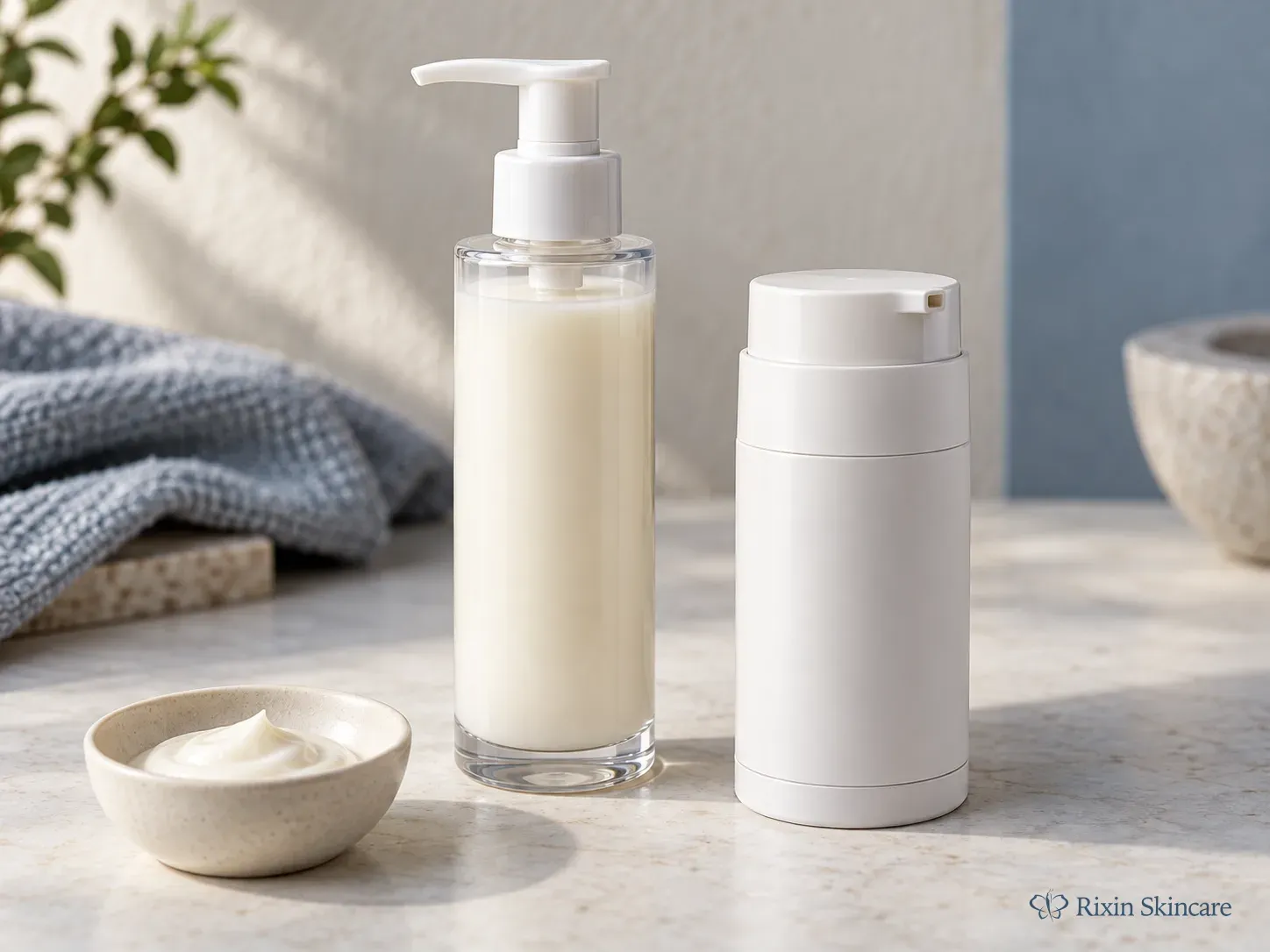
Consider a hypothetical facial lotion project. The formula is still being assessed, and the intended use calls for convenient one-handed dispensing. Two options might be a bottle with a standard pump and a specific airless dispensing system. Neither option is assumed to be more stable, safer, or easier to manufacture.
The brand can use the same evaluation questions for both candidates:
- Formula dispensing: Does the current sample dispense through the specific mechanism without an obvious usability problem?
- Use experience: Is priming, dose control, residue, and ordinary handling acceptable for the intended routine?
- Defined assembly: Are the supplier’s container, dispenser, closure, and relevant contact-part references known?
- Manufacturing fit: Has the proposed filling and assembly route been discussed, with unresolved feasibility questions recorded?
- Evidence to obtain: What supplier or technical information would be needed before this candidate could move beyond the initial sample stage?
An answer such as “pump works well” is too broad. A more useful sampling record identifies which pump and bottle combination was tried with which formula version, what was actually observed, and what remains unconfirmed.
Hypothetical sampling outcome: Suppose the standard-pump sample dispenses the current lotion acceptably and its component references are available, while the airless sample needs repeated priming. The identified standard-pump assembly could stay on the shortlist; the particular airless mechanism would need reconsideration or another sample. If the filling route for either option has not yet been assessed, record that as an open question. None of these provisional choices establishes final formula–packaging compatibility.
If both routes remain plausible, the right next step may be to compare their specific samples and documentation—not to declare a winner based on packaging category. If neither works well, the shortlist should be revisited rather than forcing the formulation into a preferred visual design.
What should you ask before approving a packaging direction?
Once the shortlist is narrow, the discussion changes from which type looks suitable? to what still needs confirmation for this exact package? Useful questions include:
- Which version are we discussing? Confirm the formula revision and the full packaging assembly identified by the supplier.
- What have we actually handled? Separate a catalogue image, empty component sample, formula-filled sample, and final assembled reference. They are not interchangeable evidence.
- What are the unresolved dispensing questions? Record observed priming, flow, dose, closure or residue issues in clear language.
- Which supplier specifications are available? Identify missing material, component, or assembly information without assuming it exists for every proposed stock package.
- What requires manufacturing review? Ask which filling, closure, assembly, and handling considerations must be confirmed for the actual project.
- What requires further technical assessment? Determine with the relevant qualified parties which formula–package compatibility, stability, preservation, or market-specific questions need evidence before a final decision.
For the steps between sample acceptance and later project decisions, see Rixin’s Sampling & Formula Approval process.
Choosing a format is not the same as confirming compatibility
The outcome should be a named candidate package system and a clear record of what remains unknown. Shortlisting identifies what to evaluate next; it does not establish compatibility for the final formula and intended conditions.
Before production, the relevant supplier, formulation, manufacturing, testing, and market-review parties should establish whether available information addresses the actual formula revision, product-contact parts, and proposed use. That evidence review is a separate decision from choosing a packaging format.
Frequently asked questions
Is an airless bottle always better than a jar for skincare?
No. Airless systems, jars, and other formats support different dispensing and access patterns. Their suitability depends on the defined formula, mechanism, intended use, component specifications, and relevant testing or assessment. Airless packaging is not automatically sterile or universally more stable.
Can one packaging type work for both a serum and a cream?
Possibly, but a shared format name is not enough. The actual formula behavior, outlet, dispensing mechanism, component system, filling route, and intended application need to be reviewed for each product. One package specification should not be assumed to work across different formulas.
Should packaging be selected before formula sampling?
A preliminary packaging direction can be chosen early, but the formula and dispensing requirements should inform each other. Early formula samples may be evaluated in neutral containers; once a relevant formula version is available, its dispensing behavior should also be checked in the proposed final package.
Make the next packaging decision specific
Before asking a supplier or manufacturer to confirm a package, prepare a short brief that identifies the current formula version, intended use and dispensing experience, one or two candidate assemblies, the sample observations, and the unresolved component or technical questions. That gives the team a defined starting point instead of a collection of attractive packaging images.
If you are ready to review your formula and shortlist with a manufacturing partner, explore Rixin’s Packaging & Label Design support for evaluating the next project-specific requirements.