
On this page
A skincare packaging compatibility report is useful only to the extent that its evidence applies to the product you intend to manufacture. The practical question is not simply “Has this bottle been tested?” It is “Does the available evidence address our final formula, the relevant product-contact components, and the conditions it was meant to assess?”
A sample can look right and dispense well during a short review while still leaving questions about the formula–package combination.
This guide is for skincare brand owners, product-development teams, and procurement or quality coordinators reviewing existing evidence before a production decision. It is not a testing protocol, a universal approval checklist, or a substitute for qualified technical and market-specific assessment.
Start with the exact formula–package system you intend to produce
Before reading the conclusion of a report, define the final production baseline: the version of the product and packaging against which the evidence must be compared.
At minimum, distinguish these project inputs where they are relevant:
- Formula identity: product name or code, revision, and the formulation represented by the proposed finished product.
- Primary container: the bottle, jar, tube, sachet, or other structure that directly contacts the formula, including available material and supplier specifications.
- Contact components: closures, liners, seals, dip tubes, pump or dropper components, and other parts that may contact the product, depending on the design.
- Pack configuration: the actual combination intended for filling and assembly, rather than a reference container viewed on its own.
- Use and distribution context: intended dispensing, relevant storage or handling conditions, and destination market where those factors affect the assessment.
You do not need to turn this into a separate approval process. The purpose is to establish what the evidence needs to be about.
For example, “30 mL serum bottle” is a description, not a complete technical identity. Two bottles of the same size may have different contact materials, closures, pumps, or component suppliers. Whether a difference matters cannot be decided from appearance alone.
If the packaging direction is not yet settled, the next question is one of packaging and dispensing fit, not whether an old report can be declared applicable.
What does the existing evidence actually examine?
A document title can be misleadingly broad. “Compatibility report,” “material specification,” and “product test report” may refer to different subjects and levels of evidence. Rather than treating the labels as interchangeable, read the underlying scope.
For each record, identify:
- Issuer and purpose. Who prepared the document, and which question was it intended to answer?
- Subject examined. Does it concern a packaging material, one component, a particular formula in a container, or an assembled formula–package system?
- Sample identification. Which formula revision, material, pack design, component codes, or sample references are actually named?
- Method and conditions. What evaluation or testing was performed, under which stated conditions and period, and against what agreed criteria, if reported?
- Results and limitations. What was observed or concluded? What is excluded, qualified, or left unresolved?
A supplier specification may help identify the selected material. It does not, by itself, prove finished-product stability or suitability for every formula. Conversely, a finished-product evaluation should not be assumed to cover different packaging parts or another formulation unless that broader applicability is supported.
Rixin’s Quality, Testing & Documentation page explains how testing, supplier files, specifications, and reports may be reviewed within a defined project scope. This article focuses on the narrower buyer decision: does the particular evidence in hand match the proposed production configuration?
Compare the report with the final production baseline
The most useful review is a side-by-side comparison. It separates a genuine match from a missing reference or a question that requires technical judgment.
The following table is an illustrative, hypothetical document-review example. It does not describe a real Rixin project, actual test results, or a required regulatory form.
| Final production baseline | What the existing record explicitly covers | Gap or question to resolve | Appropriate party to consult |
|---|---|---|---|
| Final formula revision B | Report identifies formula revision A | Did the change affect the report’s applicability? | Formulation/project team and qualified reviewer |
| Bottle with the selected pump and seal | Supplier file identifies the bottle material only | Are the product-contact pump and seal parts covered elsewhere? | Packaging supplier and technical reviewer |
| The selected production component specification | Assessment refers to an earlier component reference | Are the materials and relevant specifications demonstrably equivalent? | Component supplier and responsible project team |
| Intended storage and use context | Study lists its own stated conditions | Are those conditions relevant to this product and its intended context? | Testing party and qualified assessor, as applicable |
For contrast, imagine the records explicitly identify the same formula revision B, container, pump, and seal references as the proposed final production baseline, and specify the assessment conditions relevant to the question under review. A reviewer could record “Covered by the available evidence” for that defined question, referencing the document IDs and revisions, the stated conditions, and any exclusions. This is a hypothetical record match—not a reported test result or permission to release the product.
This comparison does not mean every document must contain every item in the table. It means that the review should be able to explain why the evidence is relevant, where it stops, and who is competent to address any difference.
A missing detail is not automatically a failed product. It may call for a supplier clarification, an explanation from the report issuer, a comparison of approved specifications, or further project-specific evaluation.
Check the components and conditions, not just the bottle name
Two recurring gaps deserve separate attention.
Was the relevant product-contact assembly represented?
The bottle body may be the most visible part of the pack, but the proposed assembly can include a closure, seal, pump, actuator, dip tube, or dropper. Not every component contacts the formula in the same way, and the materials and interfaces depend on the particular design.
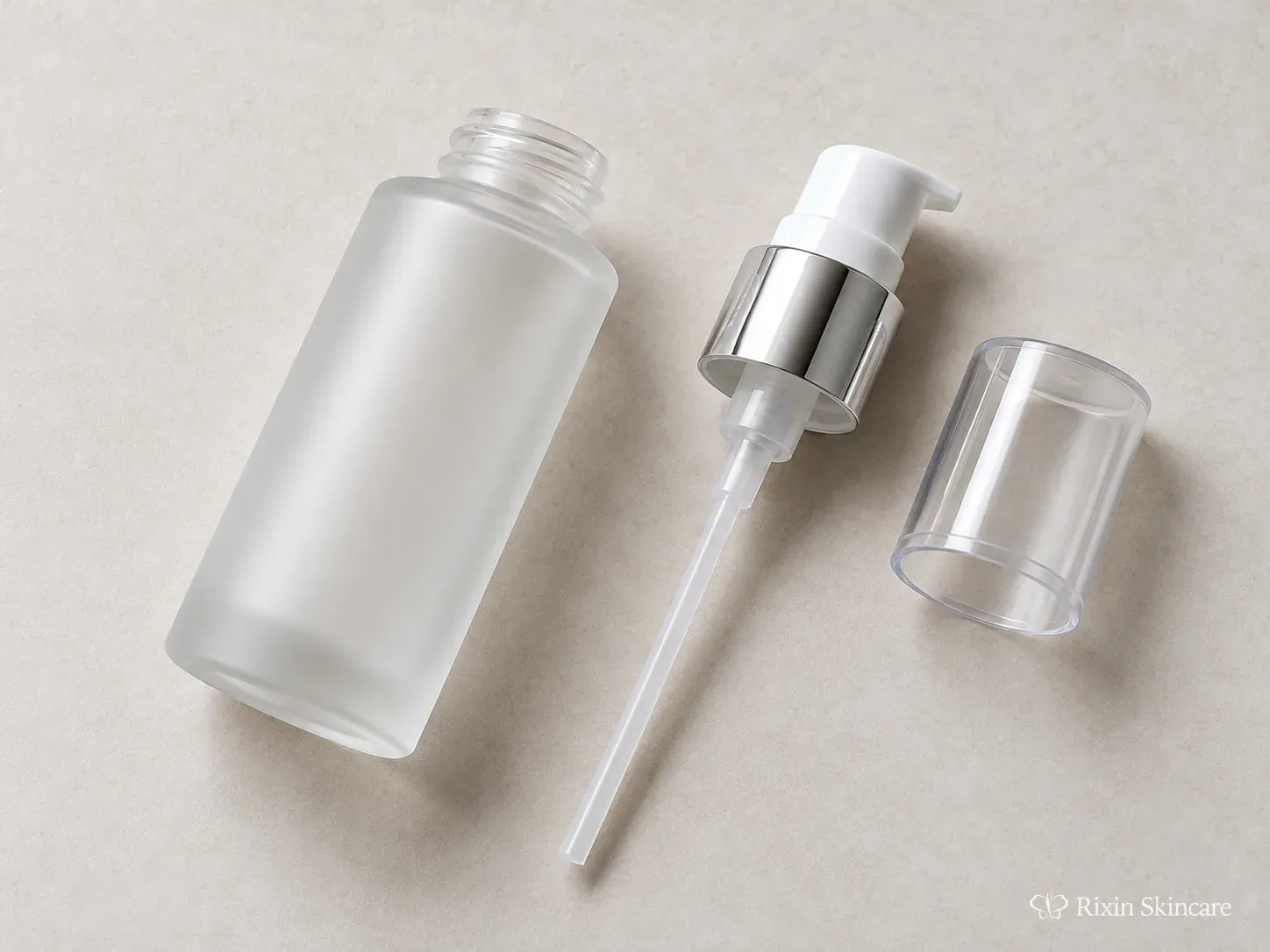
Look for evidence that identifies the parts relevant to the question being assessed. A packaging supplier may be able to confirm material or component identity; the testing party or qualified reviewer must determine whether the available material and product evidence is enough for the project.
Were the study conditions relevant to the proposed product?
A result belongs to the conditions under which it was generated or assessed. When reviewing a report, ask whether the stated period, storage conditions, contact configuration, and assessment criteria are relevant to the intended formula–package system.
The correct comparison depends on what the study was designed to show. This article deliberately does not prescribe a universal temperature, duration, test method, or pass threshold. Those details need to be determined for the actual product and scope by competent parties.
A report stating that no issue was observed under its specified conditions cannot establish what would happen outside them.
What do EU cosmetics guidelines say about primary packaging?
For a skincare product intended for the EU, the European Commission’s Guidelines on Annex I to Regulation (EC) No 1223/2009, section 3.4.3, address the characteristics of packaging materials that directly contact the cosmetic formulation.
The guidance identifies product–packaging interactions, barrier properties, and possible substance migration as factors relevant to the safety assessment. It also discusses packaging composition, additives, technically unavoidable impurities, and potential migration. These material details can inform hazard identification; evaluating the risk is the safety assessor’s responsibility.
Importantly, the guidance does not establish one standard cosmetics compatibility testing procedure for every formula and package. It recognizes that relevant evidence, knowledge of the formulation and primary packaging, and expert judgment can inform an appropriate assessment.
This is EU cosmetic safety-report guidance, not proof that a specific packaging system has passed testing, not a fixed worldwide test schedule, and not evidence that Rixin performs any particular laboratory method in-house. The brand and its qualified market-side parties need to establish the relevant legal and safety responsibilities for the destination market.
Record a review outcome without calling it product approval
A practical buyer-side review can use three working labels. These are editorial tracking categories, not legal decisions, laboratory verdicts, or authorization to start bulk production.
| Review label | What it means for the documents | Sensible next step |
|---|---|---|
| Covered by the available evidence | The reviewer can identify why the stated evidence addresses the defined product/packaging question and baseline | Record the supporting documents, limits, and competent decision owner |
| Clarification needed | A code, component, version, condition, result, or stated limitation is unclear | Ask the document issuer or relevant supplier for the missing explanation |
| Further project-specific evaluation needed | A relevant difference or unanswered technical question remains | Have the responsible technical, testing, and market-side parties decide what further assessment is appropriate |
A document can be relevant without being sufficient to support every decision. Similarly, “covered” in an internal comparison does not itself mean that the finished product is compliant, released, approved for sale, or safe under all conditions.
Keep the underlying documents and the reasoning attached to the project version they address, subject to the project’s actual documentation arrangements.
What if the formula or packaging changes after the evidence was prepared?
A change does not automatically invalidate every earlier record. It does, however, give the project team a new question: does the reason the evidence was considered applicable still hold?
Changes worth reviewing may include:
- A different formula revision or meaningful adjustment to the composition.
- A change in a direct-contact material, coating, liner, seal, or dispenser component.
- A replacement component or supplier with different specifications.
- A different filling or assembled-pack configuration that affects the matter assessed.
- A change in intended conditions or target market relevant to the original assessment.
Depending on the evidence, some differences may be resolved by documented equivalence or expert review; others may call for additional evaluation. Do not assume every change requires a complete repeat of all testing—or that a change is harmless because the package looks identical.
If the evidence belongs to a development sample rather than the intended final product, the sampling and formula approval process is a useful point of reference. Sample acceptance establishes the agreed development direction; packaging evidence and production decisions still require their own appropriate review.
How should a skincare brand hand unresolved questions to its manufacturer?
Send the relevant team a concise evidence-to-baseline comparison, not a blanket request to “approve the packaging.” Identify the proposed final formula and pack; attach or reference the actual supplier or testing records; then make the open question explicit.
For each unresolved difference, record what is different, which document raises the question, who can answer it, and what decision remains pending. For example, a supplier may need to identify a material or component, a testing party may need to explain the scope of a result, and a qualified assessor may need to determine its relevance to market safety evaluation. The project agreement should identify who coordinates and confirms those steps.
Rixin can help brands review packaging, testing, and document questions within the agreed project scope. Use Packaging & Label Design when the proposed pack or component specification still needs clarification, and Quality, Testing & Documentation when the immediate question concerns evidence, testing scope, or available records.
The useful outcome is not a longer checklist. It is a clear understanding of which evidence applies to which finished-product configuration—and which decision still requires a qualified person.
Frequently Asked Questions
Does a packaging supplier’s material specification prove formula compatibility?
No. A material specification helps identify what was supplied; check separate product-specific evidence for the formula and product-contact assembly actually under review.
Does one successful test report approve every version of a skincare product?
No. Check whether the report covers the version you plan to use—or whether a qualified project reviewer has documented how any differences affect its applicability.
Does changing a pump mean the brand must repeat every compatibility test?
Not automatically. The relevant question is whether the replacement changes the product-contact materials, dispensing or other characteristics covered by the existing evidence. Suppliers, testing parties, and qualified reviewers should determine whether clarification, additional assessment, or further testing is needed for the project.