On this page
Skincare manufacturer due diligence should verify more than a supplier’s website, quotation, certificates, or product samples.
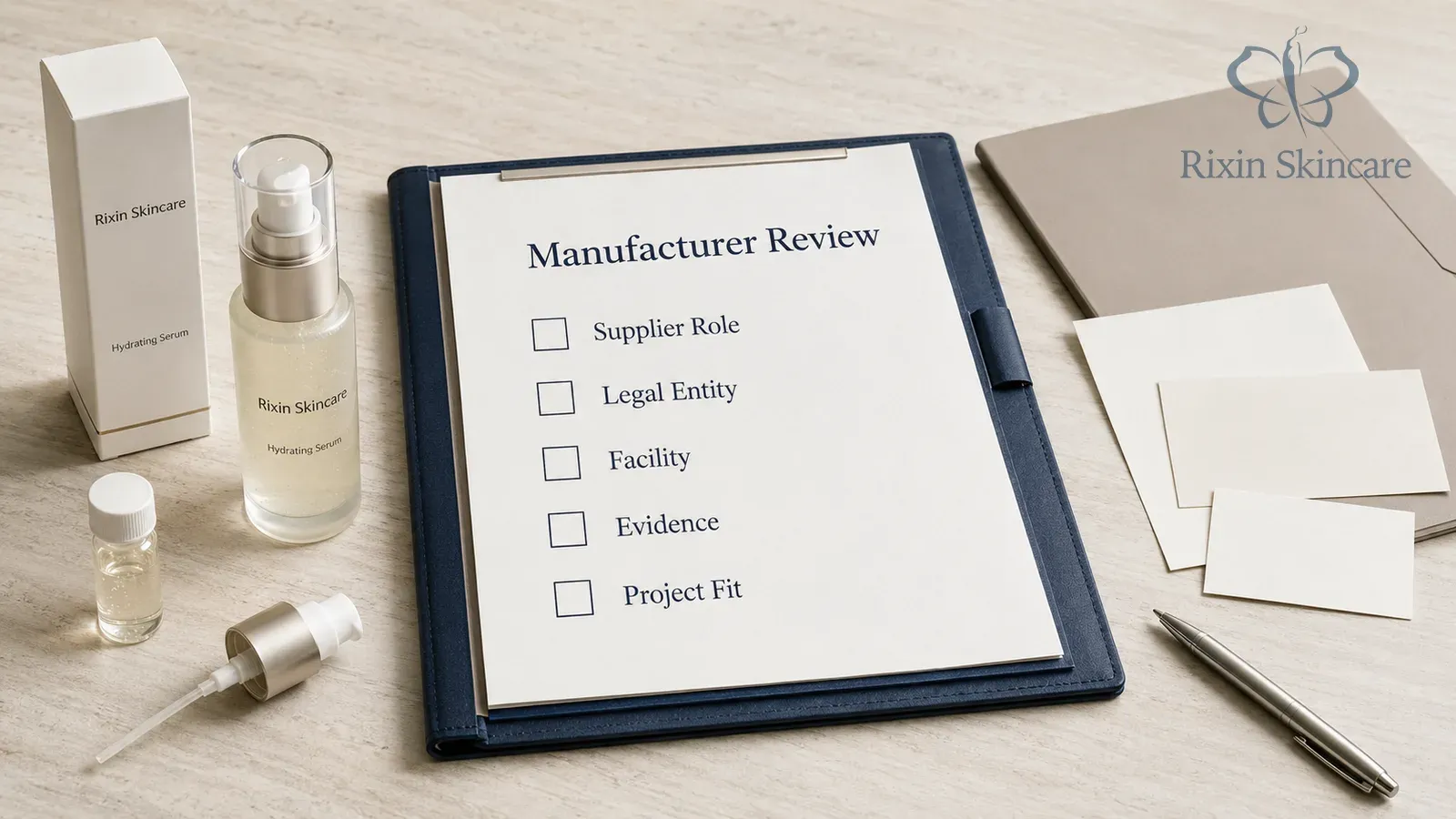
A buyer should confirm who is responsible for the project, which legal entity will contract and receive payment, which facility will do the work, and what evidence supports those points. The review should also record unresolved warning signs and whether the supplier fits the planned production scale. Give every open item an owner, deadline, and decision condition. The final outcome should be to proceed, proceed with conditions, request more evidence, hold, or reject—not simply to label the supplier “verified.”
This guide is a planning framework, not legal advice or a guarantee.
What Should Skincare Manufacturer Due Diligence Cover?
Due diligence is a structured review used to understand who the supplier is, which facility performs the relevant work, what evidence supports its claims, and whether its operating model fits the proposed project.
Start with the supplier’s role and legal or payment identity before investing significant time in a factory review. Keep four information types separate:
- a claim made by the supplier;
- a document supplied as evidence;
- an observation from a visit, video review, sample, or process discussion;
- an assumption that remains unresolved.
Record each point with one evidence status:
- Confirmed: current evidence supports the specific point.
- Supported but limited: evidence exists, but its date, scope, entity, site, or applicability is limited.
- Inconsistent: two or more claims or records do not align.
- Not provided: requested evidence has not been supplied.
- TBC: the point is to be confirmed after another supplier or project detail is fixed.
These statuses organize follow-up. They are not a numerical supplier score.
Step 1: Identify the Supplier’s Operating Role
First establish the supplier’s operating role—the part the company actually plays in the sale and production of the project. It may act as a manufacturer, trading company, agent, or mixed operator.
The label alone does not decide whether the supplier is suitable. What matters is who communicates with the buyer, signs the agreement, controls production, selects subcontractors, manages quality issues, and supplies evidence.
Ask which work is performed directly and which work may be assigned to another company or site. Record the role described during sales discussions and compare it with the contracting entity, invoices, facility evidence, and production explanation. A difference may be acceptable, but the responsibilities and evidence should be clear before the project proceeds.
Step 2: Verify the Legal Entity and Operating Facility
A legal entity is the registered company. The contracting, invoicing, and payment entities may be the same company, but the buyer should not assume they are. The claimed operating facility also needs to be connected to the company through evidence appropriate to the relationship.
At Hub level, record whether the company identity, payment identity, registered address, and operating facility are confirmed, limited, inconsistent, not provided, or TBC. A mismatch is an inconsistency to clarify before approval, not by itself a fraud finding. Use verify the legal entity and operating facility for the detailed identity, address, payment, and facility-relationship checks.
Step 3: Review Factory and Process Evidence
Factory evidence should cover the relevant production process, quality controls, storage, material and batch identification, traceability, documentation, and handling of work that does not meet the agreed requirement. These are broad evidence categories within the full review sequence.
Use questions to ask during a skincare factory audit for the detailed observation points, questions, and records. Rixin’s public manufacturing-facility information is company-specific context; it does not replace a project-specific assessment.
Step 4: Record Red Flags and Unresolved Evidence
A red flag is a point that may require deeper review, not an automatic conclusion. At Hub level, record the evidence status separately from concern severity, then use skincare manufacturer red flags for detailed warning signs and follow-up treatment.
Record two things separately:
Evidence status
→ confirmed, limited, inconsistent, not provided, or TBC

Concern severity
→ minor clarification, material condition, hold issue, or unacceptable risk
Step 5: Assess Production-Scale and Project Fit
A supplier may have real manufacturing capability and still be a poor fit for a specific project. At Hub level, production-scale fit means the operating model can reasonably support the proposed product, packaging route, quantity structure, schedule, supplier coordination, and expected growth path.
Record the result separately as Fit, Conditional fit, Unclear, or Not fit. This is a project-fit conclusion, not an evidence status. Use assess whether a skincare manufacturer fits your production scale for the detailed launch-quantity, batch, filling, capacity, scheduling, and growth-path evaluation.
Use One Due Diligence Review Matrix
Use evidence statuses for claims and records. Use the separate fit result only for the production-fit decision.
| Review area | Main buyer question | Status to record | Detailed guide |
|---|---|---|---|
| Supplier role | Who contracts, communicates, produces, and controls subcontracting? | Confirmed / limited / inconsistent / not provided / TBC | Manufacturer vs trading company |
| Legal entity | Which company signs, invoices, receives payment, and holds the registration? | Same five evidence statuses | Legal entity and facility verification |
| Operating facility | Which site performs the relevant work, and how is it connected to the legal entity? | Same five evidence statuses | Legal entity and facility verification |
| Factory and process evidence | What can be verified about production, quality, storage, traceability, and records? | Same five evidence statuses | Factory-audit questions |
| Red flags | Which inconsistency, refusal, pressure, or evidence gap remains unresolved? | Evidence status plus concern severity | Manufacturer red flags |
| Production fit | Does the operating model fit the product, package, quantity, schedule, and growth direction? | Fit / conditional fit / unclear / not fit | Production-scale fit |
Certificates can form part of the evidence review, but confirm the holder, issuing body, site, scope, status, and relevance. Rixin’s public certifications page provides company-specific information; it should not be treated as a guarantee for every product or project.
Complete a Manufacturer Due Diligence Record
Keep the record compact enough to maintain:
Supplier name and working ID
Claimed operating role
Registered, contracting, invoicing, and payment entities
Registered address and claimed operating facility
Relevant production scope
Evidence requested and received
Evidence source and date
Evidence status
Facility-review status
Audit or remote-review status
Red flags and concern severity
Production-scale fit
Open condition
Responsible owner and due date
Decision and decision date
Re-review trigger
Then choose one outcome:
- Proceed: core identity, facility, evidence, and project-fit questions are sufficiently resolved.
- Proceed with conditions: the supplier may move forward only after named conditions are completed by a defined date.
- Request more evidence: material evidence is incomplete, but the review remains active.
- Hold: the decision pauses because identity, facility, evidence, commercial terms, or project fit remains materially uncertain.
- Reject: the buyer decides that the unresolved risk or mismatch is unacceptable.
Do not approve the supplier relationship until the operating role, contracting and payment identity, claimed facility, relevant evidence, unresolved red flags, and production-scale fit are recorded on the same basis. This is a practical buyer-control method, not a legal conclusion, certification decision, regulatory approval, fraud determination, or guarantee of future performance.
Choose the Detailed Guide for Your Next Question
Use this Hub first to identify the review stage, then open the guide that matches the immediate question:
- Unclear direct production, subcontracting, or intermediary responsibility → manufacturer versus trading company.
- Company-name, payment-recipient, registration, address, or facility-connection questions → verify the legal entity and operating facility.
- Production, quality, storage, traceability, or evidence-review questions → questions for a skincare factory audit.
- Inconsistencies, pressure, refusals, or unresolved concerns → skincare manufacturer red flags.
- Product, packaging, quantity, scheduling, or growth-fit questions → assess production-scale and project fit.
Keep every unresolved point visible, assign the next action, and revisit the supplier decision when new evidence arrives or the project scope changes.