On this page
Approving a skincare formula is an important milestone, but it does not by itself make a project ready for bulk production. Before manufacturing starts, the brand and manufacturer should be working from the same production basis: the exact product reference, packaging, artwork, SKU quantities, and order scope for the order.
A useful way to think about this is a production lock. It is not a universal industry certificate, regulatory step, or formal Rixin procedure. It is a practical buyer-side checkpoint: the production inputs are clear, production-blocking questions are resolved, and any non-blocking follow-up has a named owner.
This pre-production check is the starting point in the wider production-readiness lifecycle, which continues through approved changes, finished-goods handoff, and repeat orders.
What “Production Ready” Means
A project is not production-ready just because one part of it is approved. Formula, packaging, artwork, quantity, and project-specific evidence questions can move on different timelines.
Use three simple statuses:
- Ready: the current production input is clear and the people responsible for it are working from the same version.
- Open: a decision or required review is still unresolved.
- Changed: something previously approved has been revised and may need another review before production.
For each item, also record who owns the confirmation and what evidence or status source shows the current position. That evidence does not need to be the same document for every project; it may be an approved reference, current artwork file, confirmed order record, or project-specific review status.
| Production input | Ready when | Open or changed when | Owner / evidence to record |
|---|---|---|---|
| Formula / product reference | One current product basis is clear | Approval is incomplete or the approved basis changed | Brand and manufacturer project owners; current approved formula/sample/reference |
| Packaging | Final production direction is clear | Component, fit, or package decision is unresolved or changed | Relevant brand/manufacturer packaging owner; confirmed package/component reference |
| Artwork | Current production version is confirmed | File or review is not final, or the version changed | Brand artwork owner and relevant manufacturer/packaging owner; current approved artwork version |
| SKU / quantity | Current SKU set and quantities are confirmed | SKU, size, quantity, or order scope remains unresolved or changed | Brand purchasing/project owner and manufacturer project owner; current order record |
| Testing / documents | Relevant project status is understood | A required project-specific question remains unresolved or a change may affect the evidence needed | Relevant technical, quality, or regulatory owner; current test/document/review status |
The important rule is simple: if an unresolved item could change what is manufactured, how it is packed or labeled, the SKU/order scope, or a required project review, treat it as production-blocking until it is resolved or explicitly confirmed as non-blocking by the responsible parties.
Confirm the Exact Product Reference
Formula approval answers one question: has the brand accepted the current formula direction?
It does not automatically confirm the other production inputs. If you are still evaluating texture, sensory performance, or formula revisions, the project belongs in the sampling and formula approval stage rather than bulk production.
Once the formula direction is accepted, remove ambiguity about the exact product reference. The brand and manufacturer should be referring to the same current formula, approved sample or other agreed product reference for that SKU.
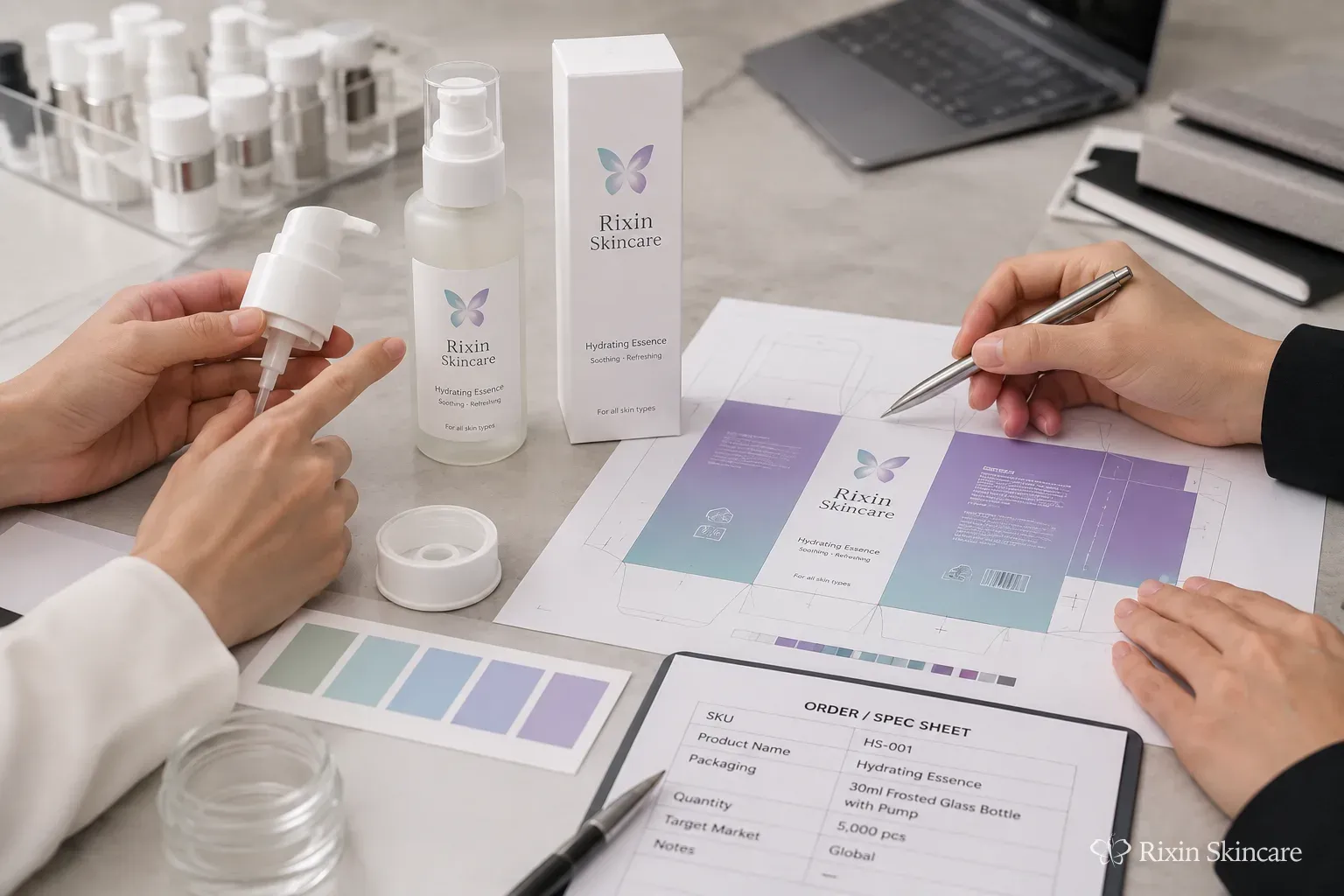
A simple version-control example looks like this:
Formula: latest approved reference. Packaging: confirmed component. Artwork: approved file version. Order: confirmed SKU and quantity. Testing or documentation: status and owner recorded.
This matters because the product name can stay the same while a fragrance, texture, fill size, or another detail changes. If the exact reference is unclear, treat the item as open, not ready.
Confirm Packaging and Artwork Separately
Formula, packaging, and artwork should not be treated as one approval.
A formula can be accepted while a pump, bottle, jar, tube, closure, carton, label, decoration method, or artwork file still needs review. Packaging can also affect filling, dispensing, whether components fit and work as intended, decoration, and the information that appears on the finished unit.
Before bulk production, confirm which packaging system and which artwork version belong to the order. If a package-fit question, component decision, or artwork review is still unresolved, keep it open rather than assuming formula approval closed it.
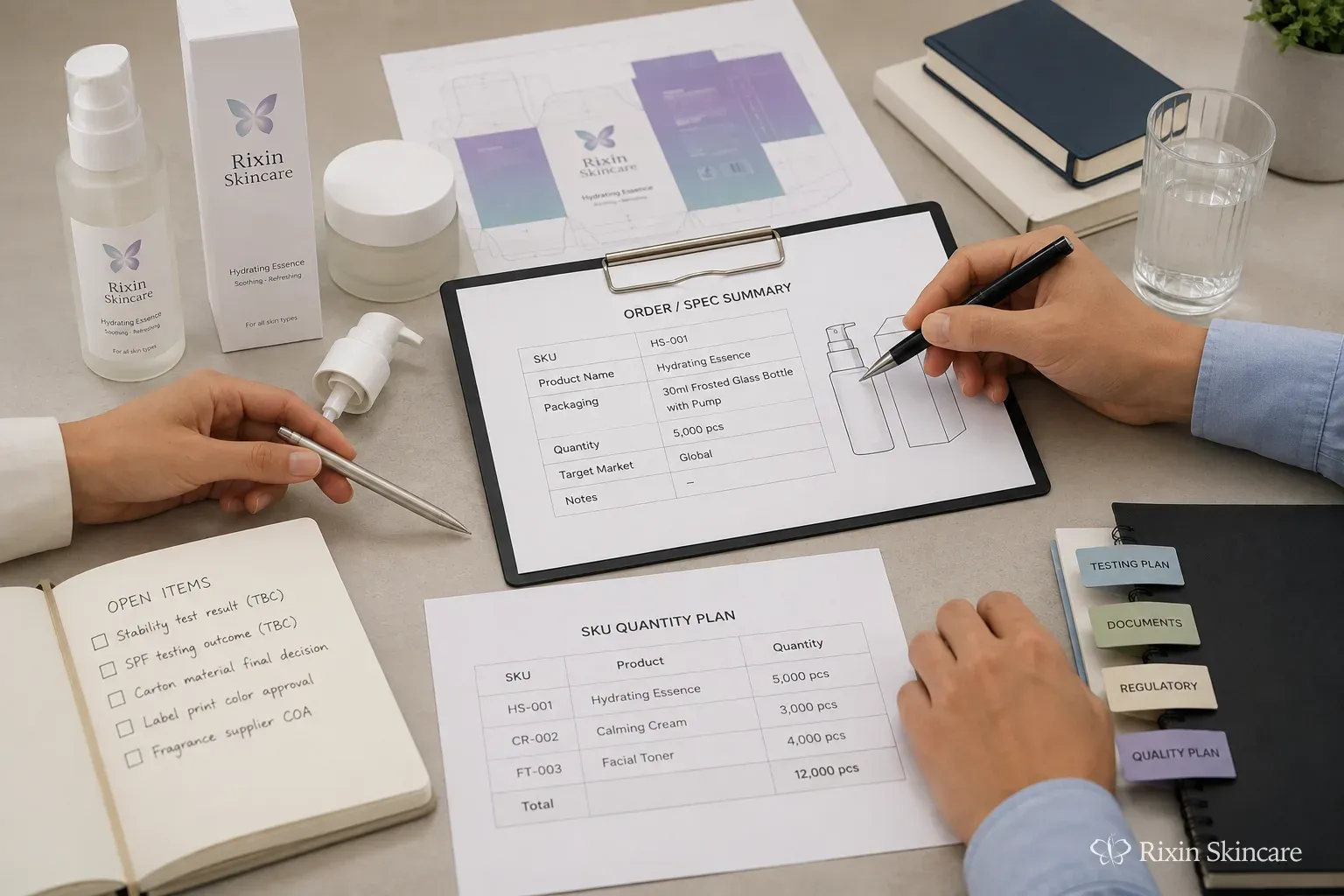
Detailed packaging work belongs in Packaging and Label Design. This article only needs the production-readiness decision: is the current packaging and artwork basis clear enough for this order to proceed?
If something already approved has changed, do not assume the previous approval still covers the new version automatically.
Confirm SKU Quantities and Order Scope
Production also needs one current order basis.
Confirm the SKU set and quantity for each SKU, together with the order details that define what is being manufactured. If a project contains several formulas, sizes, packaging versions, or artwork versions, the order should make those distinctions clear.
Avoid sending an order into production while material to-be-confirmed (TBC) decisions still affect what must be made.
A commercially agreed quantity does not make the rest of the project ready. Packaging, artwork, product reference, or a project-specific review may still be open.
MOQ and timing remain separate questions. Use the MOQ and Lead Time guide for the current minimum-order and production-period definitions rather than repeating them here.
Identify Open Testing, Documentation, or Market Dependencies
Not every skincare project requires the same tests, documents, or market review. What is relevant can depend on the product, packaging, claims, target market, project scope, and which responsibilities sit with the brand, manufacturer, or another reviewer.
The buyer therefore needs more than a list of possible tests. For every relevant item, record:
- Owner — who is responsible for confirming the status?
- Status — not required, planned/pending, completed/available, or still unclear?
- Evidence/source — what current record, result, file, or reviewer confirmation supports that status?
- Blocking effect — does this item need to be resolved before production, or has it been explicitly confirmed as non-blocking?
Applicable technical, quality, or regulatory reviewers should confirm project-specific requirements where needed. “Not every project requires the same tests” should never be interpreted as permission to ignore a requirement that actually applies to the project.
For deeper testing, documentation, and responsibility boundaries, use Quality Testing and Documentation.
Resolve Blocking Items Before Production
The Ready / Open / Changed framework is useful only if it leads to a clear decision.
Before bulk production starts, review every open or changed input and ask:
- Could this change the formula or product reference?
- Could it change the packaging or artwork used in production?
- Could it change the SKU, quantity, fill size, or order scope?
- Could it change a project-specific test, document, or market-review requirement?
If the answer is yes, the item should be resolved before production starts.
If the item does not block production, record that decision, the responsible owner, and the follow-up status. Assigning an owner by itself is not enough to clear a production-critical issue.
Changes after approval should also be reviewed separately from the initial readiness check; a changed input may reopen decisions that were previously closed.
What Happens After the Production Basis Is Confirmed?
Once the relevant inputs are confirmed and production-blocking questions are closed, the project can move into the manufacturing stages that apply to that order. Depending on the project, this may include material and component preparation, manufacturing, filling or assembly, the quality checks agreed for that project, packing, and shipment preparation.
The actual factory process belongs on the Manufacturing Facility page.
Before treating a skincare project as ready for bulk production, ask one final question:
Are the brand and manufacturer working from the same current product and order basis, with every production-blocking item resolved and every non-blocking follow-up clearly assigned and recorded?
If the answer is yes, the project has a much clearer basis for moving from approval into bulk manufacturing.