On this page
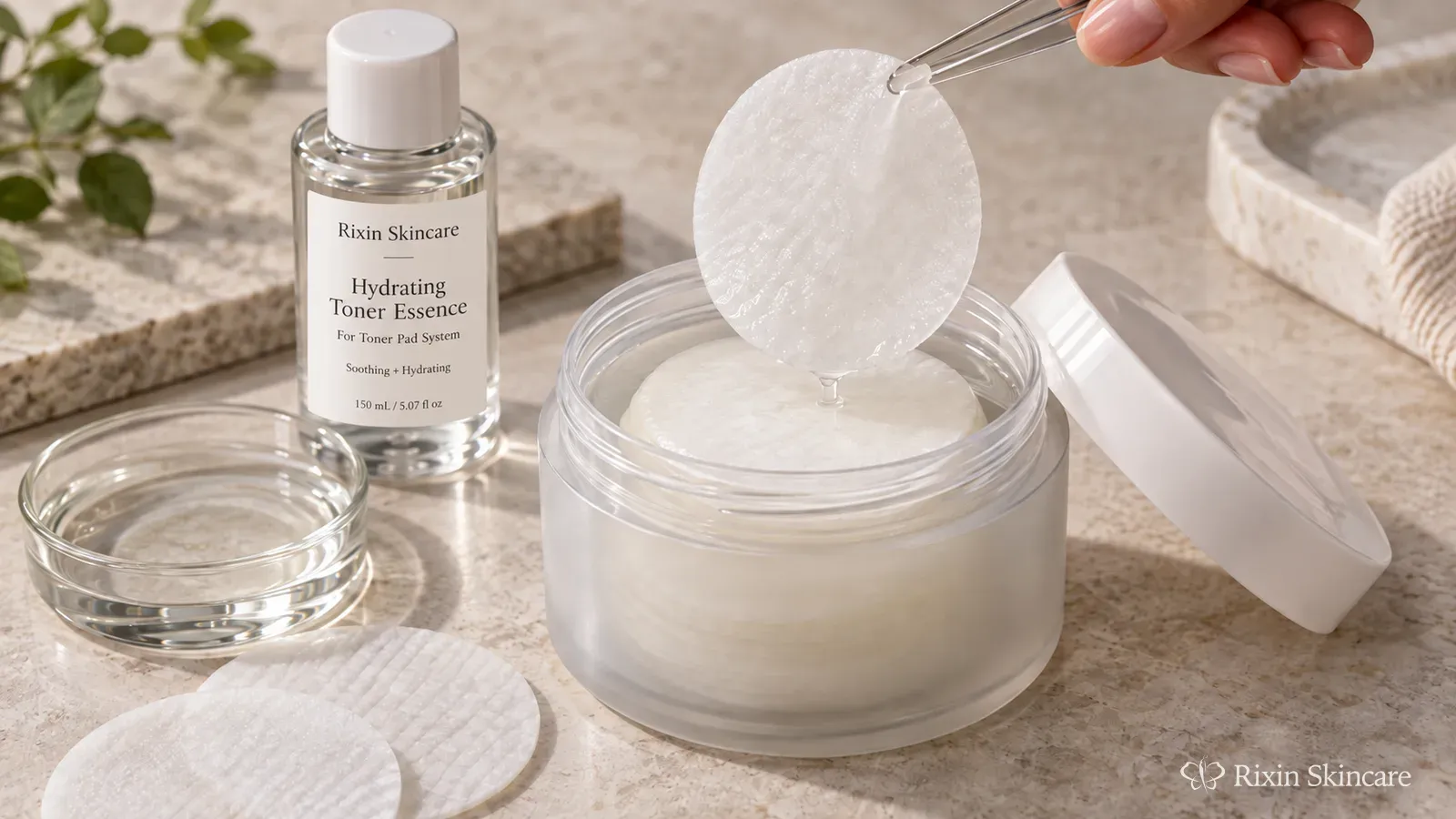
A toner pad is not simply a bottled toner poured over a stack of cosmetic pads.
For a skincare brand, the product needs to work as one coordinated system:
liquid formula → pad material → saturation level → container → repeated use → manufacturing process
That creates a different development problem from a conventional toner or essence.
The main question is:
Can the formula, pad, and package work together well enough to create a consistent product from the first pad to the last?
A successful toner pad brief therefore needs to define more than ingredients and claims. It also needs to specify the pad material and use experience, liquid behavior, quantity of product retained in the stack, dispensing or pickup method, packaging structure, and how the finished product will be sampled and produced.
For the broader framework used to decide whether a skincare trend deserves product development at all, see How to Evaluate Skincare Trends for Product Development.
At a practical level, toner pad development usually needs to move through a connected sequence:
- define the product role;
- shortlist the pad and substrate direction;
- develop or select the liquid formula;
- evaluate saturation, piece count, and pad behavior together;
- confirm package fit and pickup method;
- review the assembled sample;
- complete the relevant compatibility, stability, preservation, and production-fit review before the system is finalized.
The exact testing and approval requirements depend on the finished product, target market, packaging system, and manufacturer procedures.
What Makes Toner Pad Development Different From Bottled Toner?
A bottled toner separates the liquid formula from the applicator until the customer uses it.
A toner pad combines them before the product reaches the customer.
The liquid remains in contact with:
- the pad material;
- the full pad stack;
- the container;
- the closure and inner components;
- and any pickup accessory included in the package.
That means the pad and packaging are not secondary decisions.
They are part of the finished-product design.
A formula that feels appropriate when poured onto the hand may feel different after it has been absorbed into a pad, stored inside a stack, removed from the jar, and wiped across the skin.
The toner pad should therefore be developed and sampled as a complete product rather than as a liquid formula first and a packaging exercise later.
Define the Toner Pad’s Job Before Choosing the Pad
The first development decision is the role of the product.
A brand may want the toner pad to support a concept such as:
- lightweight hydration;
- soothing or skin-conditioning;
- refreshing post-cleansing use;
- radiance-focused care;
- texture-focused cosmetic care;
- or exfoliation-oriented positioning where the formula and target market support it.
These directions should not be treated as interchangeable.
The intended role affects:
- formula structure;
- ingredient direction;
- pad softness or surface texture;
- amount of liquid released during use;
- intended frequency of use;
- package design;
- proposed claims;
- and sample evaluation.
For example, a soft hydration-focused pad and a more texture-focused pad may require very different sensory targets even if both are sold in similar jars.
The product brief should therefore begin with the intended use experience—not with a generic request for a “popular toner pad.”
Treat the Pad Substrate as Part of the Product
The pad is not only a shape or texture choice.
The selected substrate or material specification can affect how the product behaves when saturated, stored, handled, and used.
The project may need to confirm:
- the selected substrate or material specification;
- material construction or structure when relevant;
- diameter;
- thickness;
- flexibility;
- softness;
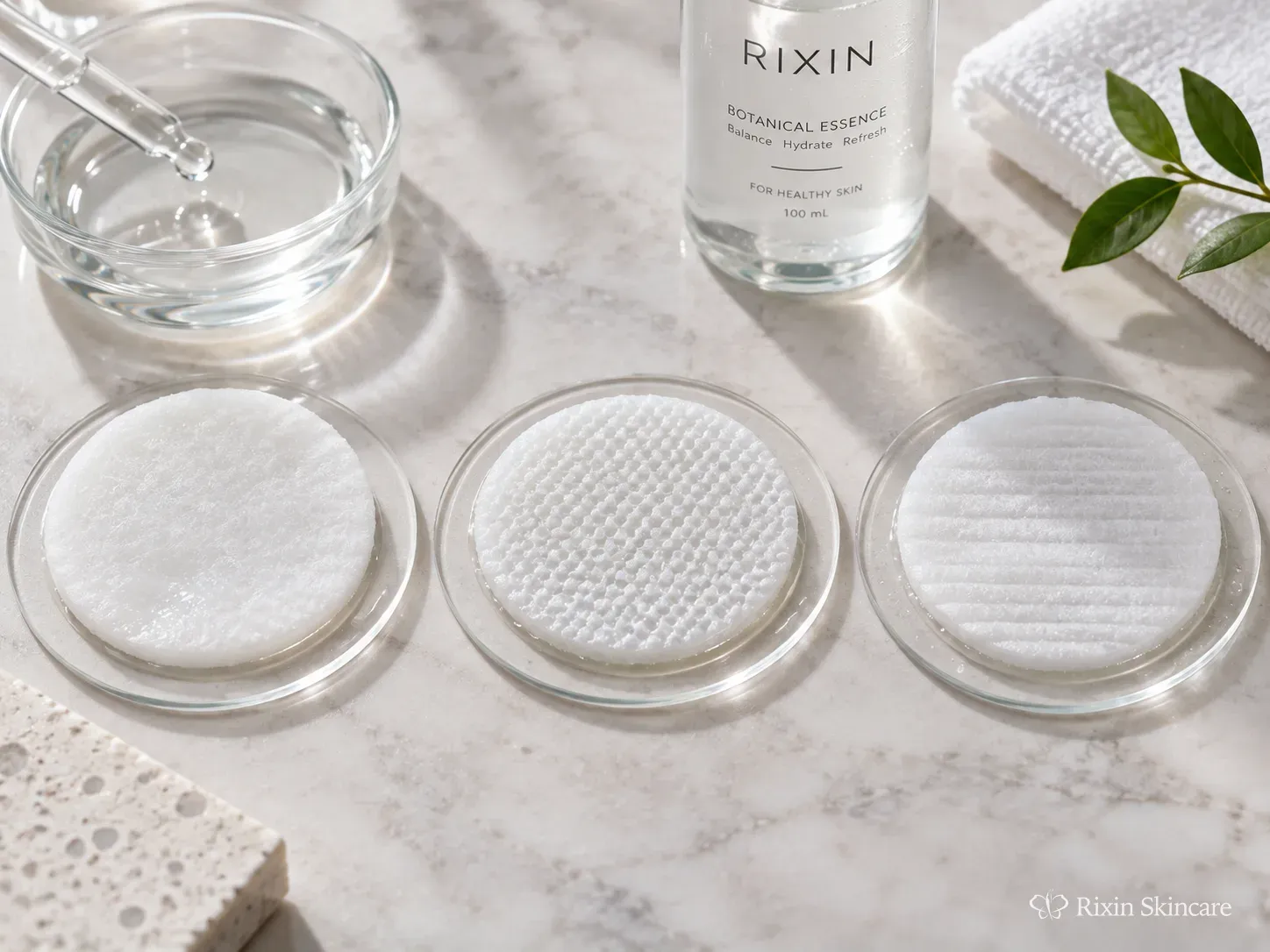
- surface texture;
- single-surface or dual-surface design;
- liquid absorption;
- liquid release;
- wet strength and integrity;
- resistance to unwanted linting, shedding, or deformation;
- and how easily one pad separates from the stack.
These variables interact.
A pad that feels suitable when dry still needs to behave appropriately after extended contact with the proposed liquid.
During sample review, the brand should consider whether the saturated pad:
- keeps its intended shape;
- remains comfortable to handle;
- releases the liquid as intended;
- remains intact during wiping;
- produces unwanted fibers or residue;
- and performs consistently enough for the intended product experience.
Material identity and supplier documentation should also be confirmed where they affect product specifications, claims, sourcing, manufacturing, or market requirements.
The objective is not to identify one universally “best” pad material.
It is to select and confirm a substrate specification whose wet-use behavior fits the formula, product positioning, package, and production route.
Pad Diameter and Thickness Affect More Than Appearance
Pad dimensions should be decided together with the container.
A larger pad may:
- cover more skin during one application;
- require a wider jar opening;
- change how easily the customer grips the pad;
- occupy more volume in the container;
- and influence how much liquid is needed across the stack.
Thickness also affects the total system.
When the pad becomes thicker, the brand may need to reconsider:
- how many pads fit inside the jar;
- how much liquid the stack holds;
- how easily pads separate;
- whether the pad feels too wet or too dry;
- and whether the package still closes comfortably.
This is why piece count should not be finalized independently from pad dimensions, substrate behavior, and jar capacity.
The finished combination needs to be physically tested.
The Liquid Formula Has to Work Inside the Pad
The liquid used in a toner pad may begin from a toner- or essence-like formula direction, but the final brief needs to account for how that formula behaves inside the pad.
Questions to review include:
- Is the liquid sufficiently fluid to distribute through the pad stack?
- Does it release from the pad comfortably during use?
- Does the finished pad feel excessively wet, dry, slippery, sticky, or heavy?
- Does the formula leave the intended finish after wiping?
- Does color remain visually appropriate inside the chosen pad and package?
- Does fragrance become too noticeable during repeated close-range use?
- Does the formula interact appropriately with the selected pad and container?
Viscosity matters because the product needs to move through and remain available within the pad system.
That does not mean every toner pad requires an extremely watery formula.
It means viscosity needs to be evaluated together with pad absorbency, release behavior, package structure, and desired after-feel.
For deeper decisions around conventional toner and essence formats, see Toner & Essence Development.
Decide How Much Liquid the Pad Stack Actually Needs
Saturation is one of the central toner pad development decisions.
Too little liquid can create a product that feels insufficiently saturated.
Too much liquid can create other problems, such as:
- excessive dripping;
- liquid pooling inside the jar;
- messy pickup;
- reduced control during use;
- or additional pressure on package sealing and transport performance.
There is no universal amount of liquid that should be assigned to every toner pad.
The appropriate fill depends on the actual combination of:
pad material + pad dimensions + piece count + absorbency + formula viscosity + jar capacity + intended use experience
This makes sample evaluation especially important.
The team should assess not only the total fill but also how the liquid is distributed through the stack.
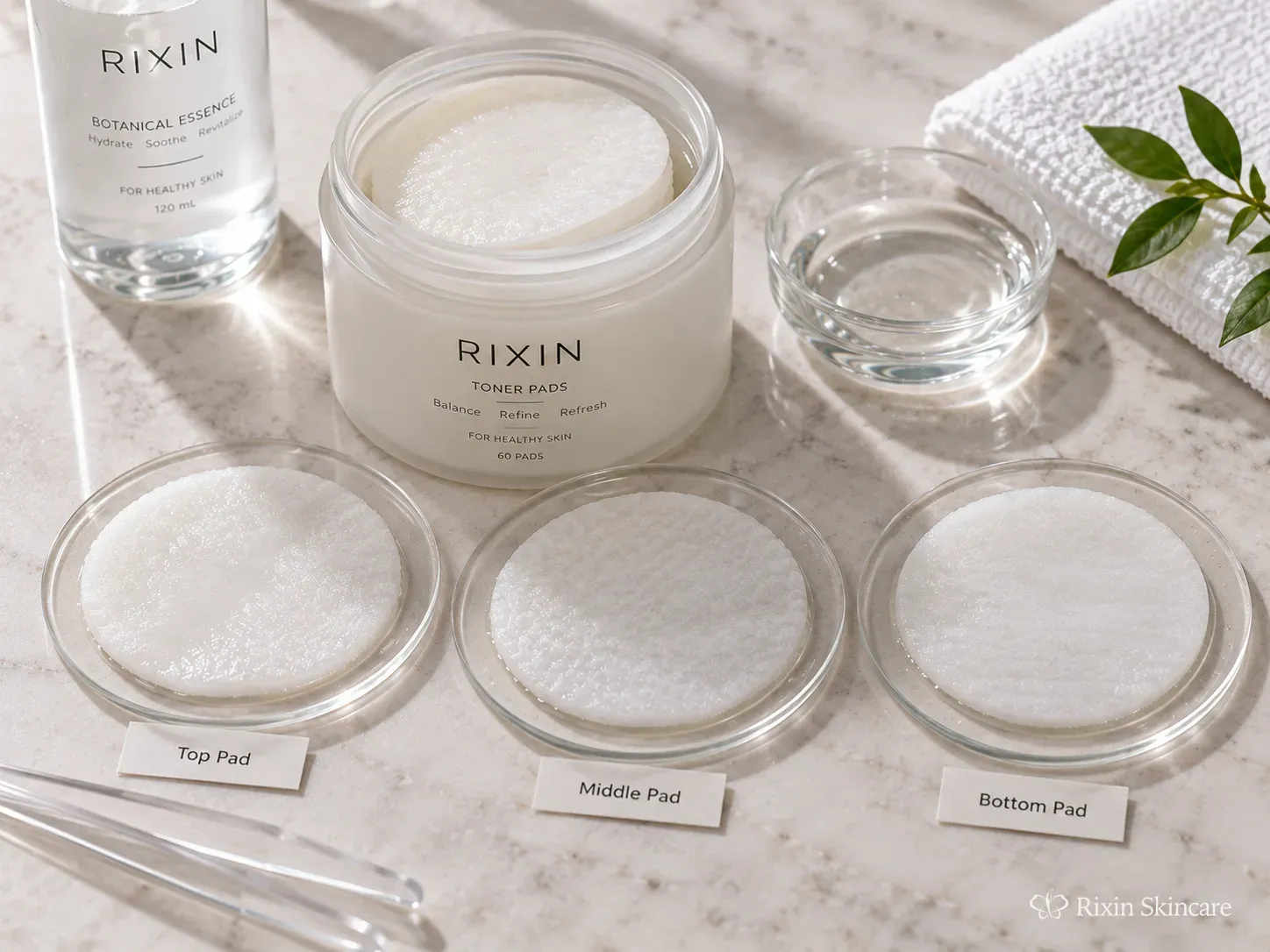
Check the First Pad, Middle Pads, and Bottom Pads
A toner pad should not be evaluated only by opening a new sample and testing the top pad.
The product experience may change through the stack.
During sampling, review pads from different positions and ask:
- Are the top pads sufficiently saturated?
- Is the middle of the stack consistent?
- Does excessive liquid collect near the bottom?
- Do pads stick together?
- Can one pad be removed without pulling out several?
- Does the liquid remain distributed acceptably after the package has been handled or stored?
These checks help determine whether the liquid quantity, pad characteristics, and packaging are working together.
The goal is not mathematical uniformity between every pad.
The goal is a finished-product experience that remains acceptable throughout normal use.
Confirm Package Architecture Around the Pad Stack
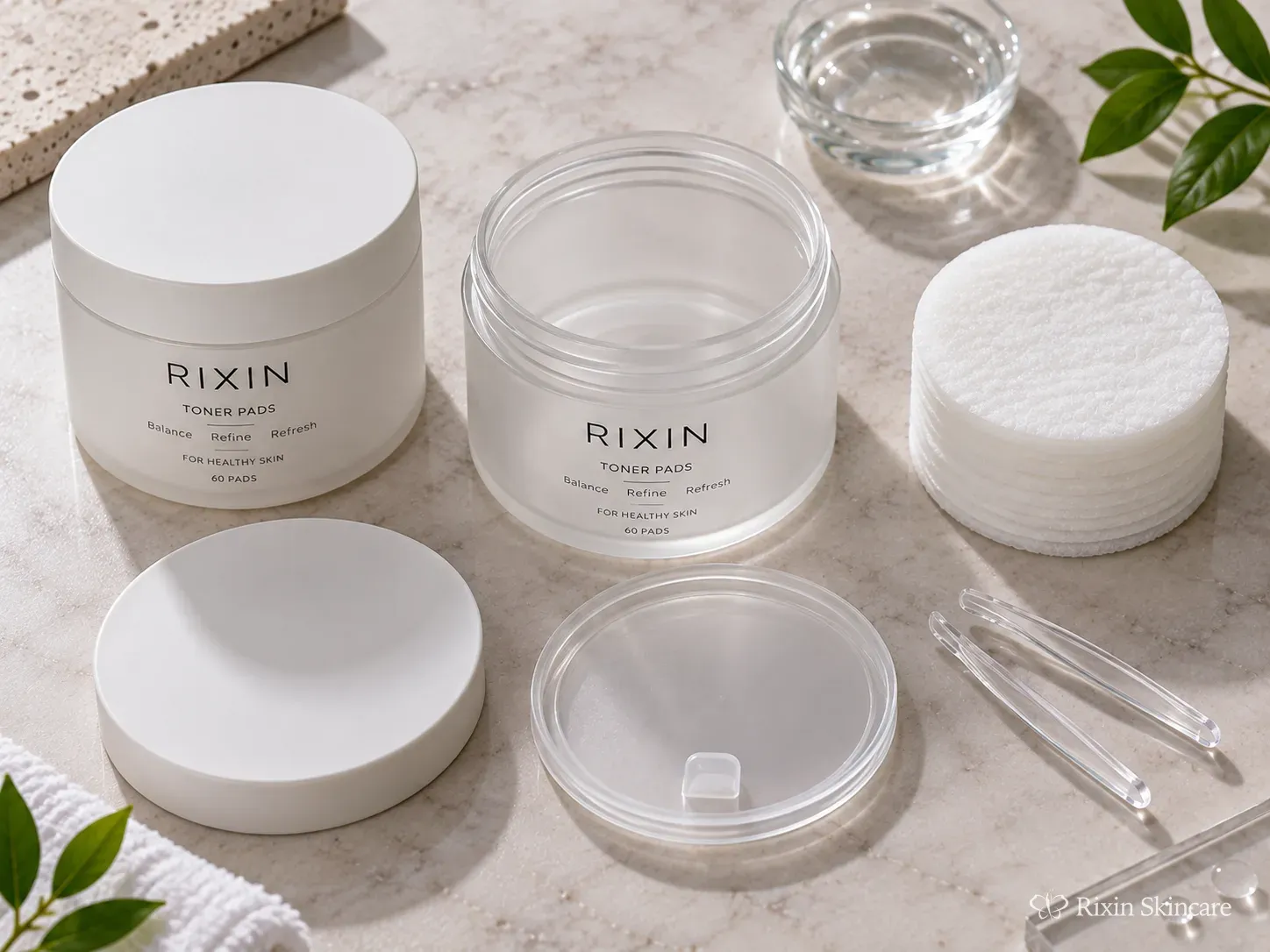
Toner pad packaging needs to fit the actual assembled system.
The development team should review:
- internal jar dimensions;
- opening diameter;
- pad diameter and stack height;
- lid structure;
- inner lid or secondary closure when used;
- sealing system;
- headspace;
- wall and base construction;
- label or decoration area;
- and space for any pickup accessory.
The opening needs to allow practical access to the selected pad, while the internal dimensions need to accommodate the intended stack and liquid load.
A visually attractive jar that does not fit the finished pad system is not a suitable package.
Decide How the Customer Will Pick Up Each Pad
Pickup design influences both usability and package architecture.
Possible directions may include:
- direct finger pickup;
- included tweezers;
- integrated tweezer storage;
- an inner tray or holder;
- or another package-specific solution.
No single method is automatically better for every product.
The right choice depends on:
- package size;
- pad dimensions;
- positioning;
- intended convenience;
- available internal space;
- and the desired user experience.
If tweezers are included, their length, grip, storage position, and interaction with the jar should be evaluated with the actual package.
An accessory that looks useful in a render but is awkward to store or use does not improve the final product.
Repeated Opening Changes the Protection Requirement
A toner pad jar may be opened repeatedly throughout its intended use period.
The brand should therefore review:
- how securely the package closes after each use;
- whether liquid collects around the opening;
- whether the closure becomes messy;
- how easily the container can be kept clean;
- and whether the package continues to protect the product under expected consumer-use conditions.
For water-based cosmetic products, preservation and microbiological safety also need to be assessed for the final formula, pad, package, manufacturing process, and intended use conditions.
The package does not replace an appropriate preservation strategy.
Final testing requirements should be determined at project level rather than assumed from the toner-pad format alone.
Ingredient Direction Should Follow the Product Positioning
Once the role, pad experience, and formula structure are clear, define an ingredient direction that fits the liquid formula, intended use frequency, pad interaction, target market, and proposed claim review. Ingredient popularity should not determine the whole brief, and ingredient information remains separate from finished-product proof.
For ingredient-specific development considerations, see the Rixin ingredient library.
A Toner Pad Can Use One Surface or More Than One
The pad may use one consistent surface or two intentionally different tactile surfaces. Choose the direction only when it improves the intended application experience; added texture should not create material and manufacturing decisions without a clear product reason. The formula, claims, instructions, and pad design should tell the same story.
Review Formula, Pad, and Package Compatibility Together
The toner pad formula remains in contact with both the pad substrate and primary package for an extended period.
Compatibility review therefore needs to consider the complete system.
Depending on the finished product and project requirements, relevant observations may include:
- formula appearance and odor;
- liquid distribution through the pad stack;
- pad integrity after saturation and storage;
- unwanted deformation, linting, or shedding;
- package integrity;
- closure function;
- leakage;
- and other relevant stability or compatibility observations.
Exact testing requirements depend on the finished product, packaging system, target market, and manufacturer procedures.
A successful result with the liquid in a separate bottle does not automatically establish that the same formula will behave the same way inside a filled toner pad jar.
Sample the Complete Toner Pad, Not Just the Formula
Sampling should move beyond a beaker or bottle of liquid. The meaningful sample is the assembled product:
confirmed substrate and pad + proposed liquid + intended fill + target piece count + proposed jar + closure
Review the system through a compact checklist:
| Area | Confirm |
|---|---|
| Formula | Appearance, fragrance, viscosity, residue, tackiness, and after-feel |
| Pad | Substrate, softness, flexibility, size, thickness, wet integrity, linting/deformation, separation, and formula release |
| Saturation | Wetness, dripping, liquid distribution, consistency through the stack, and remaining liquid |
| Packaging | Jar fit, closure, inner components, accessibility, pickup or tweezer storage, opening cleanliness, and handling |
The purpose of sampling is to confirm the complete user experience before bulk production decisions are locked.
For the wider approval workflow, see Sampling and Formula Approval.
Think About Manufacturing Before Finalizing the Concept
A toner pad requires more than producing a liquid formula. Manufacturing fit should cover pad specification and handling, pad loading, liquid filling or saturation, fill consistency, closure and sealing, accessory or inner-component assembly, inspection, and packaging. The exact process depends on the manufacturer, equipment, pad format, package, and project specifications.
Check those dependencies before finalizing pad dimensions, substrate, jar design, piece count, or other details that may affect production.
Existing Formula or Custom Development?
An existing or semi-custom formula may fit when its positioning, sensory behavior, pad interaction, saturation, and package system can be validated together. Custom development becomes more relevant when the brief needs tighter control over the formula-pad experience or unusual sensory requirements.
Choose the route after the core brief is clear. See Private Label Skincare and Custom Formulation & OEM.
Do Not Let the Product Format Become the Claim
Toner pads are a delivery format. The format does not by itself prove better hydration, exfoliation, pore, acne, soothing, brightening, or other finished-product performance. Those outcomes depend on the formula, use conditions, supporting evidence, and target-market review.
If the brand already has a bottled toner or essence, ask why the toner-pad SKU should also exist. The difference may come from application method, pad experience, convenience, usage occasion, formula, or positioning, but the format alone is not a claim.
A Practical Toner Pad Development Brief
Before requesting samples, define the format-specific inputs below.
Product role
- What is the toner pad supposed to do?
- How often is it intended to be used?
- If a bottled toner or essence already exists, why should this SKU also exist?
Pad and substrate
- selected or proposed substrate/material specification;
- preferred diameter;
- preferred thickness;
- softness;
- flexibility;
- surface direction;
- one-sided or dual-surface concept;
- wet strength and integrity;
- acceptable linting, shedding, or deformation;
- desired liquid pickup and release.
Formula
- formula direction;
- ingredient priorities;
- ingredients to avoid;
- fragrance direction;
- color and appearance;
- viscosity and after-feel;
- proposed cosmetic positioning and claims for later review.
Saturation
- target piece count;
- expected level of wetness;
- acceptable dripping;
- desired liquid distribution;
- whether excess free liquid in the jar is acceptable.
Packaging
- jar direction;
- opening size;
- closure type;
- inner lid or seal direction;
- tweezer or pickup preference;
- capacity;
- and any formula-package or access requirements.
If these decisions are still unclear, the project is still at the concept stage.
From Toner Pad Trend to Manufacturable Product
Toner pad development should move from product role → substrate and dimensions → liquid formula → saturation and piece count → package and pickup system → assembled sample → compatibility and preservation review → manufacturing fit.
Pad thickness can change liquid demand and stack height; formula viscosity can change saturation and release; piece count can change jar size; and closure design can change access and protection. The strongest concept is the one in which every component supports the same intended product experience.