On this page
A skincare trend can be a useful starting signal, but it is not yet a product brief.
Terms such as skin flooding, toner pads, milky toners, glass skin, cooling skincare, barrier support, or minimalist routines can point to changes in product format, texture, application method, packaging, or consumer expectations. They can also be too broad to justify development on their own.
For a skincare brand, the first question is not simply:
Is this trend popular?
A more useful sequence is:
Is this trend worth pursuing for our brand, and if it is, what would we actually need to develop?
That separates trend evaluation from product execution.
A practical process is:
trend signal → viability check → buyer need → product format → formula direction → sensory target → packaging → SKU role → manufacturing route
The viability check decides whether the trend is worth turning into a concept brief. A separate pre-sampling check later asks whether the product format, first sample objectives, packaging direction, and open technical questions are clear enough for a targeted development request. Passing the first check does not approve sampling or production.
Evaluate the Trend Before You Build the Product
Before discussing ingredients or requesting samples, test whether the trend has a useful commercial role.
You do not need an arbitrary score. You need enough clarity to choose one of four outcomes:
Proceed → Refine → Defer → Do not pursue
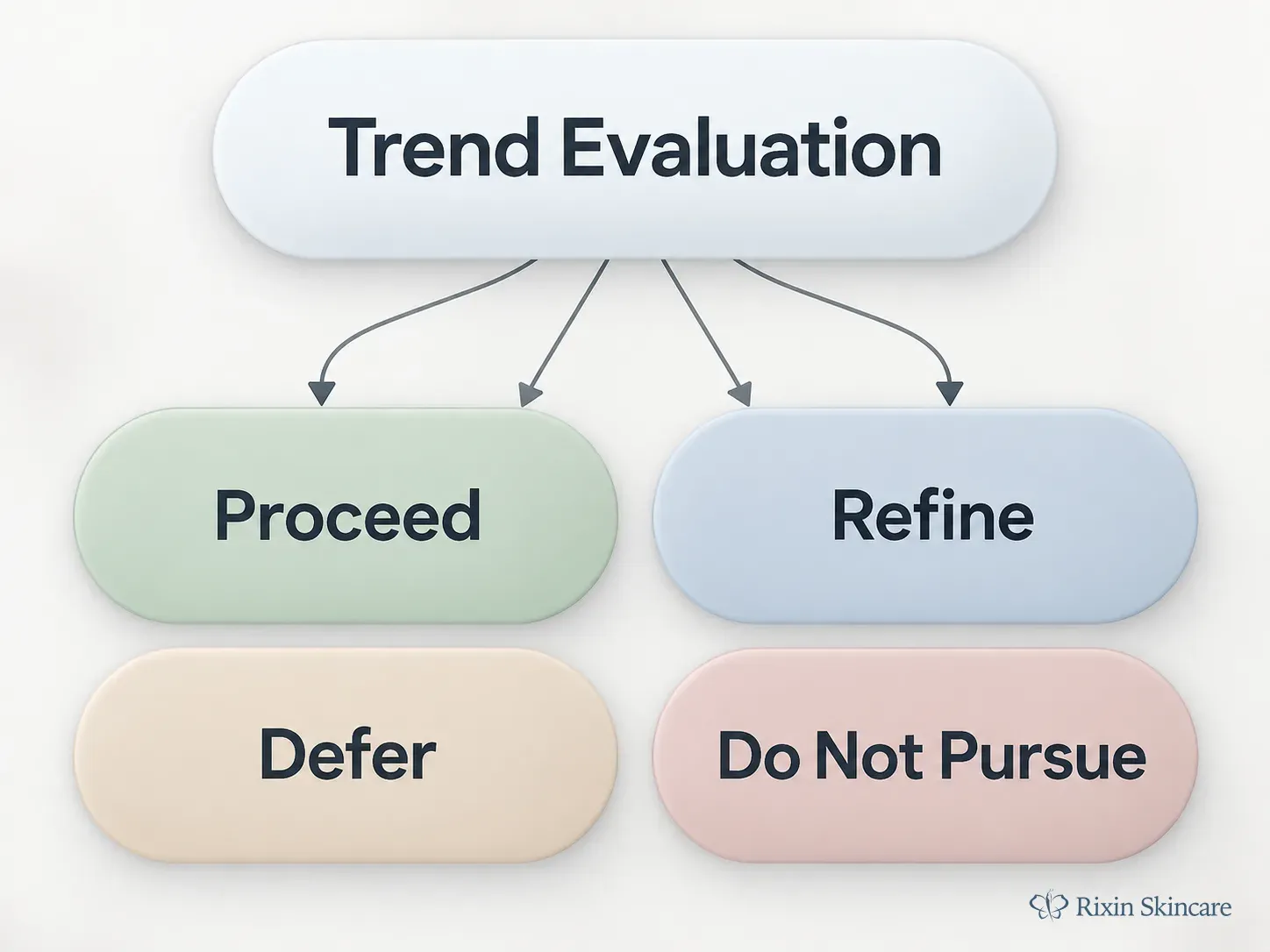
Use these six questions to decide whether to invest in a concept brief. They test buyer need, brand fit, distinctiveness, supportable positioning, practical viability, and commercial role—not whether a particular prototype is ready for use or production.
1. Does the trend represent a meaningful buyer need?
Look beyond visibility.
Ask what practical need sits underneath the trend:
- convenience;
- hydration;
- sensory experience;
- simplified routines;
- new application methods;
- radiance positioning;
- skin comfort;
- or another clear cosmetic use case.
If the only reason to create the product is that the trend is currently visible, the concept may still need refinement.
2. Does it fit the brand and intended customer?
A trend may be relevant to the market without fitting a particular brand.
Consider:
- the existing customer;
- current product positioning;
- price and channel;
- the rest of the product range;
- and the type of product experience the brand already owns.
A useful trend should strengthen or deliberately extend the portfolio, not sit beside it without a clear role.
3. Would it create a distinct product?
Ask whether the trend changes something meaningful:
- product format;
- use case;
- texture;
- application;
- packaging;
- routine role;
- or product-system architecture.
If the proposed product is essentially an existing SKU with a new trend label, the brand may not need a separate development project.
4. Can the concept be communicated with supportable claims?
Some trends are closely tied to visible-result expectations, ingredient narratives, or treatment-inspired language.
Before committing, separate:
- consumer interest;
- ingredient or supplier information;
- finished-product evidence;
- and final market-facing claims.
If the concept only works commercially when making claims that cannot be supported, it should be refined or deferred.
5. Is the format practical to develop and manufacture?
Some trends create more than formula work.
They may also require:
- a specific delivery system;
- new packaging;
- compatibility review;
- different filling;
- multiple coordinated SKUs;
- or additional project testing.
A trend can still be worthwhile, but the development complexity needs to match the expected value of the concept.
6. Does the product have a clear commercial role?
Decide where the product fits:
- hero launch;
- extension of an existing category;
- supporting routine step;
- bundle product;
- seasonal concept;
- channel-specific format;
- or replacement for an existing SKU.
If the product has no clear role in the range, more concept work may be needed before development.
Decide What Kind of Trend You Are Evaluating
If the concept passes the first viability check, identify what is actually changing. Different trend types create different development questions.
Product-format trend
The change is mainly in the physical product or delivery method, such as toner pads, mists, sticks, or balms. Ask what formula and packaging system are required for the format to work as intended.
Texture or sensory trend
The category may already exist, but the expected experience changes. A milky toner may require a different brief from a watery toner because appearance, flow, skin feel, and routine position are part of the concept.
Routine trend
The trend changes how several products work together. Skin flooding may lead to a coordinated hydration system rather than one product with a trend name, so the key question is whether one SKU or a system is necessary.
Ingredient trend
The trend begins with an ingredient name or material direction. Do not assume popularity defines the finished product; material, format, compatibility, sensory requirements, evidence, market, and claims still need review.
Use the Rixin ingredient library when the main decision is ingredient-led rather than trend-led.
Define the Buyer Need Before Choosing the Product
A trend becomes more useful once you can explain what problem it solves for the intended customer.
Ask:
- Who is the product for?
- Where does it sit in the routine?
- What experience should the user notice?
- Is it replacing an existing step or adding a new one?
- Is convenience part of the value?
- Is the concept mainly about hydration, cleansing, sensory experience, radiance, skin comfort, or another cosmetic direction?
- Does the concept make sense for the target market and sales channel?
One hydration trend, for example, could lead to a toner, serum, gel cream, facial mist, or coordinated routine.
The trend creates the direction. The buyer need helps determine which product should actually exist.
Translate the Trend Into a Product Format
Once the buyer need is clear, choose the product format before over-specifying ingredients.
The Rixin product categories show why this matters: cleansers, toners, serums, moisturizers, masks, body products, scalp products, and sunscreens each create different formula, packaging, use, and manufacturing questions.
A useful format brief should clarify:
| Decision | What to clarify |
|---|---|
| Product type | Toner, serum, cream, mist, pad, cleanser, mask, or another format |
| Application | Pour, pump, spray, swipe, squeeze, scoop, or another method |
| Routine position | Cleanse, prepare, treat, moisturize, protect, or support |
| Use pattern | Daily, occasional, targeted, travel, or another intended pattern |
| Texture | Watery, lightly viscous, gel-like, milky, creamy, balm-like, or another target |
| Finish | Fast-absorbing, dewy, low-residue, cushioned, rich, dry-touch, or another target |
| Package direction | Bottle, pump, jar, tube, pad jar, spray system, or another format |
| Target market | The country or market where formula, claims, label, testing, and documents will be reviewed |
Do not move directly from a trend name to an ingredient list.
The product format gives the rest of the development work a clearer structure.
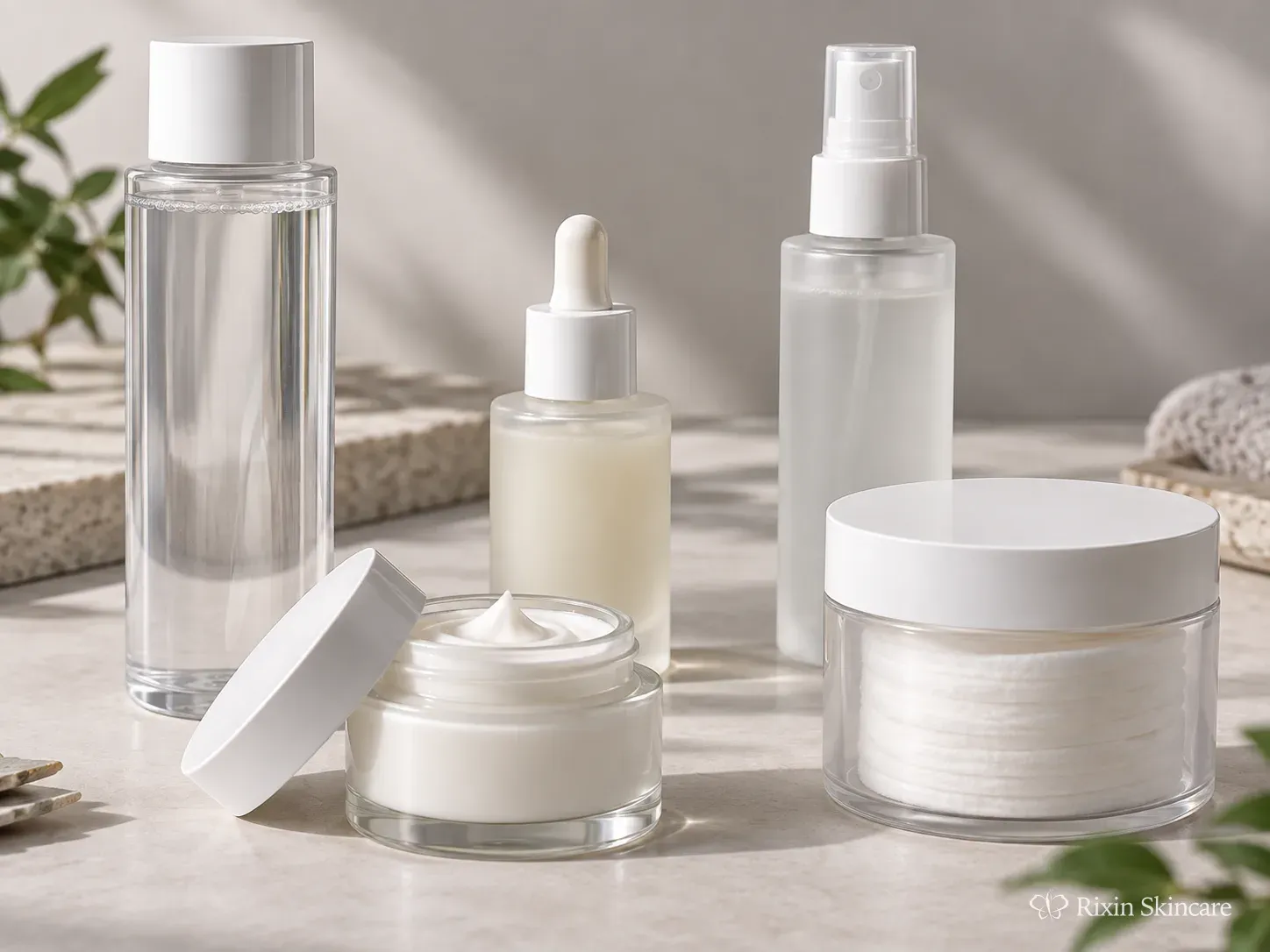
Turn the Trend Into a Formula and Sensory Brief
After the format is defined, translate the trend into a compact product brief covering:
- desired texture and viscosity;
- absorption or dry-down;
- tackiness or residue limits;
- fragrance direction;
- appearance or opacity;
- preferred ingredient directions;
- ingredients to avoid;
- reference products;
- intended cosmetic positioning;
- target market;
- packaging direction.
These requirements are more useful than asking for a formula that is simply “viral,” “premium,” or “like the trending one.” A reference product can communicate texture, appearance, packaging, or sensory direction, but it should not be treated as a request to copy another formula exactly.
For toner, essence, mist, and related development directions, see Toners & Essences.
Review Whether Packaging Is Part of the Trend
Some trend concepts cannot be separated from their delivery system. A pad, spray, stick, pump, dropper, tube, or jar changes how the product is filled, dispensed, protected, and experienced.
Ask whether the package supports the format and intended application rather than choosing it for appearance alone. For a packaging-led trend such as toner pads, the substrate, formula, closure, filling, and use experience need to work as one system; the detailed decisions belong in the product-specific guide.
Decide Whether the Trend Needs One SKU or a Product System
Some trends are strongest as one hero product.
Others make more sense as a coordinated system.
Use four questions:
- Can one SKU communicate the core idea clearly?
- Does another SKU have a genuinely different role?
- Will the customer understand why both products exist?
- Can the brand support the additional formula, packaging, approval, quantity, and inventory requirements?
Do not turn a trend into a multi-product collection simply because several formats are possible.
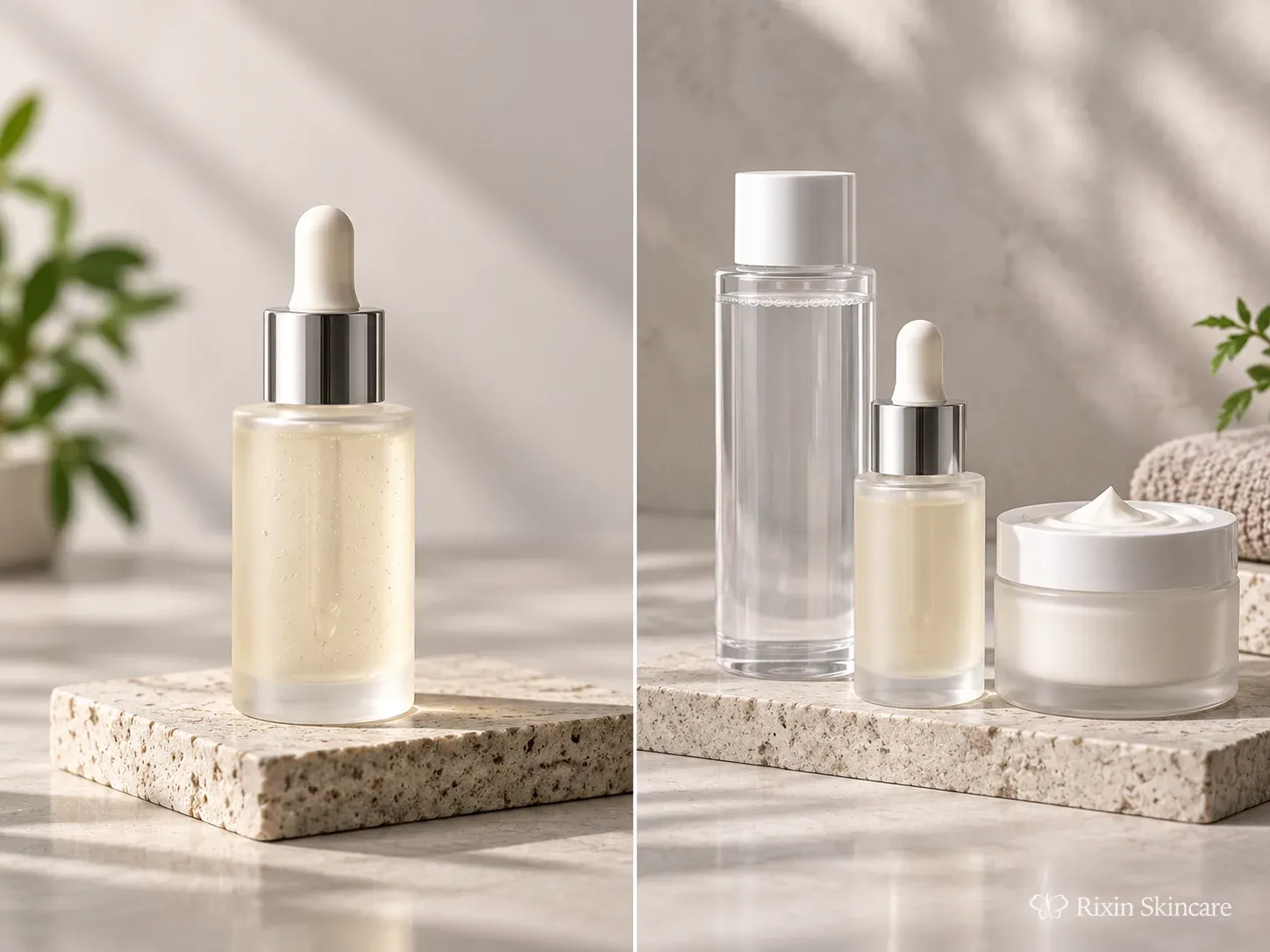
For the manufacturing consequences of adding more products, see How SKU Count Affects a Skincare Manufacturing Budget.
A new brand may decide that one distinctive hero product is the right first test. An established brand may use the same trend to extend an existing routine.
Separate the Trend From the Claim
A trend can indicate interest. It does not prove finished-product performance.
This distinction is particularly important when a concept is built around:
- an ingredient;
- a cosmetic concern;
- a visible-result expectation;
- a treatment-inspired idea;
- or a new technology.
Ingredient research, supplier material, competitor wording, or social-media discussion should not automatically become a finished-product claim.
Instead, define the intended cosmetic positioning conservatively and review what support may be required for the finished product and target market.
Useful questions include:
- What cosmetic benefit are we trying to communicate?
- What does the finished formula need to support?
- Which wording may depend on testing or other evidence?
- Does the target market create additional claim or labeling questions?
- Is the trend name itself suitable for market-facing use?
A product can still be developed around a trend while using more precise final claims.
Choose the Development Route After the Product Brief Is Clear
Once the format, sensory target, packaging, and positioning are defined, compare the brief with the available route. An existing formula may fit when it is already close to the target; custom development becomes more relevant when the concept depends on substantially different formula, sensory, or package interaction. The route depends on the confirmed brief rather than the trend label.
See Private Label Skincare and Custom Formulation & OEM.
Use Samples to Test the Product Brief, Not the Trend Name
A sample should be evaluated against the defined product target, including the intended:
- appearance;
- texture;
- absorption;
- after-feel;
- fragrance;
- residue;
- application;
- dispensing;
- and fit with the intended routine.
“Feels trendy” is not an approval standard. Detailed sample evaluation belongs to the wider development process.
See Sampling and Formula Approval.
Run a Product-Brief Gate Before Sampling
A Proceed decision authorizes concept work only. Before requesting a specific development sample, confirm the intended physical format, the first sample’s observable objectives, the proposed packaging or dispensing route, and who owns each unresolved decision. Record technical, claim-evidence, and target-market questions separately; do not imply they are already approved.
1. Which use case must the first sample represent?
Carry forward the target customer and intended use from the concept screen. Describe one specific use scenario the sample should represent; do not repeat the trend-popularity decision.
2. Which physical format and application method will be sampled?
Name the product format and intended application. State what the first sample must help the development team judge rather than asking for an undefined trendy texture or product.
3. What should the first sample demonstrate?
State observable targets for texture, finish, appearance, dispensing, and application, together with the intended ingredient direction. Separate prototype observations from claims that need supporting evidence.
4. Which packaging or dispensing route is being considered?
Identify the proposed container and delivery method, and note any fit, protection, or compatibility questions for technical review. A preliminary direction is not package approval.
5. What role does the product play in the range?
Decide whether it is a hero product, supporting SKU, routine step, extension, bundle product, or seasonal concept.
6. Which technical, claim, and market questions remain open, and who owns them?
List the questions requiring evidence or specialist review, assign an owner, and identify which must be resolved before any intended human-use assessment, product approval, or marketing claim.
7. Which development route fits the final brief?
Decide whether an existing formula can support the concept or whether custom development is required.
If the format, first sample objectives, decision owner, or material technical and claim questions are undefined, return to the concept brief before placing a sample request. A well-defined request begins development review; it is not approval for human use, production, or market claims.
How the Framework Changes by Trend Type
The same evaluation process can lead to different development priorities.
Skin flooding
Skin flooding is primarily a routine and product-system question. First decide whether one hydration hero is enough or coordinated products need distinct routine roles. See Skin Flooding: What It Means for Skincare Product Development for SKU architecture, texture progression, ingredient overlap, and sequence compatibility.
Toner pads
Toner pads are primarily a format and delivery-system question. Then assess whether the formula, pad, container, and application method can work together as one product. See Toner Pad Product Development for Skincare Brands for substrate, saturation, stack, pickup, and usability decisions.
Milky toner
Milky toner is primarily a texture and sensory-format question. The next decision is whether it has a clear sensory role distinct from a watery toner. See Milky Toner Product Development: Formula, Texture and Packaging Decisions for formula architecture, opacity, stability, layering, and dispensing.
From Trend Signal to Manufacturable Product
First decide whether the trend deserves development work. If it does, turn that decision into a brief the manufacturer can assess:
buyer need → format → formula and sensory target → packaging → SKU role → evidence needs → development route
If those answers are still unclear, refine, defer, or reject the concept rather than rushing into formulas, packaging, or multiple SKUs. The goal is not to manufacture every trend, but to identify the ones that can become coherent products for the brand, customer, market, and production plan.