On this page
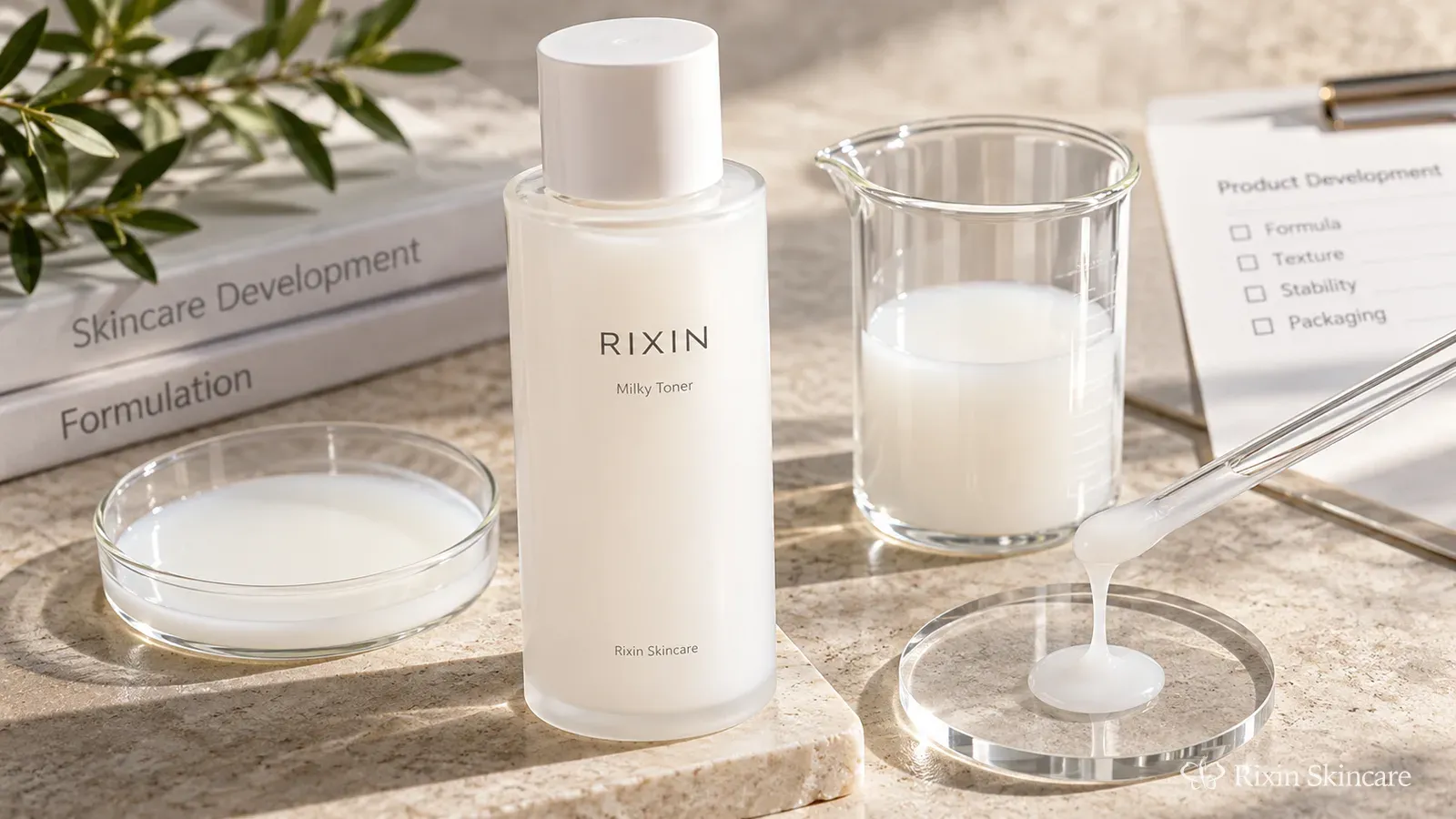
A milky toner is easy to recognize visually.
Developing one is more complicated.
For a skincare brand, the goal is not simply to make a conventional toner look white or opaque.
The real development question is:
How should the formula combine the fluid application expected from a toner with the richer visual and sensory identity associated with a milky texture?
That decision affects more than appearance.
It can influence:
- formula structure;
- viscosity;
- spread;
- absorption;
- residue;
- stability;
- ingredient direction;
- dispensing;
- bottle selection;
- layering behavior;
- and where the product sits within a skincare line.
A successful milky toner therefore needs a clear product role before the brand starts choosing ingredients or packaging.
For the broader framework used to decide whether a skincare trend deserves product development, see How to Evaluate Skincare Trends for Product Development.
At a practical level, milky toner development usually needs to move through a connected sequence:
- define the product role;
- define the intended appearance and texture;
- select a formula architecture that can support that experience;
- refine sensory and layering behavior;
- evaluate relevant stability requirements;
- match dispensing and packaging to the finished formula;
- review the formula in the intended package;
- confirm manufacturing fit before the product is finalized.
The exact formulation, testing, processing, and packaging requirements depend on the selected system, target market, manufacturer procedures, and finished-product brief.
A Milky Toner Is Not Defined by Color Alone
“Milky toner” is a product-development direction, not one universal formula. Two products can look milky while differing in fluidity, cushion, absorption, residue, and routine role.
Before choosing a formula structure, define what the product should contribute that the brand’s other liquid products do not. It may be a lightweight first hydration layer, a more cushioning alternative to a watery toner, a comfort-focused daily toner, or a visually distinctive standalone product. If it sits beside an existing toner, essence, or moisturizer, the differentiation needs to be explicit.
Define three separate targets:
- appearance: translucent, semi-opaque, opaque, or another controlled direction;
- sensory behavior: watery, fluid-cushiony, or more emulsion-like;
- product role: what the customer should use it for and what should follow it.
Appearance is not sensory weight. A creamy-looking product can remain fluid, while a lightly cloudy product can leave more cushion or film. The formula and sensory result should support the expectation created by the appearance.
Define the Texture Before Selecting the Ingredient Story
The brief should describe how the product moves before it specifies a hero ingredient.
For example:
| Texture direction | Development goal | Main sensory question |
|---|---|---|
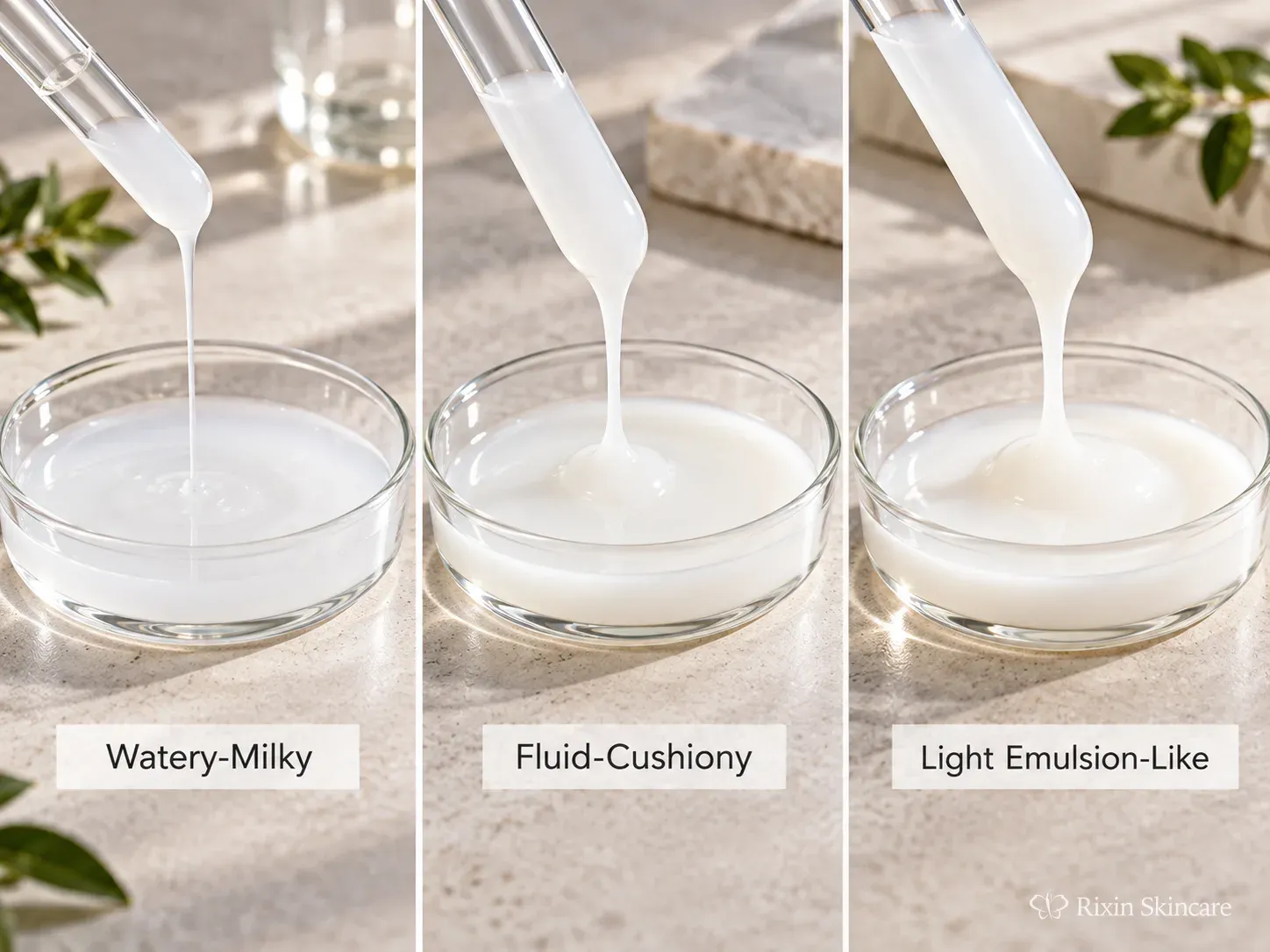
| Watery-milky | Very fluid with a milky appearance | Does it spread and absorb like a toner without feeling too thin? |
| Fluid-cushiony | Slightly more body while remaining easy to pour | Does it create noticeable softness without becoming sticky or heavy? |
| Light emulsion-like | More substantial sensory profile while still functioning as a toner | Does it remain clearly differentiated from a lotion or moisturizer? |
These are development directions, not fixed formula types.
The important point is to define the target before formula work begins.
Useful sensory targets may include:
- pourability;
- spreadability;
- slip;
- absorption speed;
- cushion;
- tackiness;
- residue;
- softness after application;
- finish;
- and behavior under the next skincare step.
For deeper decisions around toner and essence formats generally, see Toner & Essence Development.
The ingredient story should follow this texture and product-role decision, not replace it.
Formula Structure Should Follow the Target Experience
A milky appearance can come from different formula architectures. The appropriate direction depends on the target appearance and sensory profile, selected materials, processing, stability expectations, and intended package. The question is not which architecture is universally better, but which one supports the intended product role as one coherent system.
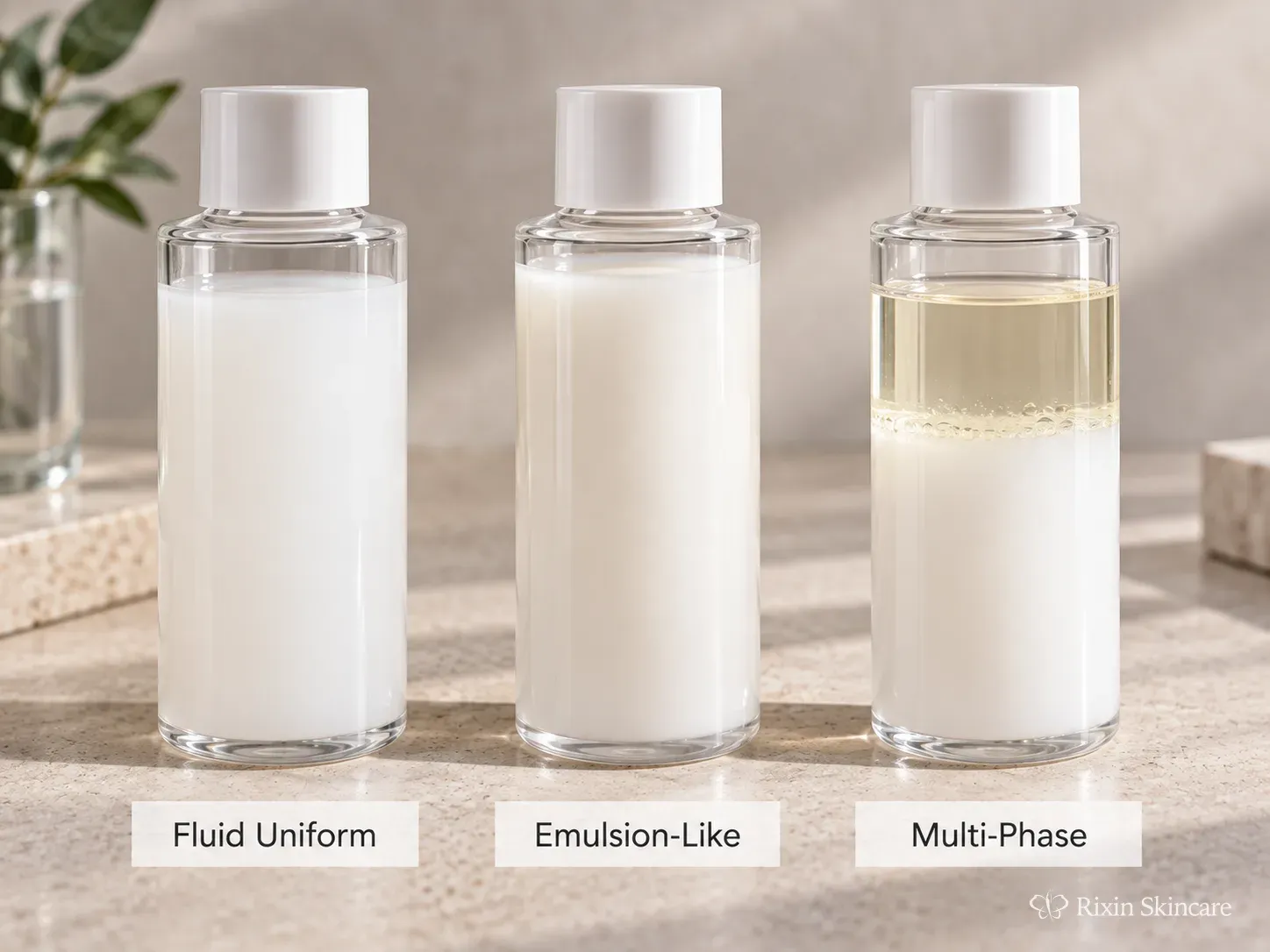
Uniform, highly fluid milky system
This direction stays close to a conventional toner’s flow while introducing a milky or softly opaque appearance. Review appearance during storage and use, flow and residue, after-feel, and dispensing control for a low-viscosity product.
Uniform, more emulsion-like milky system
This direction adds body, cushion, or emollient character while remaining clearly within the intended toner role. Review viscosity, slip, absorption, residue, and package dispensing together. The additional richness should have a product purpose rather than exist only because the formula looks creamy.
Intentionally multi-phase or shake-before-use system
A visibly separated system can be deliberate when the formula is designed to be mixed before use. That changes the formula target, package, dispensing, consumer instructions, and sample review before and after mixing. It is not equivalent to an unintentionally separating uniform formula, which should be assessed as a stability issue rather than reframed as a feature.
Across all three directions, define the intended finished state early. Exact formulation, processing, and project testing requirements depend on the selected system and package.
Stability Matters Because Appearance Is Part of the Product
In a milky toner, appearance carries more product meaning than it does in many clear liquid formulas.
Visible changes can therefore be especially noticeable.
Depending on the formulation system, development review may need to consider observations such as:
- changes in opacity;
- color shift;
- separation;
- creaming;
- sedimentation;
- changes in viscosity;
- changes in odor;
- or other signs relevant to the selected system.
The exact stability protocol depends on the finished formula, packaging, market, and manufacturer procedures.
The brand should not assume that a prototype is stable simply because it looks uniform during the first sample review.
Likewise, a successful appearance in a laboratory sample container does not automatically establish compatibility with the final bottle and dispensing system.
Packaging Should Follow Viscosity and Dispensing Behavior
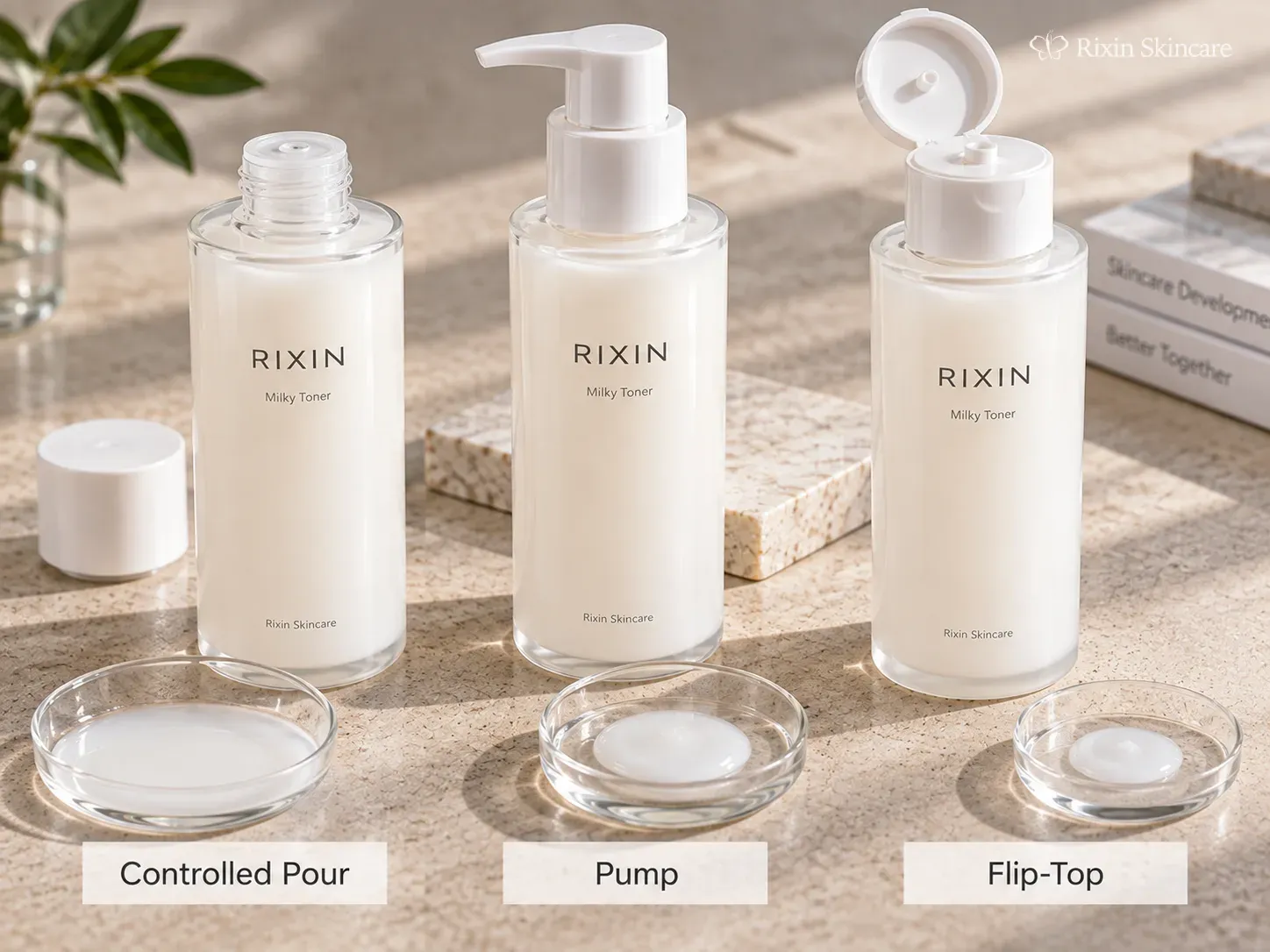
Select the package after the formula direction is reasonably clear. Review three responsibilities together:
- Dispensing: flow and viscosity must work with the opening, pump, or closure.
- Function: the formula and package must continue to behave acceptably together, including closure function, residue, leakage, and repeated use.
- Presentation: the bottle material and decoration must show or deliberately conceal the intended opacity, color, movement, and visual consistency.
Possible directions include a controlled pour, small-orifice opening, pump, disc-top, or flip-top configuration. A very fluid formula may behave differently from a more cushioning system, and a package that works for a watery toner should not automatically be assumed to suit every milky toner.
Check whether the product dispenses too quickly, the opening is too restrictive, residue collects around the closure, the customer can control the amount, and the package continues to function after repeated use. Final compatibility and testing requirements depend on the actual formula-package system.
Do Not Let a Milky Toner Become an Accidental Moisturizer
The richer a milky toner becomes, the more important product differentiation becomes.
A toner that becomes too viscous, occlusive, or cream-like may begin to overlap with:
- essence;
- emulsion;
- lotion;
- or lightweight moisturizer.
That does not automatically make the product technically wrong.
But it can make the product line harder to understand.
If the brand already sells an essence or lightweight moisturizer, ask:
- What makes the milky toner different?
- Is the difference mainly application order?
- Is the texture sufficiently distinct?
- Does each product have a separate sensory role?
- Are the claims becoming repetitive?
- Could one SKU perform the role of two?
The objective is not to defend the word “toner.”
It is to make sure each SKU has a clear reason to exist.
Consider How the Milky Toner Will Layer With Other Products
If the milky toner is intended to precede serum or moisturizer, review:
- Does the product absorb quickly enough for the next step?
- Does it leave excessive tack?
- Does it create a film that changes serum spread?
- Does it pill when followed by another product?
- Does the combined routine feel too heavy?
- Does it remain useful when used alone?
For deeper coordinated-routine discussion, see Skin Flooding: What It Means for Skincare Product Development.
Ingredient Direction Should Support the Brief, Not Replace It
Define product role → appearance → texture → after-feel → layering behavior before choosing an ingredient direction. Proposed materials still need to fit the formula structure and may affect color, odor, viscosity, stability, documentation, or claim review. Ingredient popularity does not establish that a material fits every milky toner.
For ingredient-specific considerations, use the Rixin ingredient library.
Milky Texture Is Not a Performance Claim
“Milky” describes appearance and sensory direction. It does not by itself prove better hydration, barrier repair, gentleness, or better performance than another toner. Any finished-product claim depends on the actual formula, use conditions, supporting evidence, and target-market review.
Sample the Formula in the Intended Package
A milky toner should be reviewed as a complete formula-package system rather than only in a generic sample bottle.
| Review area | Confirm |
|---|---|
| Appearance | Opacity, color, uniformity, movement, and fit with the visual brief |
| Texture and application | Pourability or pumpability, spread, slip, absorption, cushion, tack, residue, and final feel |
| Layering | Behavior by itself, under serum or moisturizer, and in the intended routine where relevant |
| Package function | Dispensing control, closure cleanliness, leakage, formula around the opening, bottle presentation, and handling |
| Ongoing review | Relevant stability, formula-package compatibility, preservation, and finished-product testing observations |
For the broader approval process, see Sampling and Formula Approval.
Existing Formula or Custom Development?
An existing or semi-custom formula may fit when its appearance, viscosity, sensory behavior, dispensing, package fit, and positioning already match the brief. Custom development becomes more relevant when the concept needs tighter control over architecture, opacity, viscosity, sensory behavior, or a specific package interaction.
The route should follow the confirmed brief rather than the trend name. See Private Label Skincare and Custom Formulation & OEM.
A Practical Milky Toner Development Brief
Before requesting samples, define the product-specific decisions below.
Product role
- What is the milky toner supposed to contribute to the routine?
- What existing product should it be clearly different from?
Appearance
- translucent, semi-opaque, or opaque direction;
- preferred formula color;
- desired visual richness;
- whether the formula should remain visually uniform during normal use.
Texture
- watery, fluid-cushiony, or more emulsion-like direction;
- target viscosity;
- desired slip;
- absorption speed;
- acceptable tackiness;
- residue;
- desired final feel.
Formula direction
- formula architecture and ingredient direction;
- desired emollient character, fragrance, and positioning where relevant;
- proposed claims for later review.
Layering
- intended application order;
- products likely to follow;
- desired wait or absorption behavior between steps;
- acceptable combined finish.
Packaging
- bottle direction;
- transparent, translucent, or opaque presentation;
- dispensing method;
- closure preference;
- formula visibility and package-fit questions.
If these decisions are still unclear, the project is still at the concept stage.
From Milky Toner Trend to Product Brief
Milky toner development should move from product role → appearance and texture → formula architecture → stability → dispensing and package fit → complete sample review.
A very fluid, softly milky system and a more cushioning, emulsion-like direction can both be valid. The formula should not become milky simply because the trend is popular; the appearance, sensory behavior, package, and product role should support the same idea.