Primary Functions
- Hydration support
- Smoother-looking texture direction
- Elasticity and age-support direction
PDRN Ingredient-Led Skincare Development
Develop private label or custom PDRN skincare around the exact material, cosmetic direction, product format, formula, package, evidence, and target market. Hydration, smoother-looking texture, elasticity, and age-supporting concepts may be considered, but the suitable route depends on the selected material and finished-product brief.
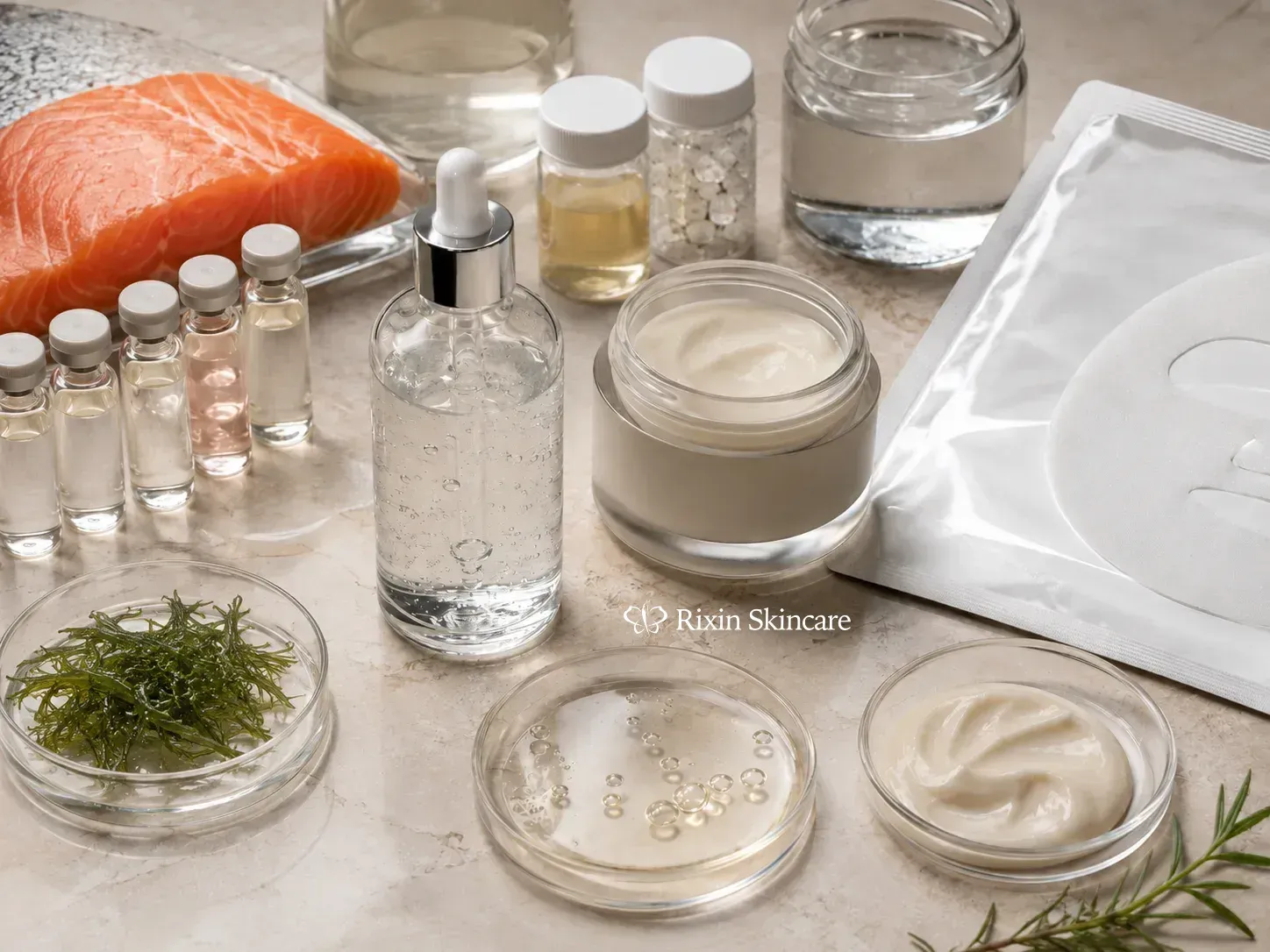
Ingredient Snapshot
Source routes vary and exact material identity and supplier documentation require confirmation.
Ingredient Direction
PDRN generally describes mixtures of DNA-derived deoxyribonucleotide fragments. Traditional research often discusses purified DNA from salmonid reproductive cells, while plant-derived and microbial-derived routes have also been reported.
The name alone does not define source, composition, molecular profile, carrier, proposed INCI, or cosmetic suitability. Begin with the exact supplier material and keep the page within topical cosmetic product development.
PDRN may fit appearance-focused concepts when the selected material and finished formula support the intended direction.
Consider serum, moisturizer, or mask concepts built around a comfortable, well-conditioned skin feel.
Develop a softer, smoother-looking appearance direction without treating an ingredient study as finished-product proof.
Explore an elasticity-focused cosmetic brief when the exact material, formula, and evidence support the wording.
Keep the positioning cosmetic and appearance-focused, with no treatment, regeneration, or guaranteed result language.
Source routes and the terms PDRN and PN are not reliable substitutes for an exact commercial specification.
Confirm species, processing, fragment profile, carrier, composition, and documents. Purified DNA from reproductive cells is a different description from salmon meat or a generic marine extract.
Plant research may involve ginseng, Gynostemma, peony-related, rose, or other sources. Species, tissue, processing, material characteristics, and evidence can differ.
Microbial materials require their own identity, availability, composition, supplier files, and cosmetic performance review.
Commercial use of both terms can be inconsistent. Compare molecular distribution, concentration, physical form, carrier, supplier definition, and intended use rather than treating them as interchangeable.
Format selection determines the relevant texture, material handling, package, and finished-product review.
| Product Format | Development Direction | Review First |
|---|---|---|
| Facial Serums | Fluid, essence-serum, or gel direction | Physical form, viscosity, clarity, tack, and dose delivery |
| Moisturizers | Lotion, gel cream, or richer emulsion | Carrier, emulsion structure, feel, stability, and package |
| Facial Masks | Sheet-mask essence or selected mask format | Essence loading, substrate, pouch, seal, and stability |
Resolve the material questions before choosing a level, process, claim, or package.
Review supplier, trade name, source species or biological origin, production route, exact composition, proposed INCI, and Certificate of Analysis.
Physical form, molecular profile, concentration basis, carrier, solubility or dispersibility, addition phase, and storage guidance can change the formula brief.
Review pH environment, temperature exposure, compatibility, preservation, clarity, viscosity, sensory effects, filling, dispensing, and package contact for the exact material.
Supplier or ingredient-level research does not prove a new serum, moisturizer, or mask. Do not transfer injection, clinical-treatment, tissue-regeneration, or wound-care language to an ordinary cosmetic claim.
Start With the Exact Material
Share the supplier reference or source direction, product format, market, packaging, quantity, documentation needs, and timing. Rixin will review the information and discuss a suitable route.