On this page
Yes, sometimes—but using one skincare formula for the U.S. and EU should be a verified product-development decision, not an assumption.
A brand may use one shared formula, a shared base with a market-specific variant, or separate formulation routes. The right choice depends on intended use, the full quantitative formula, ingredient restrictions and conditions of use, selected raw materials where relevant, and the claims planned for each market.
A quantitative formula is the complete formula with the percentage of every ingredient, not only the consumer-facing INCI list. And “same formula” does not mean “same market-entry work”: labels, documentation, responsible-party information, notifications, and other requirements may still differ even when the formula is identical. This formula decision is one part of the broader U.S. and EU skincare market-entry readiness guide; after the formula route is chosen, review U.S. vs EU Cosmetic Labeling for the separate artwork decision.
Prepare the Dual-Market Brief Before Requesting a Quote
Before asking a manufacturer to quote or adapt a formula for both markets, provide enough information for technical and regulatory questions to be identified early. This applies to private label, OEM, custom formulation, and an existing formula being transferred to a new manufacturer.
Confirm:
- target markets: U.S., EU, or both;
- product type and intended use;
- intended claims;
- use area and whether the product is leave-on or rinse-off;
- the full quantitative formula, if an existing formula is being reviewed;
- selected raw-material specifications where a blend, premix, carrier, or supplied concentration may matter;
- whether the goal is one shared formula or a market-specific variant is acceptable.
Keep these inputs in the project requirements. Quantity, timing, and sample expectations should also be in the commercial brief, but they do not replace the formula and market information above.
Start With Intended Use and Regulatory Category
Before comparing ingredients, confirm that the product has the same intended use and an appropriate regulatory category in both markets.
In the United States, intended use can determine whether a product is regulated as a cosmetic, a drug, or both. FDA explains that intended use may be established through labeling, advertising, websites, other promotional materials, consumer perception, and in some cases the known therapeutic use of an ingredient. Acne-treatment and sun-protection claims are examples that can move a skincare product into drug requirements rather than an ordinary cosmetic-only route. See the FDA guidance on cosmetics and drugs.
The buyer implication is simple: do not begin with “Are all of these INCI names allowed?” if the two versions are not actually being marketed as the same type of product.
For ordinary skincare, define intended use and claims before formula approval. If the positioning changes materially between markets, resolve that through formula development and appropriate regulatory review before treating the project as a shared-formula program.
Sunscreen follows a substantially different cross-market path and should be reviewed separately; see sunscreen UV filters.
Review the Exact Formula Under Both Market Frameworks
The U.S. and EU do not regulate cosmetic ingredients through identical systems.
For ordinary cosmetics in the United States, cosmetic products and ingredients generally are not subject to FDA premarket approval, with color additives as an important exception. Companies are still responsible for safety, proper labeling, avoiding prohibited ingredients, and following applicable restrictions. See FDA Cosmetics & U.S. Law and FDA prohibited and restricted ingredients.
The EU uses a different structure under Regulation (EC) No 1223/2009. Its annexes address prohibited substances, restricted substances, colorants, preservatives, UV filters, and conditions that may apply to particular substances or uses. Because these rules change over time, use the current consolidated EU Cosmetics Regulation rather than an old ingredient list.
For a dual-market review, start with the actual quantitative formula and check relevant ingredients together with:
- exact ingredient identity;
- percentage in the finished formula;
- product type and area of use;
- leave-on or rinse-off use;
- market-specific concentration limits or other conditions.
A matching INCI name does not prove that the same quantitative formula works in both markets.
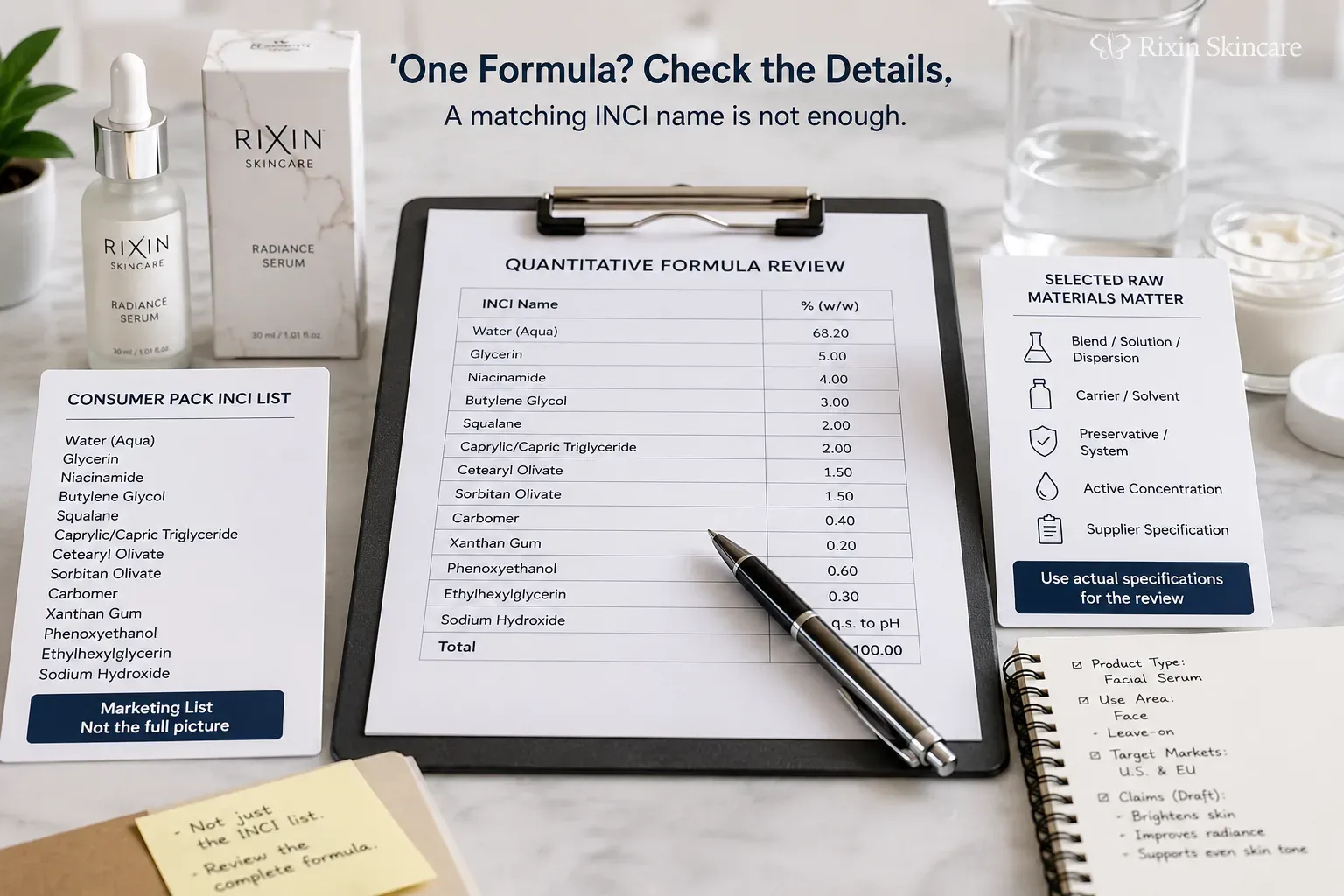
The selected raw material may also matter. A blend, solution, dispersion, premix, or proprietary system can contain carriers, solvents, preservatives, or other components not obvious from a marketing ingredient name. Where relevant, use the current supplier specification and composition information needed by the regulatory reviewer.
CosIng should not be treated as an approval list. The European Commission states that CosIng is informational and has no legal value; an INCI name appearing there does not mean the ingredient is approved for cosmetic use. See the European Commission CosIng notice.
For ingredient-specific questions, use the ingredients hub and the relevant ingredient page rather than turning the shared-formula review into an ingredient database.
Choose a Shared Formula or a Market-Specific Variant
After review, the project usually falls into one of three practical outcomes.
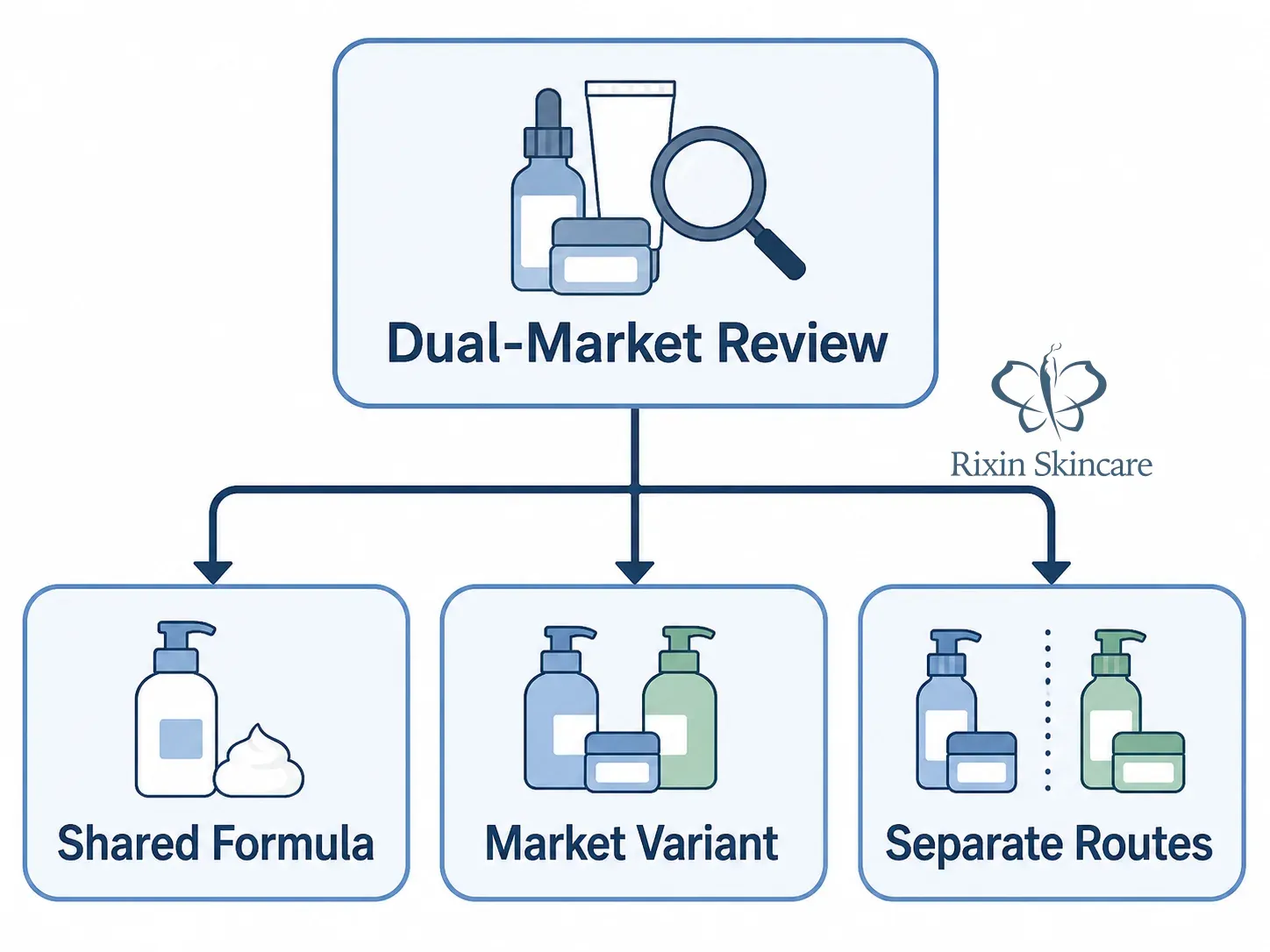
One shared formula
One formula may be feasible when the intended use is compatible, the complete formula can fit both market frameworks, relevant concentrations and conditions of use can be met, selected materials are suitable, and planned claims do not create an incompatible product category.
A shared formula can simplify development, sampling, purchasing, production planning, and inventory because fewer formula versions need to be controlled.
It does not eliminate market-specific work. The U.S. and EU versions may still require different labels, documentation, responsible-party information, notifications, or other launch steps.
Shared base with a market-specific variant
A variant may be more practical when the product concept and main formula structure can stay the same but one market needs a formula-level adjustment.
That can add another formula version, samples, approvals, specifications, artwork or SKU control, purchasing, and production planning. Depending on the manufacturer and project, multiple variants can also affect MOQ, lead time, and inventory. Confirm those commercial effects for the actual project rather than treating them as universal numbers.
Separate formulation routes
Separate routes may be appropriate when intended use differs materially, the regulatory category changes, a major functional system cannot be reconciled, or the changes needed for one market would undermine the product brief.
Two formulas are not automatically a project failure. A controlled market-specific version can be easier to manage than repeatedly changing one global formula to satisfy incompatible requirements.
For example, a non-EU brand importing a private-label non-SPF moisturizer may be able to use the same quantitative formula for the U.S. and EU while changing market-specific labels and documentation. If review identifies a formula-level issue in only one market, the brand may keep the same product concept but approve a controlled variant.
Keep Formula and Claims Decisions Together
Claims need to stay visible during formula review because they can affect how the product is regulated and what evidence is needed.
For the U.S., the key issue is intended use: claims can cause a product marketed as skincare to fall within drug requirements.
For the EU, the issue is different. Commission Regulation (EU) No 655/2013 requires cosmetic claims to follow common criteria including truthfulness and evidential support. It also states that ingredient properties should not be presented as finished-product properties without adequate support. See the official EU cosmetic claims regulation.
Do not collapse these systems into one rule. Keep two questions together:
What is in the formula?
What are we planning to say the finished product does in each market?
The brand should define the intended claims. The manufacturer should provide agreed formula and raw-material information. The appropriate regulatory reviewer—and, for EU safety work, the qualified safety assessor where relevant—should assess applicable regulatory and evidence questions. The packaging team should adapt approved market-facing information after those decisions are confirmed.
Confirm the Decision Before Formula Approval
Before calling a product “dual-market ready” internally, record both the answer and the owner for each item.
- Target markets — Brand: Are the U.S. and EU both confirmed?
- Intended use and claims — Brand + regulatory reviewer: Are the proposed uses, claims, and category questions defined?
- Quantitative formula — Manufacturer: Is the current formula available with percentages, not only an INCI list?
- Raw-material information — Manufacturer / suppliers: Are relevant specifications available for selected blends, premixes, carriers, or supplied concentrations?
- Market-specific formula review — Regulatory reviewer: Have relevant restrictions, concentrations, product types, use areas, and other conditions been reviewed against current requirements?
- Formula route — Brand + manufacturer: Is the project proceeding with one shared formula, a controlled variant, or separate routes?
- Sampling and version control — Brand + manufacturer: If there are variants, are sample approvals, formula versions, specifications, and later changes clearly separated?
- Market-facing execution — Regulatory reviewer + packaging team: Are label, documentation, notification, responsible-party, and other market-entry tasks being handled separately from the formula decision?
A simple status such as confirmed / open / owner / next action can make this easier to manage.
Change control continues after approval. If the formula, selected raw material, concentration, claims, packaging, or target market changes, ask the appropriate reviewer whether the earlier assessment needs to be revisited. Regulatory requirements can also change, so a formula reviewed today should not be assumed to remain suitable indefinitely without maintenance.
One skincare formula can sometimes serve both the U.S. and EU. A shared formula should result from reviewing the actual product, formula, materials, claims, and current market requirements—not from matching INCI names or assuming that one market automatically covers the other.
When one formula cannot cleanly support both markets, a controlled variant may be the better product-development decision.