On this page
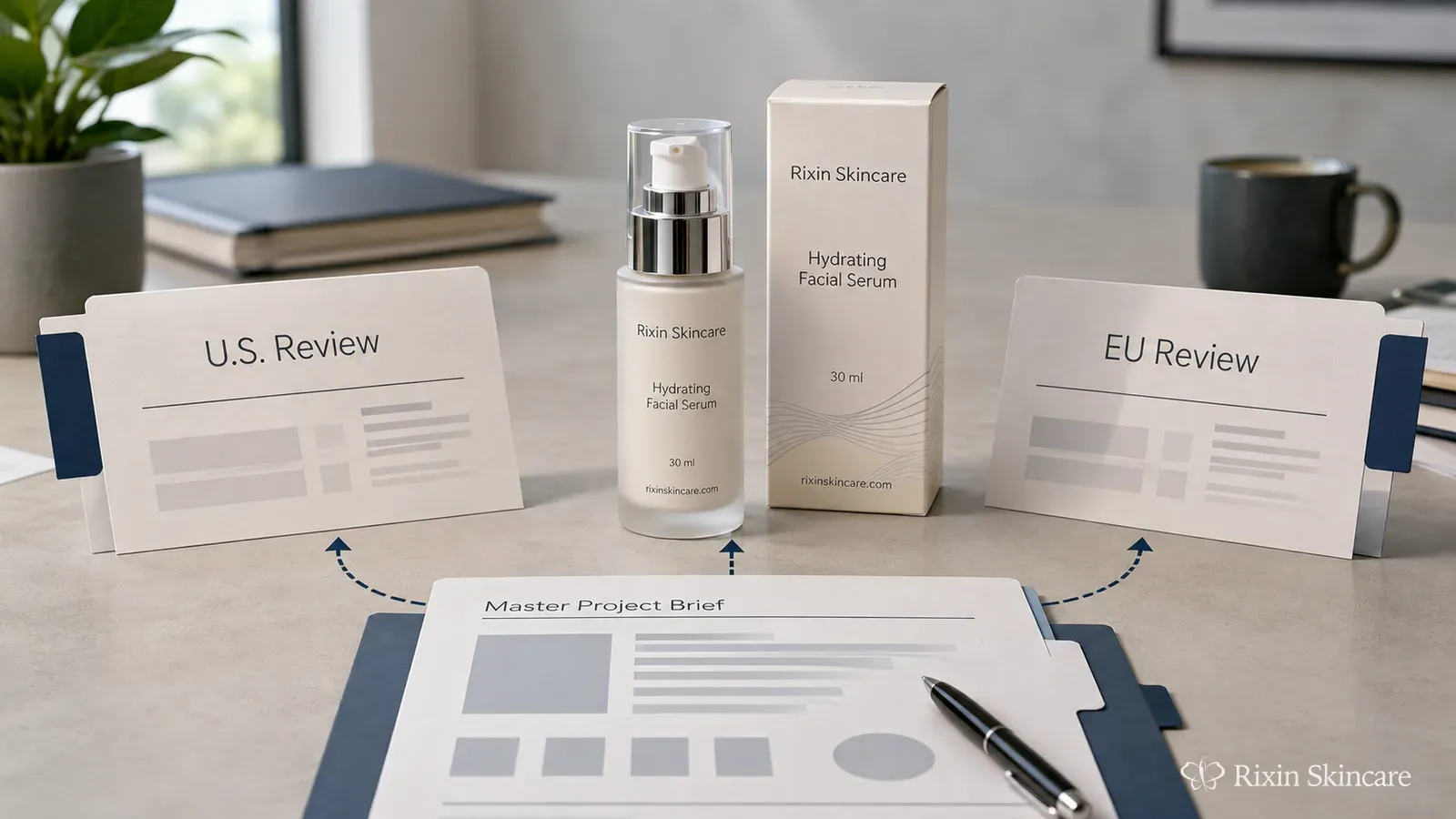
A skincare brand planning one product for both the United States and European Union should manage it as one manufacturing project with two coordinated market reviews.
The practical sequence is:
Market → Formula → Artwork → Production
Define the markets first, review the formula for both, resolve each market’s label details, and release production only when the approved formula and packaging files are aligned.
Some parts may stay shared. Others need separate U.S. and EU work.
This guide focuses on product-development and manufacturing readiness. It does not cover the full commercial market-entry process such as customs clearance, tariffs, VAT, warehousing, company formation, or distributor contracts.
Start With One Dual-Market Project Brief
Make the U.S. and EU part of the brief from the beginning instead of adding the second market after formula or packaging approval.
For a private-label, custom-formulation, or existing-formula adaptation project, define:
- target markets: U.S., EU, or both;
- the EU countries where the product is expected to be sold;
- product type and intended use;
- claims — what the product is expected to say it does on the label and in marketing;
- current formula status;
- whether one shared formula is preferred;
- whether a market-specific formula variant would be acceptable;
- primary packaging format;
- target quantity range and timing expectations;
- expected testing or documentation support.
These inputs do not replace regulatory review. They help the brand, manufacturer, and reviewers identify issues before important decisions are approved.
Keep the brief aligned with the project requirements. If the market, claims, formula, or packaging direction changes later, reopen the affected review.
Some products may need a different route because regulatory classification can differ between markets. Sunscreen is an important example: FDA notes that some products regulated as cosmetics in Europe are regulated as drugs in the United States. See FDA Cosmetics & U.S. Law.
Before requesting a quotation
Before asking for a quotation, provide:
- project type;
- target markets and EU countries;
- formula status or formulation direction;
- target quantity range;
- packaging format;
- intended claims;
- required testing or documentation support;
- target timing.
For those separate decisions, use the MOQ and lead-time guide and sampling and formula approval guide.
Build Two Market Reviews Early
Once the brief is clear, separate the U.S. and EU reviews early enough to identify issues before the formula or final label and packaging files are approved.
The two reviews stay connected to the same product project, but they are not interchangeable.
| Project decision | U.S. review | EU review | Detailed guide |
|---|---|---|---|
| Product route | Confirm intended use and applicable U.S. category | Confirm the intended EU cosmetic route | U.S. requirements / EU requirements |
| Formula | Review the exact formula for the U.S. | Review the exact formula for the EU | U.S.–EU formula guide |
| Market records | Confirm applicable U.S. responsibilities and records | Confirm applicable EU safety, product-information, and notification work | U.S. / EU requirements guides |
| Artwork | Confirm U.S. label details | Confirm EU label details and required languages | U.S. vs EU labeling guide |
This is a routing map, not a legal checklist.
For the U.S., MoCRA includes requirements such as facility registration, product listing, serious adverse-event reporting, and safety substantiation—records supporting adequate product safety—with exemptions and role-specific conditions. FDA also states that registration and listing are not product approval. See FDA’s MoCRA overview.
For the EU, the Cosmetics Regulation uses a different structure. It includes an EU Responsible Person—the person or company designated in the EU for the product—plus safety, product-information, notification, and labeling requirements. The CPNP is the European Commission’s online notification portal. See the current EU Cosmetics Regulation and European Commission CPNP.
Confirm which requirements apply to the actual product and the role each party performs. The practical takeaway is simple: one market review does not automatically cover the other.
Decide What Can Stay Shared Across Both Markets
After the market-specific reviews identify the open questions, decide what can remain common.
Formula
A shared formula may be possible, but it should be the result of review rather than an assumption.
The question is whether the exact formula, including ingredient amounts, can support both intended markets or whether the project needs a shared base with a market variant or separate formula routes.
For example, a moisturizer may keep one formula if both reviews support it. If one market requires a material change, create a separate controlled variant.
The detailed decision belongs in the Can One Skincare Formula Work in Both the U.S. and EU? guide listed above.
Do not call the formula final for both markets while an open market-specific question could still require more development.
Artwork
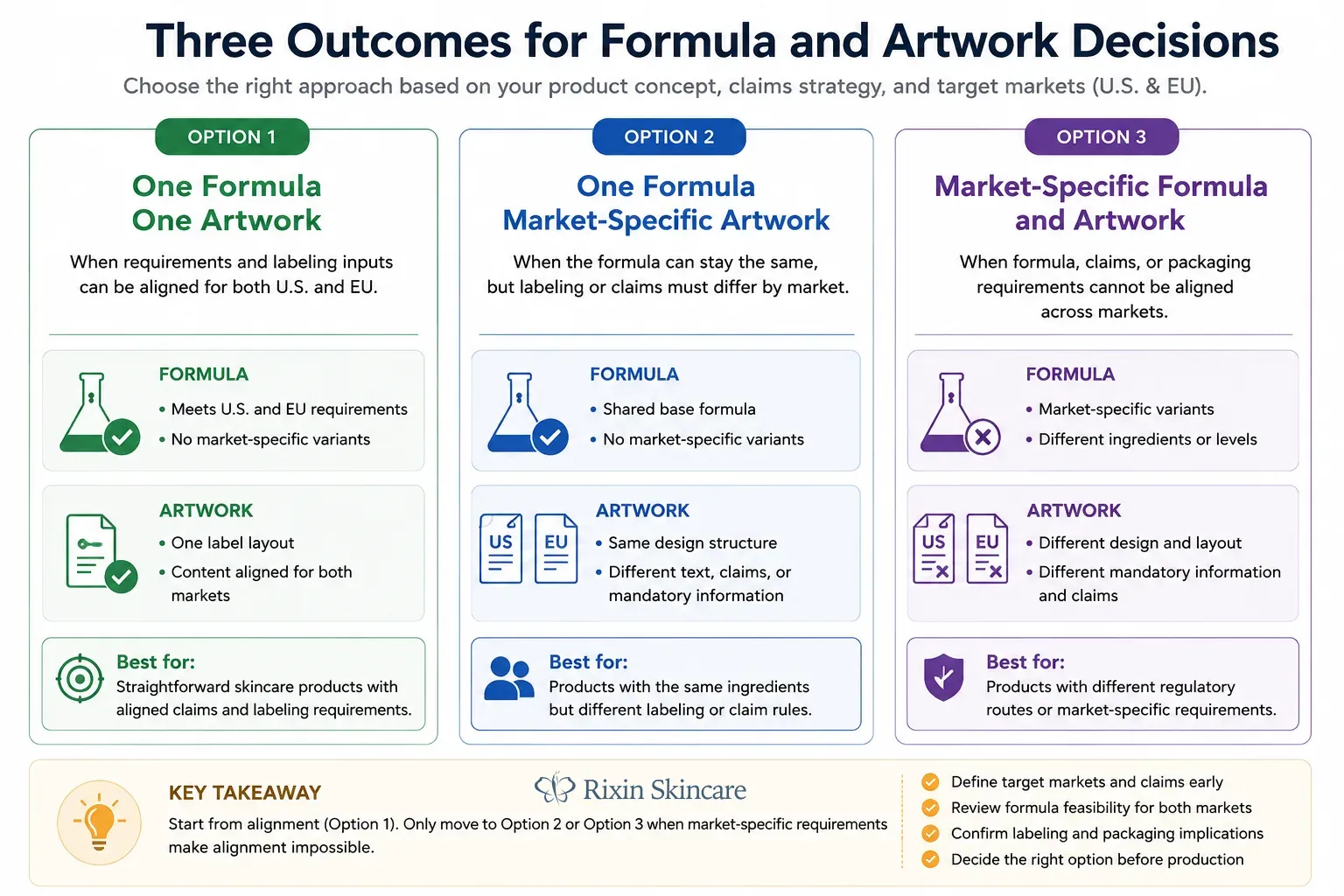
Formula sharing and artwork sharing are separate decisions.
Artwork here means the final label and packaging files that will be approved for printing or production.
Even when the formula stays identical, the U.S. and EU versions may need different company or Responsible Person information, languages, durability information, contact details, or other label fields.
A moisturizer could therefore use the same bottle, carton shape, logo, colors, and front-panel design while maintaining separate approved U.S. and EU text files.
The project may use:
- one shared artwork file;
- one visual design with separate U.S. and EU text versions;
- separate market artwork.
The detailed comparison belongs in the U.S. vs EU Cosmetic Labeling for Skincare Brands guide listed above.
Assign Owners and Deliverables
Dual-market projects become difficult when each party assumes someone else has already confirmed a decision.
Assign both an owner and an expected deliverable.
| Decision or information | Typical owner or contributor | Expected output |
|---|---|---|
| Target markets and commercial direction | Brand | Confirmed market brief |
| Intended use and claims | Brand + appropriate reviewer | Approved claims direction |
| Formula and manufacturing information | Manufacturer | Current formula and agreed technical information |
| Selected raw-material information | Manufacturer + supplier where relevant | Available specifications or supplier documents |
| U.S. market review | Brand / appropriate U.S. reviewer | U.S.-specific open issues and required actions |
| EU market review | Brand + EU Responsible Person / appropriate reviewer | EU-specific open issues and required actions |
| Market-facing label information | Brand + labeling / regulatory reviewer | Approved label text inputs |
| Artwork files | Brand + packaging team | Approved market-specific file and version |
| Production release | Brand + manufacturer | Agreed formula and packaging version for production |
These are project-planning roles, not a universal allocation of legal responsibility. Exact responsibilities depend on the market, product, contract, and role each party performs.
A practical handoff could be: the brand confirms markets and claims; the manufacturer supplies the formula and agreed product information; the reviewers identify market-specific requirements; the packaging team applies approved label information; and the brand and manufacturer release the correct formula and artwork version.
Where testing or documentation support is part of the manufacturing project, keep it connected to the relevant quality testing and documentation workstream rather than treating documents as an afterthought.
Use Four Readiness Gates Before Production Lock
The following four gates are a project-control framework, not a legal certification, industry standard, or universal compliance checklist.
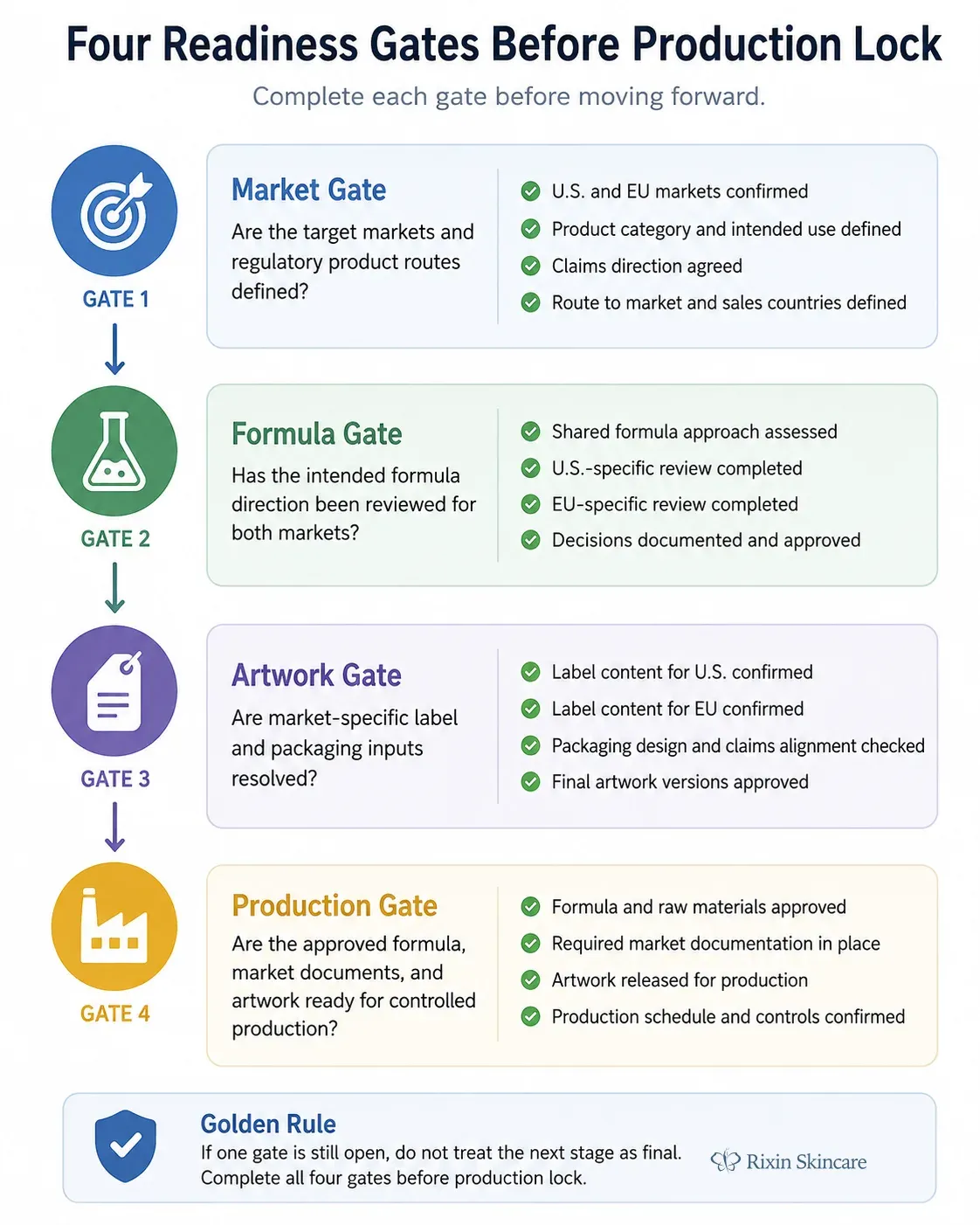
1. Market Gate
Are the target markets and product routes defined?
Confirm that the U.S. and EU are intentionally included, the intended use and claims are known, and any product-category issue that could change the route has been identified.
If the Market Gate is still open, do not treat the formula or label direction as final for both markets.
2. Formula Gate
Has the formula direction been reviewed for both markets?
Confirm whether the project is proceeding with one shared formula, a controlled variant, or separate formula routes.
This gate does not mean the formula has received government approval. It means the open formula questions that could require more development have been addressed for the project.
3. Artwork Gate
Are the label details required for each market resolved?
Confirm that the correct formula version, claims, market information, languages, and approved artwork file and version are aligned.
Do not release packaging simply because the visual design looks finished.
4. Production Gate
Are the approved formula, required project information, and correct packaging files ready for production?
Before final manufacturing release, make sure the project team is using the same approved formula and the correct market-specific packaging version.
If the formula, claims, Responsible Person, EU countries, or artwork changes after a gate is closed, reopen the affected review.
The sequence remains:
Market → Formula → Artwork → Production
Tasks can run in parallel, but do not finalize a later decision while an earlier open decision could still change it.
For one U.S.-EU skincare manufacturing project, define the markets early, separate the reviews, decide what can stay shared, assign the handoffs, and close the four gates before treating formula and packaging decisions as final.