On this page
A finished skincare formula and approved package do not automatically make a product ready for the U.S. market. Before production or launch, a brand should resolve the main U.S. cosmetic requirements that can affect the product, evidence, label, and manufacturing project.
In practical terms, confirm six things early: the product’s regulatory category, the applicable MoCRA roles, facility-registration and product-listing responsibilities, the safety-substantiation path, label and claim direction, and the information you need from the manufacturer. Treat this as an internal planning gate—not as FDA approval or legal clearance.
This guide focuses on FDA-facing federal cosmetic questions that can affect a manufacturing project. It is not intended to cover every requirement that may apply to a product sold in the United States. Other legal, regulatory, commercial, or retailer requirements should be reviewed separately where relevant. For the broader project sequence and owner handoffs, use the U.S. and EU skincare market-entry readiness guide. When formula and artwork decisions are connected, continue to Can One Skincare Formula Work in the U.S. and EU? and U.S. vs EU Cosmetic Labeling.
Before You Request a Manufacturing Quote
Give the manufacturer the U.S.-market facts that can affect development: the product type and intended use, planned claims, whether the formula is fixed or still open to change, the package format, and any known documentation or evidence questions.
Your full RFQ should also cover quantities, timing, and sample expectations. Keep those broader commercial inputs in the project requirements rather than turning regulatory review into the whole project brief.
Whether you are using private label or custom formulation, raise U.S.-market issues before formula and artwork approval. A late classification, claim, or labeling change can create avoidable rework.
Is the Product a Cosmetic or a Drug?
Start with intended use, not registration paperwork.
Under U.S. law, a product may be regulated as a cosmetic, a drug, or both depending on what it is intended to do and how it is promoted. FDA explains that claims about treating or preventing disease, or affecting the structure or function of the body, can place a product on a drug regulatory path.
For example, a moisturizer positioned to hydrate and improve appearance may fit a cosmetic purpose. A product promoted to treat acne is making a drug claim. A moisturizer marketed with sun-protection claims can also involve drug requirements. See FDA’s Cosmetics & U.S. Law and Cosmetics Labeling Claims.
For a skincare buyer, the action is simple: decide the U.S. regulatory category before changing or locking the formula. Then address any technical consequences through formula development.
Sunscreen-specific development and UV-filter questions belong in the sunscreen development and sunscreen UV filters resources rather than in this general U.S. market-readiness guide.
Know the Core MoCRA Responsibilities
The Modernization of Cosmetics Regulation Act of 2022, or MoCRA, expanded FDA’s authority over cosmetics and created requirements that affect many brand-manufacturer projects. FDA’s current Registration & Listing of Cosmetic Product Facilities and Products page is the primary reference for the registration and listing framework.
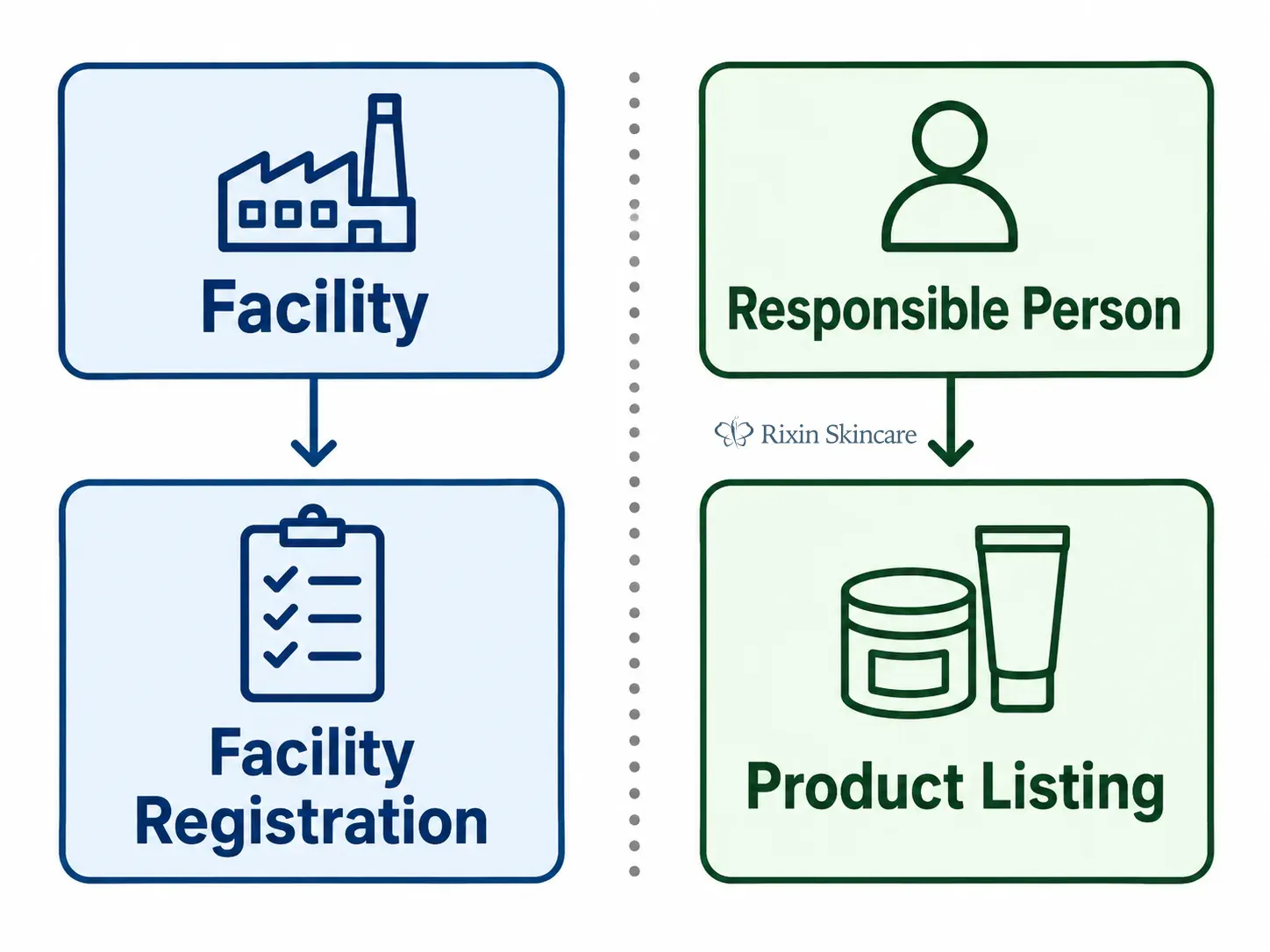
Three concepts should not be collapsed into the phrase “FDA registration.”
Responsible person. Under MoCRA, the responsible person is the manufacturer, packer, or distributor whose name appears on the cosmetic product label under the applicable U.S. provisions. Identify that party for the finished product instead of assuming the contract manufacturer owns every U.S. obligation.
Facility registration. Manufacturers and processors subject to the requirement must register their cosmetic facilities with FDA and renew the registration every two years.
Product listing. The responsible person must list each marketed cosmetic product with FDA, including required product information, and provide required updates.
Facility registration and product listing are therefore different obligations. FDA also states that registration and listing are not cosmetic approval programs, and FDA does not issue certificates approving a cosmetic because it has been registered or listed.
MoCRA includes certain small-business exemptions, with important exceptions. Do not decide eligibility from company size alone; verify it for the actual company, facility, and product.
For a foreign manufacturing facility, FDA’s Form FDA 5066 instructions include U.S. agent contact information as part of foreign-facility registration. FDA treats that contact role separately from the statutory definition of the MoCRA responsible person, so the parties involved in the U.S. project should be identified rather than assumed.
The useful buyer action is to record who owns each applicable obligation and what facility or product information that person needs.
Post-market duties also exist. For example, MoCRA includes serious adverse-event reporting requirements for the responsible person. The detailed reporting procedure is outside this article, but the planning lesson matters before launch: give continuing U.S. responsibilities a clear owner rather than treating compliance as a one-time filing exercise. FDA’s MoCRA overview should be checked for the current requirements.
Plan for Safety Substantiation
MoCRA requires the responsible person to ensure and maintain records supporting adequate safety substantiation for the cosmetic product. FDA does not prescribe one universal test package that every cosmetic must complete.
That distinction matters for private-label and OEM buyers. Safety substantiation is not the same as ordering a fixed checklist of tests. Depending on the product, the supporting basis may involve formula information, ingredient or supplier documentation, existing safety data, specifications, relevant testing, and other scientifically appropriate evidence.
The buyer should therefore ask two separate questions:
- What evidence supports the safety of this finished product?
- Which supporting information must come from the manufacturer, suppliers, laboratories, or another party?
Do not treat the existence of a test report or supplier document as automatic proof that every U.S. requirement has been satisfied.
Use quality, testing, and documentation for Rixin’s project-level support boundaries. This article is not a universal testing checklist, and the actual evidence and testing plan should be confirmed for the product and target market.
Review Label and Claims Before Artwork Is Locked
Label and claim review should happen before artwork becomes expensive to change.
FDA’s Summary of Cosmetics Labeling Requirements explains the federal framework. At a high level, a U.S. cosmetic label can involve product identity, net quantity, ingredient declaration, business information, applicable warnings or directions, and other required information. Labeling must also be truthful and not misleading.
Claims need separate attention because they help establish intended use. The difference between “hydrates dry-looking skin” and “treats acne,” for example, is not only a marketing choice. It can change the regulatory path and the evidence, formula, and label review the project needs.
For manufacturing, use this sequence:
market and claim direction → required label information → artwork → printing and packaging execution
This article is not a complete FDA labeling checklist. Once the required market-facing information is confirmed, the packaging and label design process can handle artwork and production coordination.
Identify What You Need From the Manufacturer
Products made outside the United States still need to meet applicable U.S. requirements when marketed in the U.S. FDA provides separate guidance for importing cosmetics.
The buyer should therefore identify what information needs to move between the brand, the responsible person, any relevant U.S. importer or distributor, and the manufacturing facility.
Depending on the project, confirm categories such as:
- exact formula or product identity;
- ingredient and supplier information relevant to the review;
- manufacturing-facility details needed for applicable filings;
- current product specifications;
- available test results, safety data, or supplier documents;
- final packaging and label information;
- changes made after samples or specifications were approved.
A regulatory responsibility can belong to one party while the supporting information comes from another.
Record each item as confirmed, available with stated limits, or still to be confirmed. If information is limited, state the limitation—for example, whether a report covers only one raw material, one test condition, one formula version, or one manufacturing batch.
Also keep the approved product version visible throughout sampling. If the formula, raw material, claims, packaging, or label information changes after a sample is reviewed, ask whether that change affects a U.S. market-readiness assumption. The purpose here is not to build a complete change-control system, but to avoid relying on evidence or label decisions tied to an older product version.
This is different from supplier due diligence. Here, the question is what product and facility information is needed for U.S. market preparation. If you need to verify whether the supplier or facility itself is credible, use the skincare manufacturer due diligence guide.
Use a Six-Point U.S. Readiness Check
Use the following as an internal project gate, not as a legal determination that the product is compliant, approved, or cleared for sale:
- Is the product’s intended use and regulatory category understood?
- Are the applicable MoCRA roles identified?
- Are facility-registration and product-listing responsibilities resolved?
- Is there a defined safety-substantiation path and a clear owner for the supporting records?
- Have U.S. label and claim questions been reviewed before artwork is locked?
- Are the required manufacturer, facility, product, and evidence inputs identified and tracked?
If all six areas have clear owners and no open issue is likely to change the product, the project may proceed under its internal plan, subject to any required regulatory review.
If some items remain open but are defined and assigned, development may continue while they are tracked.
If an unresolved issue could change the formula, claims, label, or manufacturing direction, hold the affected approval until it is reviewed.
U.S. cosmetic market readiness is not one “FDA registration” task. It is a set of product, MoCRA, safety, labeling, and information-handoff questions that should be resolved early enough to guide the manufacturing project rather than corrected after production.