On this page
U.S. vs EU cosmetic labeling requirements can differ even when a skincare brand uses the same formula and packaging format in both markets.
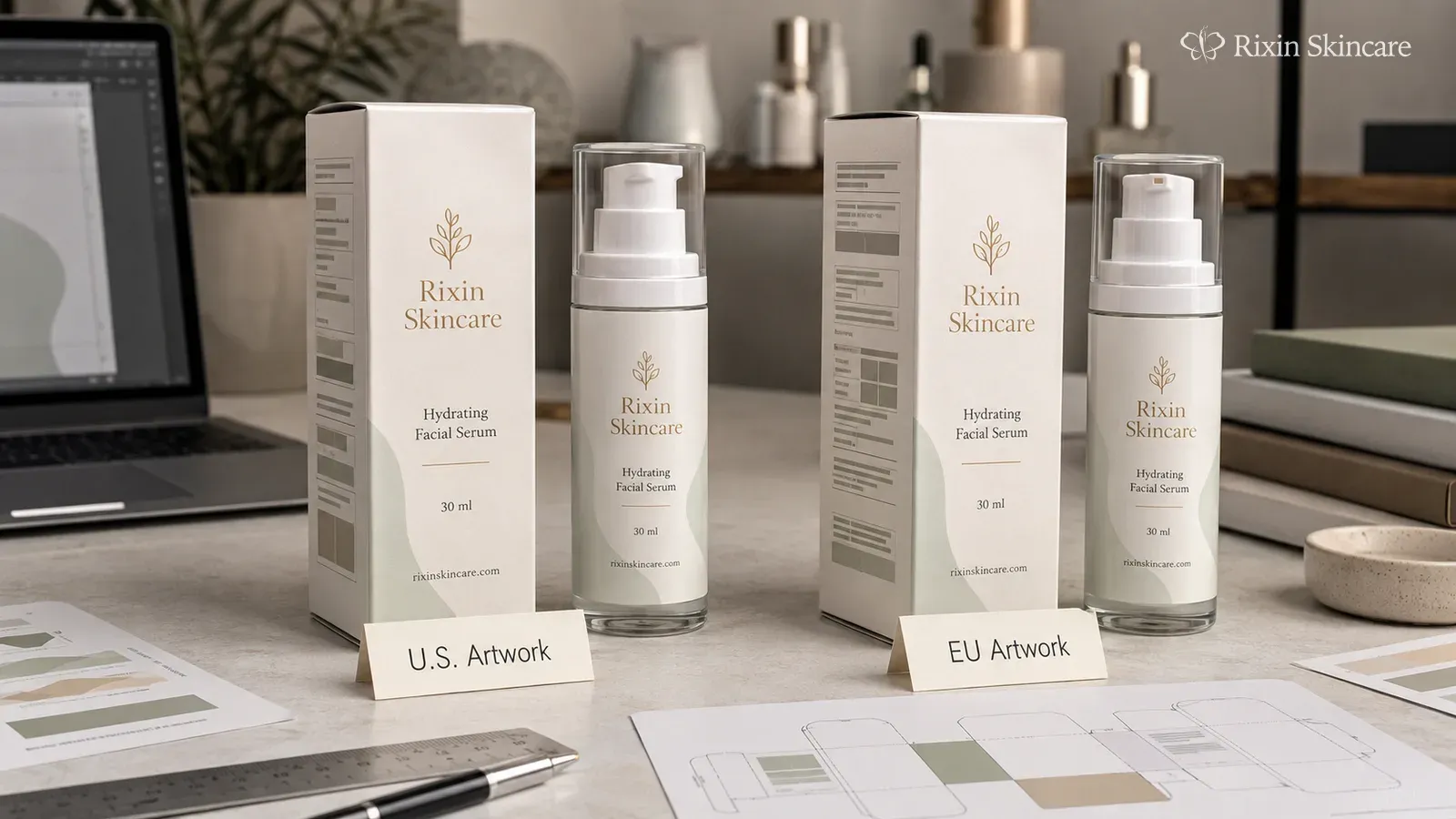
The same bottle, carton, logo, and visual design may still need different controlled artwork files. U.S. artwork can require different business and adverse-event contact information, while EU artwork can require Responsible Person details, imported-product origin, durability information, and market-specific languages.
Treat formula approval and artwork approval as separate gates. Before print release, decide whether the product can use one shared artwork file, the same visual design with separate U.S. and EU text versions, or fully separate artwork. For the broader project sequence and owner handoffs, use the U.S. and EU skincare market-entry readiness guide. For the U.S.-specific label inputs, see U.S. Cosmetic Requirements; the EU-specific requirements are linked below.
Define the Markets and Product Version Before Design
For private label, OEM, custom formulation, or an imported finished-product project, confirm the key artwork inputs before design is finalized:
- U.S., EU, or both;
- the EU countries of sale;
- product type, intended use, and claims;
- final formula version;
- primary container and outer packaging;
- U.S. business information and adverse-event contact;
- confirmed EU Responsible Person details;
- who will review translations, regulatory copy, final proofs, and print release.
Keep these decisions aligned with the project requirements.
This gives the brand two separate questions:
Can the formula stay the same?
Can the artwork stay the same?
The first belongs in the U.S.–EU formula review. This guide focuses on the second.
What Must a U.S. Cosmetic Label Account For?
FDA regulates cosmetic labeling under the Federal Food, Drug, and Cosmetic Act, the Fair Packaging and Labeling Act, and related regulations including 21 CFR Parts 701 and 740. FDA describes the principal display panel (PDP) as the part of the label most likely to be displayed or examined at retail. The PDP generally carries the product identity and net quantity statement. Other required information can appear on an information panel. See the FDA Summary of Cosmetics Labeling Requirements.
Product identity and net quantity
The label needs a statement identifying the product or its cosmetic function, not only the brand name.
Net quantity also has specific U.S. rules for placement, units, prominence, and type size. A quantity such as “30 ml” placed anywhere on the carton should not be treated as a complete U.S. label review. Detailed PDP measurements belong in final labeling review rather than this buyer guide.
Business information
The label must identify the name and place of business of the manufacturer, packer, or distributor as applicable. If the named company is not the manufacturer or packer, wording such as “Manufactured for” or “Distributed by” may be needed.
For a private-label project, confirm the company relationship and intended label wording before artwork approval rather than assuming the overseas factory name must be the primary U.S. business identity.
Ingredients, warnings, and MoCRA contact
Retail cosmetics generally require an ingredient declaration using applicable U.S. naming and order rules, plus warnings or material information where required. FDA’s Cosmetic Ingredient Names page is a useful starting point for nomenclature questions.
Under 21 U.S.C. § 364e, each cosmetic product label must also include a domestic address, domestic phone number, or electronic contact information, which may include a website, through which the U.S. responsible person can receive adverse-event reports. See the U.S. Code labeling requirement.
The U.S. responsible person and EU Responsible Person are different legal concepts. For artwork planning, keep their label information separate.
What Must an EU Cosmetic Label Account For?
EUR-Lex lists a current consolidated version of Regulation (EC) No 1223/2009 dated 1 May 2026. Article 19 sets out the main EU cosmetic labeling requirements. See the current consolidated EU Cosmetics Regulation.
At buyer level, EU artwork may need:
- EU Responsible Person name and address;
- country of origin for imported cosmetics;
- nominal content;
- minimum durability or period-after-opening information where applicable;
- particular precautions for use;
- batch number or another identifying reference;
- product function unless clear from presentation;
- ingredient list.
Responsible Person and durability
The Responsible Person designation structure is addressed under Article 4 of the Cosmetics Regulation and belongs in the broader EU cosmetic requirements guide. For artwork, the practical step is to place the confirmed Responsible Person name and address correctly on the EU label.
Article 19 also requires the country of origin for imported cosmetics.
For products with a minimum durability of 30 months or less, Article 19 provides for a date of minimum durability. For products lasting more than 30 months, the label uses the period after opening (PAO) where that concept is relevant. Do not assume every skincare product should automatically carry the same “12M” symbol.
Member State languages
A Member State is an individual EU country.
One English artwork should not automatically be assumed suitable across the EU. Under Article 19, the language of specified information—including nominal content, durability information, precautions, and product function—is determined by the law of the Member State where the product is made available to the end user.
For multi-country distribution, confirm the countries early because translation review, label space, proofing, and file version control can affect the artwork workflow.
U.S. vs EU: What Actually Changes on the Artwork?
| Artwork question | U.S. | EU |
|---|---|---|
| Product identity / function | Identity statement on the PDP | Function unless clear from presentation |
| Business / responsible-party information | Manufacturer, packer, or distributor information plus MoCRA contact | EU Responsible Person name and address |
| Quantity | U.S. net quantity rules | Nominal content under Article 19 |
| Country of origin | Separate U.S. import/customs marking review where applicable | Required for imported cosmetics |
| Durability | Review applicable U.S. requirements | Minimum durability / PAO framework |
| Ingredients | U.S. ingredient declaration rules | Article 19 ingredient list |
| Warnings / precautions | Applicable warnings and material information | Particular precautions where required |
| Language | FDA language rules and applicable exceptions | Specified information follows Member State requirements |
This is a buyer-level comparison, not a complete legal checklist.
One boundary matters: U.S. country-of-origin marking is not simply an FDA cosmetics-label rule. Imported goods may also be subject to separate U.S. Customs and Border Protection marking requirements under 19 U.S.C. § 1304 and 19 CFR Part 134. Treat import marking as a separate review from FDA cosmetic labeling.
The main project lesson is simple: formula compatibility and artwork compatibility are separate decisions.
Can One Artwork Work for Both Markets?
Sometimes, subject to market-specific regulatory review.
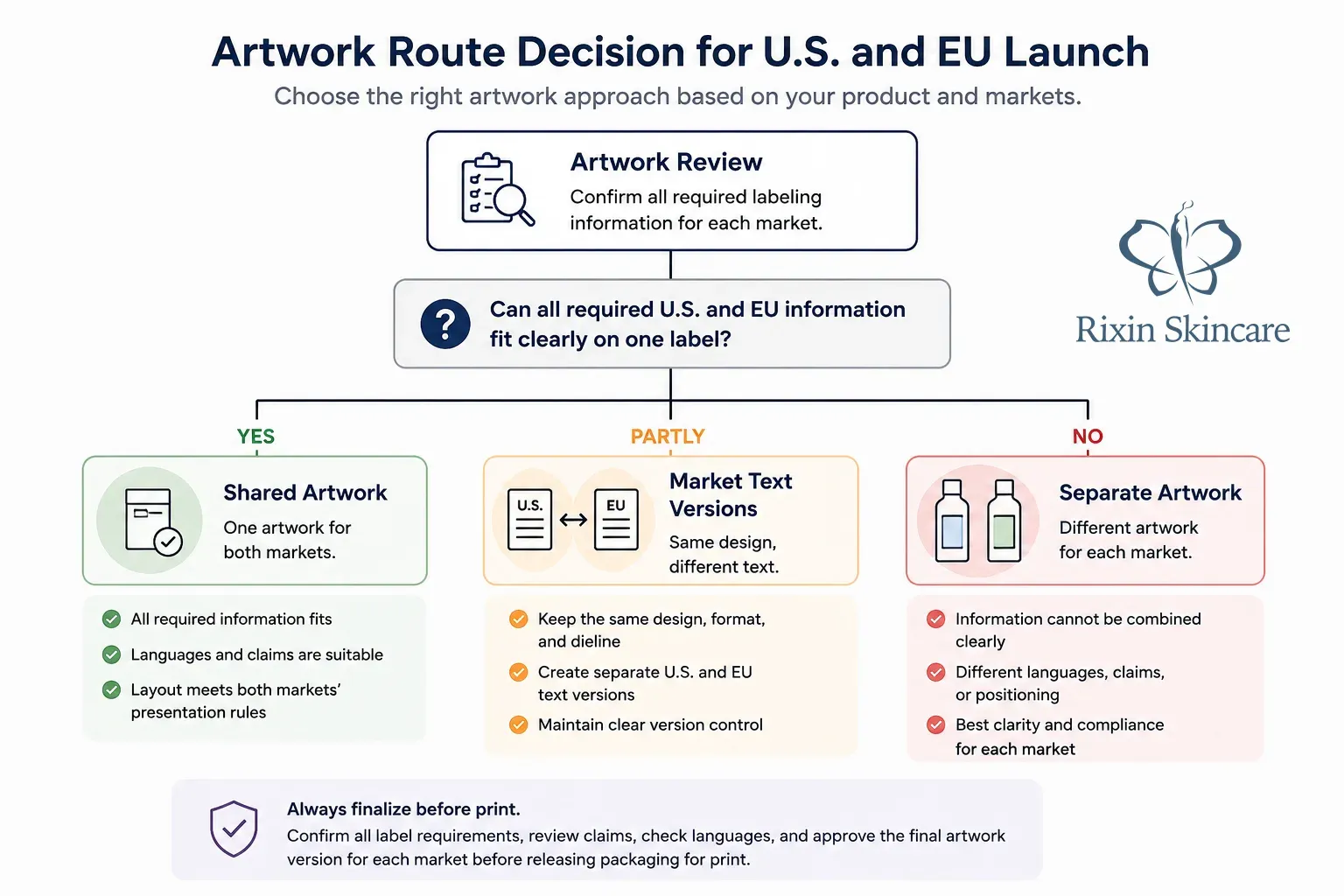
One shared artwork file
One identical file may be possible when required information for both markets can be shown correctly, intended EU languages fit, claims are suitable for both markets, and the layout remains readable.
Do not choose this approach only to avoid maintaining a second file.
Same visual design with separate market text
This is often different from one identical artwork file.
A brand can keep the same bottle, carton, dieline, logo, color system, and front-panel design while controlling separate U.S. and EU files for required text.
For example, a moisturizer can retain the same visual design while the U.S. carton uses the applicable U.S. business and adverse-event contact information and the EU carton uses Responsible Person details, country of origin, durability information, and required Member State languages.
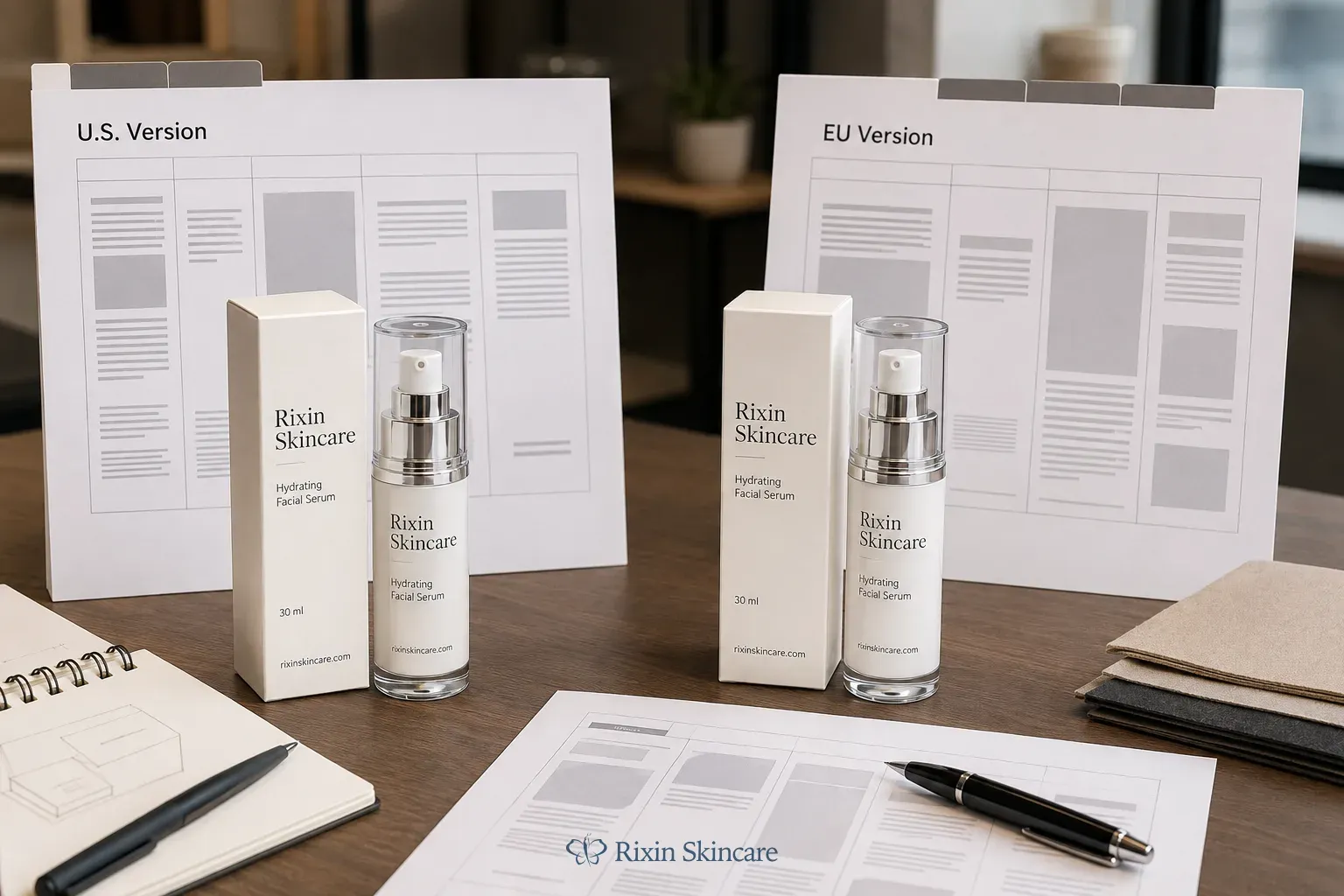
This approach preserves visual consistency but can add translation, proofing, SKU, purchasing, and version-control work.
Separate market artwork
Separate artwork may be cleaner when required information does not fit clearly, claims differ, multilingual EU text needs substantially more space, or one version follows a different regulatory category.
Do not force one artwork version if required information becomes unreadable, incomplete, or difficult to control.
Once the required information is confirmed, packaging and label design can handle artwork adaptation and production coordination. Artwork adaptation is not regulatory approval.
Check Claims Before Print Release
Claims should be reviewed before they become final packaging copy.
In the U.S., claims can affect intended use and whether a product remains a cosmetic or also falls under drug requirements. FDA also prohibits false or misleading cosmetic labeling. See the FDA Cosmetics Labeling Regulations.
In the EU, Article 20 prohibits labeling, marketing, and advertising from implying characteristics or functions a cosmetic does not have. Commission Regulation (EU) No 655/2013 adds common criteria for cosmetic claims, including truthfulness and evidential support. See the EU claims regulation.
The brand should define the claims, the brand’s regulatory or qualified labeling reviewer should confirm the regulatory and evidence implications, and the packaging team should use only approved wording.
Complete an Artwork-Readiness Check
Use this as a project-control gate. Some items are legal label requirements; others are internal controls designed to stop the wrong formula, translation, or artwork version from reaching production.
| Check | Primary owner | Status |
|---|---|---|
| Markets and EU countries confirmed | Brand | Confirmed / Open |
| Correct formula version linked | Brand + Manufacturer | Confirmed / Open |
| Product identity and claims approved | Brand + Regulatory reviewer | Confirmed / Open |
| U.S. business and MoCRA contact confirmed | Brand / U.S. responsible person | Confirmed / Open |
| EU Responsible Person details confirmed | Brand / EU Responsible Person | Confirmed / Open |
| Origin and import-marking treatment reviewed | Regulatory / Import reviewer | Confirmed / Open |
| Quantity and durability fields reviewed | Regulatory / Labeling reviewer | Confirmed / Open |
| Ingredient declaration matches formula and market | Manufacturer + Regulatory reviewer | Confirmed / Open |
| Warnings / precautions confirmed | Regulatory reviewer | Confirmed / Open |
| EU languages and translations approved | Brand + Translation / Regulatory reviewer | Confirmed / Open |
| Final regulatory text proof approved | Regulatory / Labeling reviewer | Confirmed / Open |
| Correct controlled artwork file released to print | Brand + Packaging team | Confirmed / Open |
For multilingual EU artwork, approve translations and final proofs before packaging production starts. File names, revision numbers, market designations, and approval records should clearly distinguish the current U.S. and EU versions.
If the formula, claims, Responsible Person, U.S. contact information, countries of sale, translations, or package dimensions change, reopen the affected artwork review.
The same skincare formula can support both markets and still require different controlled artwork files. Decide what each market requires first, then choose the simplest artwork structure that keeps the information readable, reviewable, version-controlled, and appropriate for the intended market.