On this page
A finished skincare formula and package do not automatically make a product ready for the European Union. Before launch, confirm who will act as the EU Responsible Person, how the safety assessment and Cosmetic Product Safety Report (CPSR) will be prepared, who will maintain the Product Information File (PIF), who will submit the Cosmetic Product Notification Portal (CPNP) notification, and whether the final formula, claims, and label are ready for the intended EU markets.
These are connected project decisions, not one “EU registration” task. Use this guide as a buyer-level planning framework and internal readiness gate, not as legal clearance or regulatory approval. For the broader project sequence and owner handoffs, use the U.S. and EU skincare market-entry readiness guide. When formula and artwork decisions are connected, continue to Can One Skincare Formula Work in the U.S. and EU? and U.S. vs EU Cosmetic Labeling.
Prepare the EU Project Before Requesting a Quote
Give the manufacturer enough market information to identify regulatory and technical questions before formula and artwork approval. State the product type, whether you are starting from a private-label base or requesting custom formulation, intended claims, target EU countries, packaging direction, and known documentation needs.
Quantity, timing, and sample expectations also belong in the project brief, although they are commercial inputs rather than EU regulatory requirements. Keep those details in the project requirements.
For example, a non-EU brand planning a private-label serum should not wait until artwork approval to decide who will be the Responsible Person or which languages the final label may need.
Identify the EU Responsible Person Early
Under Regulation (EC) No 1223/2009, a cosmetic product may be placed on the EU market only when a Responsible Person is designated. In practical terms, this is an individual or company established in the EU that takes the regulatory responsibility assigned to the Responsible Person under the Cosmetics Regulation.
For an imported cosmetic product, each importer is the Responsible Person for the specific product it places on the market unless the importer designates another EU-established person by written mandate and that person accepts the role in writing. The current consolidated EU Cosmetics Regulation sets out this structure in Article 4.
For brands buying from a manufacturer outside the EU, the overseas contract manufacturer should not automatically be treated as the EU Responsible Person. Before final formula or artwork approval, record:
- who will act as the Responsible Person;
- whether the importer will hold that role or designate another eligible person;
- which product information the Responsible Person will need from the brand and manufacturer.
The practical buyer question is not simply “Do we have an EU contact?” It is who holds the Responsible Person role for this product, and is that person receiving the information needed to perform it?
Understand How the Safety Assessment, CPSR, and PIF Fit Together
The safety assessment, CPSR, and PIF are related, but they are not interchangeable.
Before a cosmetic product is placed on the EU market, the Responsible Person must ensure that the product has undergone a safety assessment and that a CPSR is prepared in accordance with Annex I of the Cosmetics Regulation. The safety assessment in Part B must be carried out by a qualified safety assessor. The European Commission’s CPSR guidance explains the framework in more detail.
A CPSR should not be confused with a factory test report. Preparing the safety assessment can require information about the finished formula, raw materials, product exposure, specifications, microbiological quality, stability, packaging, and other relevant safety information. The exact evidence depends on the product.
The PIF is broader. The Responsible Person must keep it readily accessible, and it includes the CPSR plus other required product information. At a high level, that includes a product description, the manufacturing method and a statement on GMP compliance, evidence supporting claimed effects where justified, and specified information on animal testing. The PIF must be updated when necessary and kept for ten years after the last batch is placed on the market.
A useful mental model is:
safety information → safety assessment → CPSR → CPSR forms part of the PIF
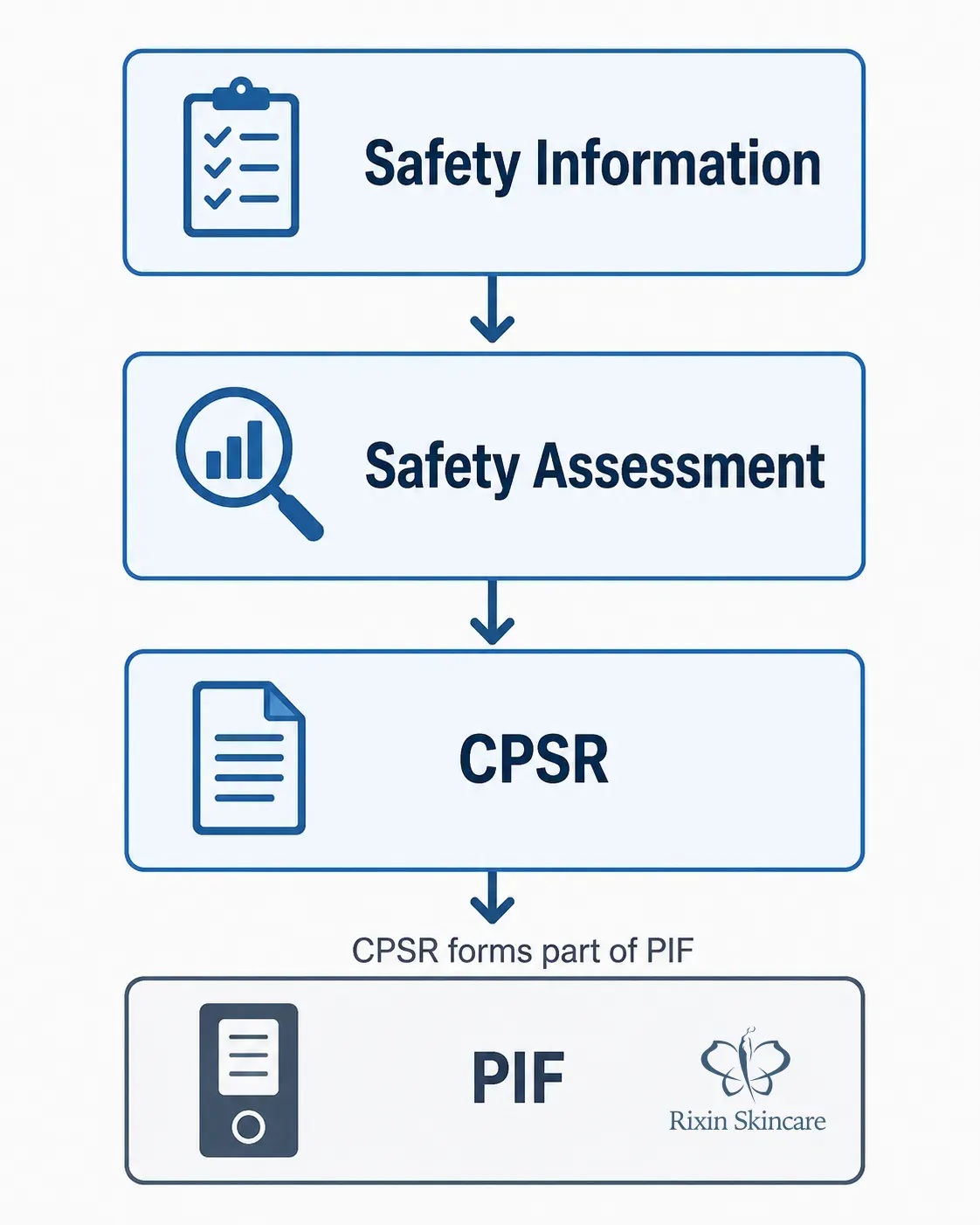
The manufacturer supplies agreed technical and product information. The qualified safety assessor performs the safety assessment required for Part B of the CPSR. The Responsible Person ensures the required safety assessment and CPSR are in place and keeps the PIF accessible and current.
This is why “we have test reports,” “we have a CPSR,” and “we have a PIF” do not mean the same thing. For project-level support, use quality, testing, and documentation rather than treating this article as a universal PIF or testing checklist.
Understand the Role of CPNP Notification
The Cosmetic Product Notification Portal is the European Commission’s online notification system for cosmetics. Under Article 13, the Responsible Person must submit specified product information electronically before the product is placed on the market.
The European Commission’s CPNP information page states that once a product has been notified through CPNP, no further notification is required at national level within the EU for that notification.
CPNP notification is not EU product approval. It should not be described as an approval certificate or as evidence that an EU authority has approved the cosmetic.
For the buyer, clarify who will submit the notification and which formula, label, Responsible Person, country-of-origin, and other required product details must be confirmed. If relevant information changes later, the Responsible Person should determine what CPNP information needs updating.
Certain products or materials can have additional requirements. The Commission, for example, identifies a separate Article 16 CPNP module for certain cosmetics containing nanomaterials. Those cases should be reviewed separately.
Review Formula, Claims, and Label Details Before Final Approval
EU cosmetic requirements can affect the formula, claims, and label. Review them before packaging is printed.
For the formula, confirm that the selected ingredients and intended product use are suitable for the EU market before formula lock. Ingredient restrictions and other product-specific questions may require review, but detailed ingredient analysis belongs in the relevant ingredient and formula development work.
For claims, Commission Regulation (EU) No 655/2013 requires cosmetic claims to follow common criteria including truthfulness and evidential support. The official claims regulation also makes clear that ingredient properties should not be presented as finished-product properties without adequate support.
For the label, Article 19 covers information such as the Responsible Person name and address, country of origin for imported products, nominal content, durability or period-after-opening information where applicable, precautions, batch identification, product function, and ingredient declaration, among other requirements. Some information must appear in languages determined by the Member State where the product is made available, so an English-only label should not automatically be assumed suitable across the EU.
This is not a complete EU labeling checklist. Once the requirements are confirmed, packaging and label design can address artwork and production coordination.
Identify What Information Is Needed From the Manufacturer
A brand, Responsible Person, safety assessor, and manufacturer may each hold different parts of the information needed before EU market placement.
Depending on the product, the manufacturer may need to provide or confirm:
- the exact finished formula and current product version;
- relevant raw-material and supplier information;
- product specifications;
- manufacturing-method and relevant GMP information;
- available safety, testing, or technical documentation;
- packaging information;
- changes made after samples, specifications, claims, or artwork were reviewed.
The European Commission’s CPSR guidance explains that obtaining reliable safety information may require input from the manufacturer, raw-material suppliers, safety assessor, and other technical experts.
The key distinction is simple: legal responsibility and information supply are not the same thing. A manufacturer may provide technical information used by the Responsible Person or safety assessor without becoming the legal owner of that party’s obligation.

Version control also matters. If the formula, raw material, concentration, packaging component, claim, or label changes after an earlier review, record the change and ask the appropriate reviewer whether the CPSR, PIF, label, or notification needs reassessment or updating.
A practical handoff should identify each item as confirmed, available with limits, or still required—and identify who owns the next action.
Use a Six-Point EU Market-Readiness Check
Use this as an internal project decision tool only. Passing the checklist does not mean that a product has received EU approval, does not replace a qualified safety assessment, and does not establish legal clearance for market placement.
- Has the EU Responsible Person structure been identified?
- Is the safety-assessment and CPSR path defined for the finished product?
- Is the Responsible Person prepared to maintain the PIF, and are supporting-information gaps identified?
- Is responsibility for CPNP notification clear?
- Have EU formula, claim, and label questions been reviewed before final approval?
- Is the manufacturer-side information needed by the brand, Responsible Person, or safety assessor identified and current?
If these areas have clear owners and no unresolved issue is likely to change the product or its market-facing information, the project may continue under its internal plan, subject to any required regulatory review.
If open items are known, assigned, and tracked, development may continue where appropriate while they are resolved. If an unresolved issue could change the formula, claims, label, packaging, documentation, or manufacturing direction, hold the affected approval until the appropriate reviewer has assessed it.
EU cosmetic market readiness is not one CPNP filing, one CPSR, or one PIF. It is coordinated preparation across the Responsible Person, safety assessment, product information, notification, market-facing requirements, and manufacturer information needed before the product is placed on the EU market.