On this page
Choosing between one hero product and a broader skincare line affects more than branding. It changes how much manufacturing work, packaging coordination, approval effort, and inventory your team must plan for.
A hero-product launch concentrates the first project on one product, or SKU, with a clear commercial role. A full line spreads the launch across several products that work together as a broader assortment. Between those two is a third option that is often useful: a focused routine with a small group of products that have distinct roles.
There is no universal best choice.
The better question is:
Which launch shape gives your customer a clear offer while keeping the first manufacturing scope realistic for your budget, quantities, packaging, approvals, and operating capacity?
As a practical rule, start with a hero product when one SKU can carry the offer clearly. Choose a focused routine when several complementary products are needed to deliver the intended customer experience. Choose a broader line when the proposition genuinely depends on a coordinated multi-SKU assortment and the business can support the added manufacturing and operating scope.
If you are still defining the overall product architecture, start with How to Plan a Skincare Product Line for Manufacturing. This guide focuses on one narrower decision: how much of that line should actually enter the first launch.
1. What Is a Hero-Product Launch?
A hero-product launch puts one SKU at the center of the first manufacturing project.
That product carries most of the initial product story, customer attention, launch education, and inventory commitment. It may later become the anchor for a larger range, but the first commercial scope stays concentrated.
A hero product does not have to be a serum, moisturizer, or any specific format. Its role comes from the business and product concept, not from the container.
A strong hero-product candidate usually has:
- a clear reason for existing;
- a product format customers can understand without a large supporting range;
- a formula and packaging direction that can stand on their own;
- enough commercial importance to justify focused sampling, artwork, inventory, and launch work; and
- a logical path for later line extensions if the brand wants to expand.
For example, a brand may begin with one serum because that format expresses the core concept clearly. Another brand may begin with a moisturizer, cleanser, mask, or sunscreen-oriented project because that product is the clearest first offer.
The decision is not “Which category is most popular?” It is “Which product can carry the first launch without needing several other SKUs to make the offer understandable?”
2. What Does a Full Skincare Line Mean?
A full skincare line is a broader first-launch assortment in which several products are intentionally developed, packaged, approved, and launched as one connected range.
“Full line” should not be defined by one fixed SKU count. The important difference is that several SKUs are being coordinated as one first-launch scope rather than treated as separate future extensions.
A broader line may include several routine steps, several product formats, or several products built around one commercial concept. The customer is expected to understand the collection as more than a single-product offer. Some products or launch activities may also depend on one another, but that dependency is something to manage rather than a universal definition of a full line.
That changes the project.
Instead of asking only whether one formula and package are ready, the team must also ask:
- Does every SKU have a distinct role?
- Do the products work together as one routine or assortment?
- Can packaging be coordinated without forcing unsuitable components?
- Can quantities be supported across all planned SKUs?
- Can samples, artwork, approvals, testing, and documentation be managed across the range?
- Can the business carry the resulting inventory and launch workload?
A broader line can create a stronger assortment when the concept genuinely depends on multiple products. It can also create unnecessary manufacturing complexity when products are added only because the brand wants the launch to “look complete.”
3. The Middle Option: A Focused Routine
The decision is not limited to one product or a large collection.
A focused routine sits between those extremes.
Instead of launching every planned format, the brand selects a small group of products with clear complementary roles. A cleanser, treatment product, and moisturizer could form one focused routine. Another project might use a serum and moisturizer, or another compact combination that makes sense for the intended customer.
The important point is not the number. It is the relationship between the products.
A focused routine can make sense when:
- one product alone would not express the intended customer experience;
- several products have genuinely different roles;
- the team wants a coordinated line without carrying every future extension in phase one; and
- the manufacturing and packaging scope remains manageable.
This approach also creates a natural expansion path. Products that are useful but not essential can remain in the roadmap instead of being forced into the first production scope.
4. When Starting With One Hero Product Makes More Sense
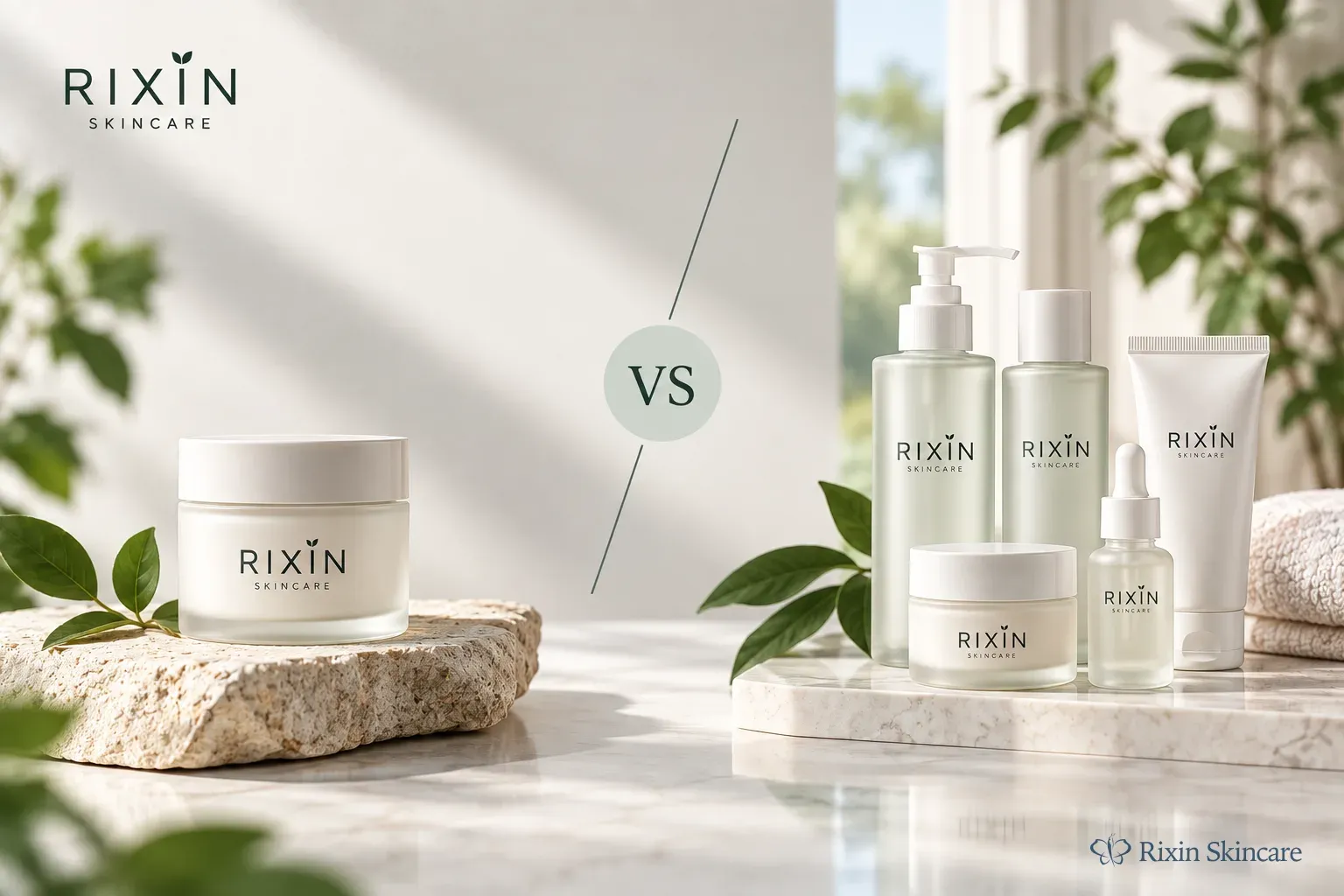
A hero-product launch is often easier to justify when the product concept is already strong enough on its own.
That can be especially relevant when the business is still learning about its customer, channel, packaging preferences, or demand pattern.
From a manufacturing-planning perspective, concentrating on one SKU can reduce the number of parallel decisions the team must manage.
The project still requires serious work. One SKU can still involve custom formulation, package compatibility, component sourcing, artwork, samples, testing, documentation, and market review. “One product” does not mean “simple.”
It does mean those decisions are concentrated in one product rather than repeated across several.
A hero-first approach may be worth considering when:
The core product story is already clear.
Customers can understand the offer without needing several products to explain it.
The business wants a narrower first inventory commitment.
The team would rather learn from one commercial product before expanding the assortment.
Packaging development needs focused attention.
One primary package system can be reviewed before the brand coordinates several containers, cartons, pumps, caps, or decoration specifications.
The formula requires deeper development.
If a formula needs deeper development, keep the first launch focused. This avoids managing several formula projects at once.
The next products are obvious extensions, not launch necessities.
The roadmap can remain broad while the first manufacturing project stays narrow.
If the project is considering whether an existing formula route or deeper development is more appropriate, compare Private Label Skincare with Custom Formulation & OEM.
5. When a Broader Line Makes More Sense
A broader launch can be justified when the commercial concept genuinely depends on an assortment rather than one anchor product.
For example, the customer may be buying a routine, a coordinated regimen, a retailer-ready collection, or a set in which several products have distinct roles.
In that situation, reducing the launch to one product may weaken the offer rather than simplify it.
A broader first line may make more sense when:
The customer proposition depends on multiple routine steps.
Customers are meant to use the products together. Removing most of them could change the offer.
Different SKUs serve clearly different purposes.
The line is not built from near-duplicate products added only for shelf presence.
The team can support parallel development and approvals.
More products mean more items to review, approve, track, order, and launch.
The quantity plan is realistic across the range.
The business has considered how product-level and packaging-level minimums may affect each SKU.
The packaging system has been planned at both SKU and line level.
Each package must suit its own formula while still contributing to a coherent family.
The business is prepared for broader inventory exposure.
More SKUs can create more inventory positions and more demand variability.
If the project is already committed to a coordinated multi-product range, Private Label Skincare Sets and Product Line Manufacturing covers the commercial manufacturing scope for multi-SKU projects.
6. Compare the Three Launch Shapes
The most useful comparison is not “small versus large.” It is how each launch shape changes the decisions your team must manage.
| Launch shape | Main advantage | Main planning challenge | Best fit when |
|---|---|---|---|
| Hero product | Concentrates the first project around one clear offer | The single product must carry enough commercial value on its own | One product can express the concept clearly and the team wants a focused first scope |
| Focused routine | Gives the customer a connected experience without launching every future SKU | Each product still needs a distinct role and coordinated development | Several products are needed for the intended routine, but a broad collection is not essential |
| Broader line | Creates a wider assortment from launch | More formulas, packages, approvals, inventory positions, and dependencies must be managed together | The commercial offer genuinely depends on multiple products and the team can support the larger scope |
This table is a planning tool, not a rule.
A hero-product launch can still be technically demanding. A broader line can still be efficient when the products, packaging, quantities, and approvals are well defined.
The decision depends on whether the added SKUs create enough customer and commercial value to justify the added project scope.
7. How SKU Count Changes Manufacturing Complexity
Every added SKU introduces another object that must be defined, reviewed, approved, produced, packed, and carried through the launch.
Some work may be shared across the project. Other work repeats at SKU level.
That can include:
- formula review or development;
- batch planning;
- primary packaging;
- component sourcing;
- carton or label artwork;
- samples;
- compatibility questions;
- testing or documentation review;
- approvals;
- production scheduling; and
- inventory.
This is why the decision should not be framed as “more products cost more” and stop there. The important question is which parts of the project repeat, which can be shared, and which create new supplier or production constraints.
For the detailed cost and quotation implications, use How SKU Count Affects a Skincare Manufacturing Budget. That article owns the deeper budget mechanism; the decision here is whether those additional SKUs are important enough to belong in phase one.
8. Packaging Can Change the Decision
A product-line concept may look simple until packaging is added.
One hero product may require one primary packaging system, one artwork path, and one set of component decisions.
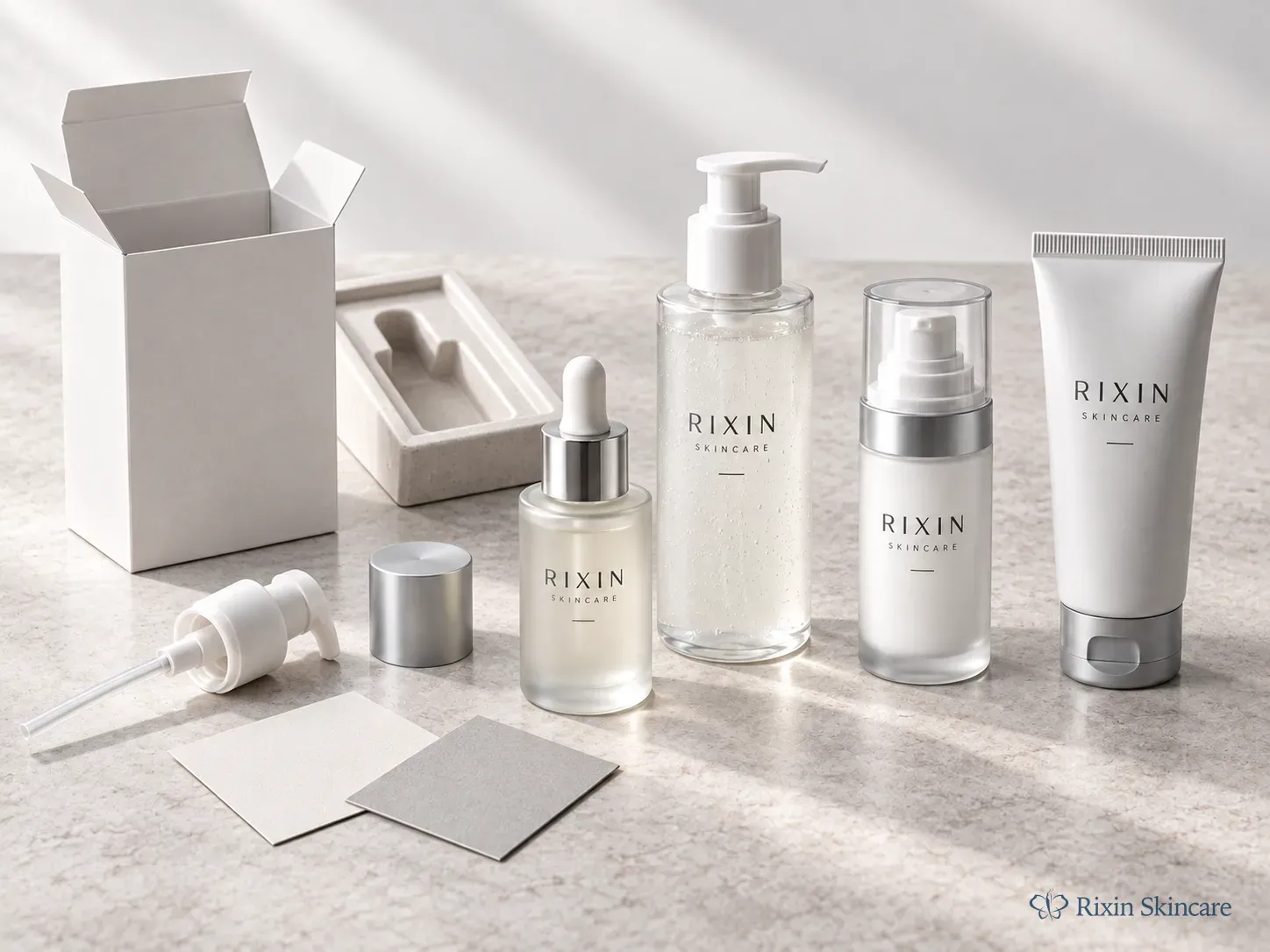
A broader line may involve a dropper bottle, airless pump, cleanser pump, tube, jar, carton, label, cap, insert, or other components across different products. Even when the visual design is coordinated, those components may come from different suppliers or have different minimums, lead times, decoration methods, or compatibility requirements.
That is why packaging should be evaluated in two layers:
- Product fit: Does the component work for this formula and dispensing need?
- Line fit: Do the packages still feel like one family when placed together?
A visually consistent line is useful. But visual consistency should not force a technically unsuitable package onto one SKU.
Review Packaging and Label Design when package structure, decoration, labels, cartons, or set-level presentation are material to the launch decision.
9. MOQ and Inventory Exposure Can Operate at SKU or Component Level
Minimum order quantity (MOQ) and packaging constraints may apply by SKU or component, even when the brand treats the launch as one project.
That means a broader line can create several quantity questions at once.
You may need to consider:
- expected finished-goods quantity for each SKU;
- whether different products use different packaging suppliers or components;
- whether decoration or cartons have separate minimums;
- how inventory will be allocated across faster- and slower-moving products; and
- whether the business is comfortable carrying several finished-goods positions at the same time.
This does not mean a broader line should be avoided. It means total launch volume alone is not enough to judge feasibility.
For current project-specific rules, use MOQ and Lead Time rather than assuming one universal minimum applies to every product or component.
10. Review and Approval Workload Increases With Assortment Complexity
A multi-SKU line also expands the review workload.
Each product may have its own formula sample, packaging sample, artwork file, component decision, testing question, or approval status.
The risk is not only that the project contains more work. The risk is that one unresolved SKU can hold up a coordinated launch if the team expects every product to be ready at the same time.
A useful question is:
If one product needs another sample or packaging revision, does the whole launch need to wait?
If the answer is yes, the line has a dependency that should be visible in the planning stage.
A phased approach can sometimes reduce that dependency. The brand can preserve the broader line vision while deciding which products truly need to launch together.
See Sampling and Formula Approval for the deeper approval path.
11. Use a Decision Framework Instead of a Universal SKU Rule
Use the three-way comparison above to choose a launch shape, then apply one go / defer check to each proposed SKU:
- Needed now? Does this product deliver a distinct part of the first customer offer, or can the offer still work without it?
- Ready to scope? Is its formula and packaging direction clear enough for a manufacturer to assess, with critical sample and approval questions identified?
- Able to launch? Can the brand support the product-specific quantities, inventory, approval workload, and any dependencies on other SKUs?
Keep in phase one when the SKU has a necessary role and a workable route to the next project gate. Defer it when its role is optional or key requirements remain unresolved. If the proposition depends on two products being used together, assess them as a focused routine rather than forcing a one-SKU answer.
There is no universal SKU threshold. Record the reason for each keep-or-defer decision before asking for detailed quotations.
12. A Phased Launch Does Not Mean Abandoning the Full Line
One of the most useful planning distinctions is between product-line vision and first production scope.
Your product-line vision can include a broad routine, multiple formats, future sizes, variants, or seasonal extensions.
The first manufacturing project does not need to contain all of them.
For example:
Phase one: Launch the hero product or focused routine that establishes the core offer.
Later phase: Add products that extend the routine, create new use cases, or broaden the assortment after the first launch is operational.
This lets the team preserve strategic direction without turning every idea into an immediate formula, packaging, approval, and inventory commitment.
It also gives later products a clearer brief because the brand has more information about how the first launch is being sold, used, and managed.
13. Decide the Launch Shape Before Requesting a Detailed Quote
A manufacturer can review whether the project is feasible, along with the formula route, packaging, samples, and production needs. Give the manufacturer a clear picture of what belongs in the first launch.
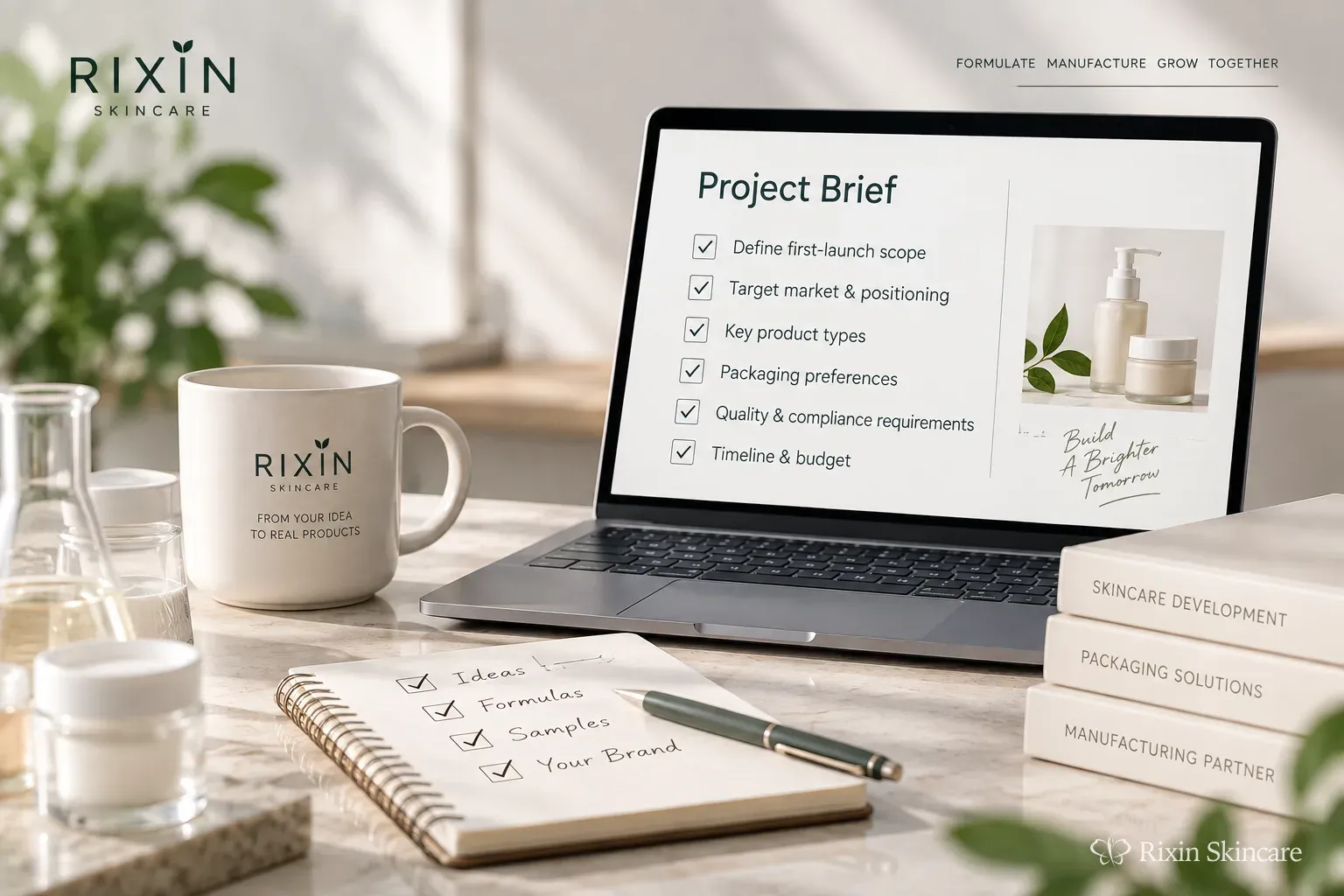
Before requesting a detailed review, send:
- the selected launch shape and phase-one SKU list, with a one-line role for each product;
- target market and planned quantity per SKU;
- formula and packaging direction, including questions still open for manufacturer review;
- the products intentionally deferred; and
- critical sampling, approval, inventory, or timing dependencies.
Use Project Requirements for the fuller inquiry checklist.
14. Hero Product or Full Line: The Practical Decision
Choose the smallest first-launch scope that still delivers the intended customer offer. That may be one hero product, a focused routine, or a broader line. The deciding factors are the distinct roles of the SKUs and whether the brand can support their manufacturing, approval, packaging, and inventory needs.
Document which products launch now, which are deferred, and which open requirements the manufacturer needs to assess.
Once that scope is defined, the next step is to test whether the formulas, packaging, quantities, approvals, and manufacturing plan support it. For multi-SKU projects, review Private Label Skincare Sets and Product Line Manufacturing. When the scope is ready for manufacturer review, request a proposal with the confirmed decisions and open questions.