On this page
A skincare product line should be planned as a connected manufacturing project, not as a list of products that happen to share a brand name.
Before requesting samples or a quote, define who the line is for, what the first launch needs to accomplish, which products have a clear role, and what still needs to be confirmed. Then map each planned SKU to a development route, packaging direction, quantity, target market, approval needs, and launch timing.
The goal is not to create the largest possible range. It is to create a first-launch scope that a manufacturer can review clearly and that your team can support operationally.
A useful planning sequence is:
Customer and market → product roles → first-launch assortment → formula route → packaging system → quantity and feasibility → approvals → manufacturer brief
This guide explains that sequence from a manufacturing-planning perspective. It does not cover company formation, branding exercises, e-commerce setup, fundraising, or general marketing strategy.
1. Start With the Line Goal, Customer, and Target Market
Product selection is easier when the line has a defined job.
Start by writing down three things:
- who the products are for;
- what routine, concern, use case, or commercial need the line is meant to address; and
- where the products are intended to be sold.
A first-time brand launch, an extension for an existing brand, a retailer-exclusive range, a professional-use collection, and an ingredient-led concept can all produce very different product decisions.
The target market matters early because formula review, packaging, artwork, testing, documentation, and claim wording may depend on where the products will be sold. You do not need to solve every market requirement before product planning begins, but you should avoid treating market selection as a last-minute label change.
A practical starting statement can be simple:
We are planning a first-launch skincare range for [customer type] in [target market], built around [main routine, concern, or product concept].
That sentence gives the rest of the line a reason to exist.
2. Give Each Planned Product a Clear Role
A product should not enter the first launch only because the manufacturer can make it.
At planning level, it helps to separate products into three roles:
Anchor or hero product. The product that most clearly expresses the line concept or gives the launch a focal point.
Routine-support product. A product that makes the intended routine more complete or supports how the anchor product is used.
Later extension. A product that fits the brand but does not need to be in the first manufacturing scope.
Not every brand needs one single hero product, and not every routine needs multiple products. The value of this framework is simply to force one question for every planned SKU:
What does this product add that the first launch actually needs?
If that answer is weak, the SKU may belong in a later phase rather than the first order.
If you are weighing one hero product against a broader first launch, compare the hero-product versus full-line decision guide before fixing the assortment.
3. Build the First-Launch Assortment Around Roles, Not Catalog Availability
Once the product roles are clear, decide which formats actually belong together.
A cleanser, serum, moisturizer, and mask may all fit the same brand concept, but that does not mean all four must launch at once. Evaluate each format against the customer routine, the core product story, and the operational complexity it adds.
For example, a serum may be the main product if the concept calls for a focused leave-on step. A moisturizer may be more important when the routine needs a daily support step. A mask may make sense as a complementary format but may not be essential to the first launch.
If you are still evaluating format options, compare the manufacturing considerations for facial serums, moisturizers, and facial masks. Then decide whether each format serves a clear purpose in the first launch.
Avoid choosing a universal number of SKUs. A smaller launch is not automatically better, and a larger line is not automatically more credible. What matters is whether each SKU has a clear role and whether the combined scope is realistic for your budget, quantities, approvals, packaging, and launch plan.
4. Decide What Must Be Fixed Now, What a Manufacturer Must Confirm, and What Can Wait
A useful way to control the project is to separate decisions into three buckets.
| Decision status | What it means | Typical examples |
|---|---|---|
| Decide now | The brand should define this before serious manufacturing review | target customer, target market, first-launch concept, tentative SKU list, quantity direction |
| Confirm with manufacturer | The decision depends on formula, packaging, supplier, production, testing, or market feasibility | formula route, package compatibility, component minimums, sampling scope, testing or documentation needs |
| Defer to later launch | The idea can stay in the roadmap without increasing the first manufacturing scope | secondary formats, extra sizes, additional variants, nonessential line extensions |
This prevents two common planning problems: sending a manufacturer a vague concept with no usable scope, or trying to finalize technical details that require manufacturer and supplier review.
The first launch should contain enough decisions to be reviewable, while leaving project-dependent items clearly marked for confirmation.
5. Use an Ingredient Story Carefully Across Multiple SKUs
Some product lines begin with an ingredient concept. That can help create a coherent range, but it should not force every SKU into the same formula logic.
A shared ingredient story does not automatically mean:
- the same material level belongs in every product;
- the same supplier material is suitable for every format;
- the same claim wording can be used across the line;
- the same stability, compatibility, processing, or packaging considerations apply to every SKU.
Treat the ingredient as one part of the product-line architecture, then review each formula separately.
If the ingredient choice is central to the project, use the Ingredients Hub and the relevant ingredient page to review material-specific questions. Keep ingredient identity, source, formulation constraints, and claim evidence on those specialist pages rather than turning the product-line plan into an ingredient-science article.
For a PDRN-led assortment, see How to Build a PDRN Skincare Line for format and first-launch decisions.
6. Choose the Development Route for Each SKU
A multi-product line does not have to force every SKU through the same development route.
Some products may fit an existing formula direction with limited adjustment. Others may need deeper formula work because of the target texture, ingredient requirements, performance direction, packaging, or market-specific constraints.
At a high level:
- Private Label Skincare is the route to review when an existing formula direction may fit the project.
- Custom Formulation & OEM is the route to review when the formula needs deeper development around the project brief.
- Formula Development provides more context on the development work behind a custom direction.
Do not decide the route only from the number of SKUs. Two products in the same line may have different development needs, and those needs should be identified in the project scope rather than hidden under one label.
7. Plan Packaging as a System, Not as a Final Decoration Step
Packaging decisions affect more than appearance.
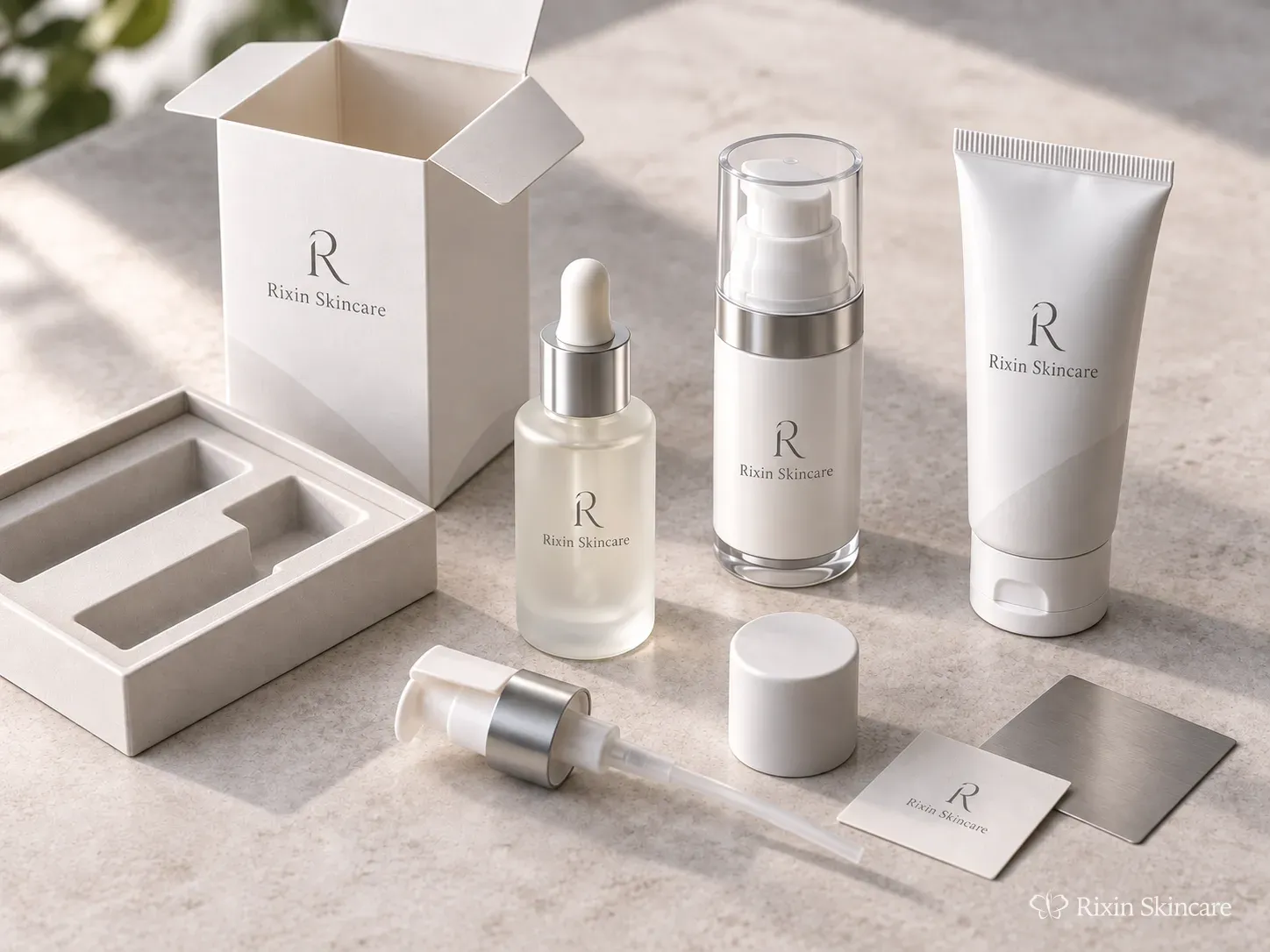
For each SKU, the package needs to be reviewed in relation to the formula, dispensing method, fill size, component availability, artwork, decoration, filling requirements, and target market. Across the line, the packages also need enough visual consistency to feel related without forcing every product into the same container.
A useful packaging review asks two questions at the same time:
- Does this package work for this individual product?
- Does the collection still make sense as one range?
Those are different questions. A coordinated visual system cannot compensate for a package that is unsuitable for the formula or production process.
If cartons, labels, pumps, caps, decoration, or set-level presentation are part of the project, include them early enough for supplier and production requirements to be reviewed. See Packaging and Label Design for packaging-specific planning.
8. Check Whether the First-Launch Line Is Manufacturable
The assortment may look coherent from a brand perspective and still need to be simplified for manufacturing.
Each additional SKU can introduce its own combination of:
- formula or batch requirements;
- quantity allocation;
- packaging components and supplier minimums;
- artwork and approvals;
- samples and package review;
- testing or documentation questions;
- inventory and production scheduling;
- unresolved items that can delay quotation or approval.
The important point is not that “more SKUs are bad.” It is that every added SKU should be reviewed on the same manufacturing basis.
For a more detailed budget review, see How SKU Count Affects a Skincare Manufacturing Budget. It explains how shared work, packaging minimums, approvals, inventory, and quotation scope change as SKUs are added.
For exact current project rules, keep MOQ and timing questions on MOQ and Lead Time. MOQ should not be treated only as one total-project number; product and packaging requirements may need to be reviewed per SKU or component.
Sampling is another separate layer. A planned line may need formula samples, packaging review, artwork approval, or other checks before production. See Sampling and Formula Approval for the approval path.
Testing and documentation also depend on the product, claims, packaging, target market, and project scope. Use Quality, Testing and Documentation for that deeper review rather than assuming one requirement applies to every SKU.
9. Sequence the Launch Instead of Forcing Every Idea Into Phase One
Apply the three-bucket framework to the launch schedule by keeping a later-extension list alongside the first-launch list. This preserves the broader product vision without turning every possible idea into an immediate packaging, approval, inventory, and production commitment.
A product is a reasonable candidate for phase one when:
- it has a clear role in the customer routine or product concept;
- its formula and packaging direction are defined enough for review;
- the expected quantity is realistic for the project;
- the team can support the associated approvals, inventory, and launch work; and
- delaying it would materially weaken the first-launch offer.
This is not a rule to launch fewer products. It is a way to separate strategic fit from launch timing.
10. Turn the Product-Line Plan Into a Manufacturer-Ready Brief
When the first-launch assortment is reasonably defined, convert it into one project brief.
For a more useful initial manufacturing review, put the information you already know in one place and mark project-dependent items as open. The brief can include:
- the tentative product and SKU list;
- the target market;
- the role of each planned product;
- whether each formula is existing, adaptable, custom, or still undecided;
- important ingredient requirements, where relevant;
- the packaging status or preferred direction;
- expected quantity per SKU;
- known testing or documentation needs, if already identified;
- the desired launch timing, if known; and
- open items that still need manufacturer review.
Do not hide uncertainty. Mark undecided items clearly rather than filling the brief with assumptions.
The full inquiry checklist belongs on Project Requirements. Use it before requesting a detailed review or quotation so the manufacturer can distinguish confirmed scope from open questions.
11. Move From Planning to Commercial Review
Once you can explain the first-launch assortment, quantity direction, target market, and what is known or still open about formula route and packaging, the project is ready for a more useful manufacturing discussion.
If you are planning several related products, a coordinated routine, or a set, review Private Label Skincare Sets and Product Line Manufacturing to see how Rixin approaches multi-SKU project scope.
The key transition is from an internal product idea to a reviewable project scope, not one fixed manufacturing sequence:
Product idea → defined first-launch line → manufacturer review → project requirements refined and confirmed → production preparation
Sampling, packaging review, testing, documentation, and approvals may be refined at different points as the project scope is reviewed.
A manufacturer can help test whether the proposed range is practical, but the strongest starting point is a clear buyer-side plan: what each product is for, what belongs in phase one, what remains open, and what can wait.
When those decisions are ready, request a proposal with the project information you already have.