On this page
A skincare routine does not need completely different ingredients in every product.
Some overlap is normal.
A toner, serum, and moisturizer may share humectants, emollients, supporting ingredients, or even part of the same broader ingredient story.
The problem begins when several SKUs start to feel interchangeable.
If every product highlights the same ingredients, repeats the same benefits, occupies a similar position in the routine, and tells essentially the same story, customers may struggle to understand why the complete system needs multiple products.
For a skincare brand, the useful question is therefore not:
How do we eliminate ingredient overlap?
It is:
How do we decide which ingredients should repeat across the system and which ingredient roles should remain distinct enough to justify each SKU?
That is one part of the broader product-system planning process described in How to Plan a Skincare Routine as a Product System.
Here, the focus is specifically on ingredient overlap, ingredient roles, positioning, and differentiation across multiple products.
Ingredient Overlap Is Not Automatically a Problem
When the same ingredient appears in more than one SKU, that does not automatically mean the product system is poorly designed.
Several products may reasonably share ingredients for different formulation or positioning reasons.
For example, one ingredient may support the base of multiple formulas while another becomes the defining ingredient story of only one product.
The same ingredient name may also appear in products that differ in:
- overall formula architecture;
- concentration;
- supplied material or grade;
- supporting ingredients;
- product format;
- texture;
- application stage;
- packaging;
- intended positioning;
- or finished-product claims.
That means ingredient repetition alone does not tell a brand whether two products are meaningfully different.
It also does not establish that using the products together is unsuitable.
Exact formulation fit depends on the selected materials, concentrations, supplied forms, complete formulas, intended use, target market, and project-level assessment.
The system-level question is narrower:
Does the overlap support the routine, or does it make the products unnecessarily repetitive?
Separate Ingredient Repetition From Formula Similarity
Two products can share several ingredients without being equivalent formulas.
Conversely, two products can use somewhat different ingredient lists and still occupy nearly the same role in the line.
That is why ingredient overlap should be reviewed at more than one level.
A brand can separate the review into:
| Level | Main question |
|---|---|
| Ingredient repetition | Do the same ingredients appear in more than one SKU? |
| Formula direction | Are the products built around meaningfully different formula concepts? |
| Product role | Does each SKU have a distinct reason to exist in the routine? |
| Positioning | Does each product tell a different enough story to the customer? |
| Claims | Are the finished-product claims appropriately differentiated and supported? |
This distinction matters because a product system should not be judged by INCI repetition alone.
A shared humectant does not make a toner and serum the same product.
A shared emollient does not make two moisturizers equivalent.
And two products with different hero ingredients can still be too similar if they are positioned for the same use, same routine step, same sensory experience, and same benefit story.
Ingredient overlap is therefore best treated as a product-system design question, not simply an ingredient-counting exercise.
Give Each SKU a Different Ingredient Role
One way to reduce unnecessary overlap is to assign ingredients different roles across the system.
A useful distinction is:
- hero ingredient direction;
- supporting ingredient direction;
- shared background or formula-support ingredients.
These roles do not need to be communicated to customers using those exact terms.
They are development tools.
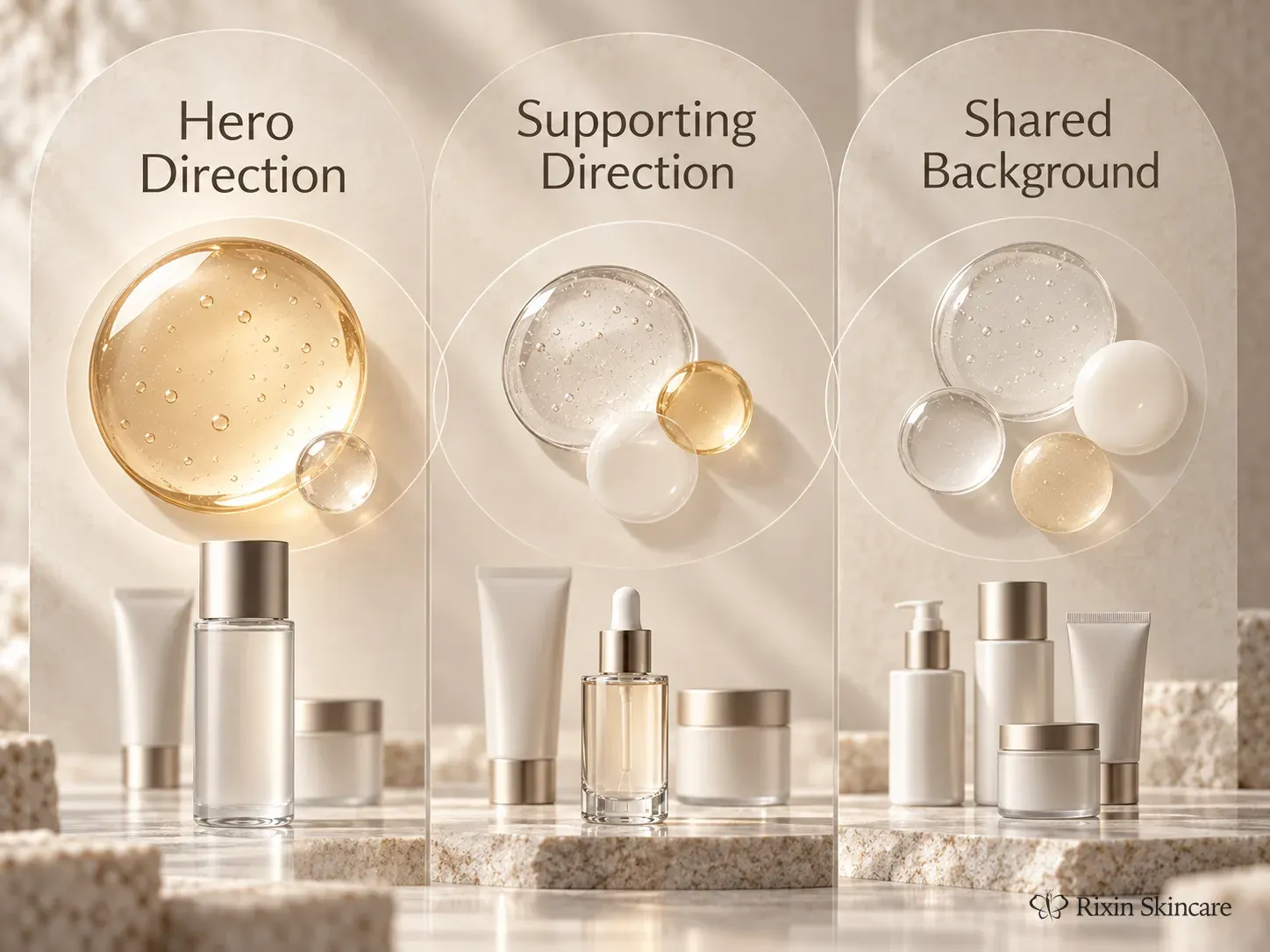
Hero ingredient direction
This is the ingredient story most closely associated with why a particular product exists.
A hero direction should not automatically be copied across every SKU simply because the brand wants the line to feel consistent.
If the same hero story dominates the toner, serum, and moisturizer, product differentiation may become weak.
Supporting ingredient direction
A supporting ingredient may contribute to the formula or positioning without defining the entire SKU.
This creates room for related products to share part of a broader system story without becoming duplicates.
Shared background ingredients
Some ingredients may appear across several formulas because they support basic formulation needs.
Their presence does not necessarily need to become a marketing story.
The important distinction is between:
ingredients that happen to be shared
and:
ingredients that define why the customer should buy each product.
Those are not the same thing.
Watch for Positioning Overlap, Not Just INCI Overlap
A line can feel repetitive even when its products highlight different ingredients. Overlap in the benefits and product stories may matter more to the customer than overlap in the ingredient lists.
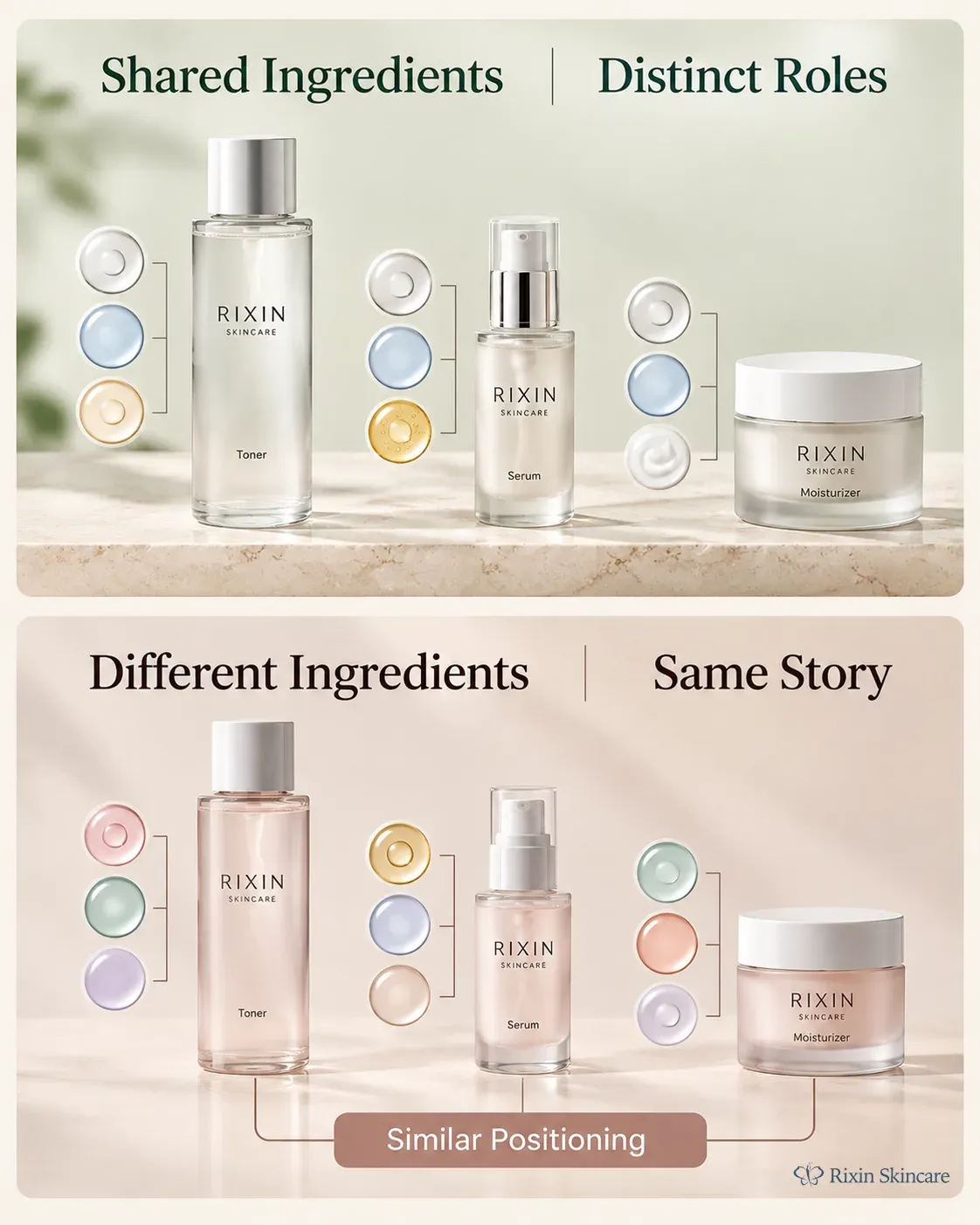
Consider three products that all communicate essentially the same idea:
- hydration;
- barrier support;
- glow;
- smoother-looking skin.
If each SKU uses different highlighted ingredients but every product leads with nearly identical language, the system may still feel repetitive.
The reverse can also happen.
Several products may share part of the same ingredient system while remaining distinct because their roles are clear.
For example:
- one product may provide the lightweight first leave-on step;
- another may carry the more concentrated product story;
- another may serve as the finishing moisturizer.
The exact formulation and claim language still require product-level review.
But from a system-planning perspective, the key question is:
Does each product have a distinct ingredient and positioning job?
For the sensory side of that system decision, see How to Plan Texture Progression Across a Skincare Routine.
Decide Which Ingredients Should Repeat Across the System
Ingredient repetition can be intentional.
The objective is not to create artificial difference by forcing every formula to use completely unrelated materials.
Instead, decide what the repeated ingredient is doing in the system.
Useful questions include:
- Is this ingredient part of the brand’s broader product concept?
- Does it need to be a hero story in every SKU?
- Is it functioning mainly as a supporting formula component?
- Would repeating it across several products make the positioning clearer or more repetitive?
- Does another SKU have a stronger reason to own the ingredient story?
- Does the selected material, supplied form, or specification need separate review for each formula?
A brand may choose to repeat one ingredient direction across a coordinated line while changing its prominence.
For example:
- one SKU may feature it;
- another may use it as supporting context;
- another may not mention it in front-facing positioning at all.
That creates a more flexible system than treating every repeated ingredient as a mandatory hero ingredient.
For example, consider a proposed Hydration Essence + Focus Serum + Comfort Moisturizer range:
- Keep as shared: The formulator may use a supporting humectant direction in more than one SKU where it suits each formula. The brand does not need to turn that shared material into three separate hero claims.
- Differentiate the message: Let the Focus Serum own the featured ingredient story, subject to finished-product claim evidence. Present the essence through its lightweight first-step experience and the moisturizer through its finishing texture and comfort role.
- Investigate before approving: Ask the formulation team whether the exact material, grade, supplied form, preservation approach, and package fit work in each proposed formula. Sharing a marketing ingredient name does not establish technical interchangeability.
- Defer if redundant: If a proposed fourth product repeats the same ingredient story, texture, and use occasion without a clear customer role, leave it out of the initial launch brief until its purpose is defined.
These are briefing decisions, not proof of safe ingredient combinations, equivalent formula behavior, or finished-product efficacy. They keep the product roles distinct without letting package copy dictate the formulas.
Give Each SKU a Clear Ingredient Story
The essence, serum, and moisturizer example above shows how one product can carry the main hero-ingredient message while the others are differentiated by texture or routine role. Record that division of roles before asking the formulation team to confirm the exact materials for each SKU. Sharing a marketing theme does not establish formula equivalence or finished-product claim support.
Review Claims Across the Product System
Ingredient overlap becomes more consequential when it also creates claim overlap.
If several products repeat the same highlighted ingredient and use nearly identical benefit claims, the system can become harder to understand.
The brand should review:
- what each finished product is intended to claim;
- which ingredient evidence is relevant to that product;
- whether the claim is appropriate for the selected formula;
- whether several products are repeating the same primary message;
- and whether the product roles remain distinguishable without overextending the ingredient story.
An ingredient’s presence does not automatically prove a finished-product claim.
Supplier information, research on an ingredient, or data from another grade or concentration should not automatically be treated as finished-product efficacy evidence.
Final claim wording depends on the actual formula, the selected material, supporting evidence, product testing where required, and the target market.
For ingredient-specific development questions, the Rixin ingredient library provides a separate route for evaluating individual ingredient directions.
Record the lead claim for each SKU alongside its distinct routine role. Check that the claim has evidence for the actual finished product rather than relying only on an ingredient story.
Ingredient Differentiation Is Only One Part of the Product Role
Ingredient direction should support a clear SKU role, but it does not need to carry the entire burden of differentiation.
Products may also differ through:
- texture;
- product format;
- application stage;
- finish;
- packaging;
- dose;
- or another development choice.
A practical system might look like:
| SKU | Ingredient role | Other differentiation |
|---|---|---|
| First leave-on step | Shared supporting hydration direction | Lightweight application and first-step role |
| Serum | Stronger hero-ingredient direction | More focused positioning and distinct texture |
| Moisturizer | Supporting or complementary ingredient direction | Finishing role, richer sensory profile, final skin feel |
This is only an example.
The actual system should follow the approved development brief rather than a fixed category rule.
Turn Ingredient Roles Into a Product-System Brief
A multi-SKU project becomes easier to discuss when ingredient roles are documented across the full system.
A compact brief can include:
| Field | What to define |
|---|---|
| SKU role | Why this product exists in the routine |
| Hero ingredient direction | Which ingredient story, if any, should define this SKU |
| Supporting direction | Which ingredients support the concept without owning the positioning |
| Shared ingredients | Which ingredient directions may reasonably repeat across products |
| Differentiation | What should remain distinct from neighboring SKUs |
| Claim direction | What the finished product may need to communicate, subject to evidence review |
| Material confirmation | Which exact material, grade, supplied form, or supplier documentation requires project-level confirmation |
| System overlap check | Where the routine risks becoming repetitive in ingredients, positioning, or claims |
This system brief should not replace an individual formula brief.
Each product still needs its own detailed development requirements.
The system brief has a different job:
It shows how the ingredient stories relate to one another before each formula is treated as an isolated project.
It can also help identify early problems, such as two products trying to own the same hero ingredient or several SKUs repeating nearly identical positioning.
For brands developing several coordinated formulas, Custom Formulation & OEM provides the broader development route.
Ingredient Overlap Should Be Intentional, Not Accidental
The most useful question is not:
Do these products share ingredients?
It is:
Is the overlap intentional, and does each SKU still have a distinct role, ingredient story, and reason to exist?
When that answer is clear, ingredient repetition becomes part of a coordinated product system rather than an accidental source of duplication.