On this page
A toner, serum, and moisturizer can each feel good on their own but work poorly together. The first may leave a little tack, the second may add cushion, and the moisturizer may leave a noticeable film. None of these effects is necessarily a problem by itself.
Once the products are layered, however, the routine can feel heavier, stickier, slower to settle, or more repetitive than intended. Texture progression means planning how the application feel and finish change from one step to the next, not just approving each formula on its own.
For a skincare brand, the central question is:
How should each product feel so that every step has a distinct sensory role and the full routine remains coherent when the products are used together?
This guide focuses on those between-product sensory transitions. For the wider routine structure, see How to Plan a Skincare Routine as a Product System.
Texture Progression Is a System Decision, Not a Viscosity Rule
Texture progression is sometimes simplified into:
thin → thicker → thickest
That sequence can describe an appearance, but it is not a reliable product-development rule. Viscosity is only one part of sensory behavior: two formulas that look equally thick may spread and settle differently. One may leave little residue; another may add drag, cushion, tack, or a noticeable film.
In practical terms, texture progression is:
The planned change in application feel, body, absorption, residue, and finish as the customer moves from one product to the next.
This means a brand should not ask only:
Is the serum thicker than the toner?
It should also ask:
- Does the serum feel meaningfully different?
- Does it spread well over the first layer?
- Does it add useful body without repeating the previous step?
- Does the moisturizer still feel comfortable after both products are underneath it?
- Does the complete routine match the intended positioning?
The key is whether each transition feels intentional and the complete routine meets the agreed sensory direction—not whether every step is thicker than the last.
Give Each Step a Different Sensory Job
Each product should contribute a clear sensory role to the routine, without needing a dramatically different texture. The goal is to make the products feel complementary rather than interchangeable.
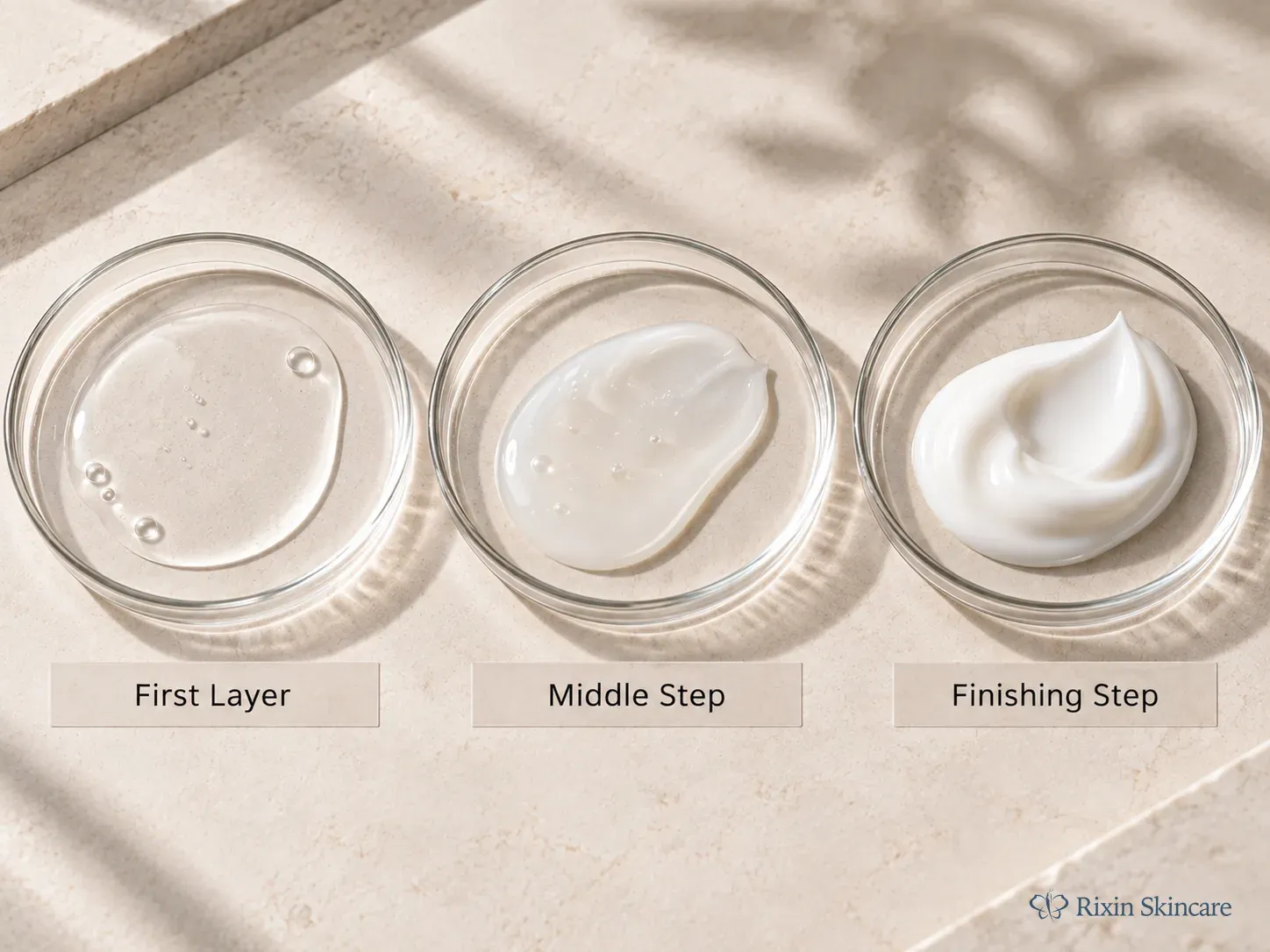
A simple three-step leave-on system might look like this:
| Routine step | Possible sensory job | Main development question |
|---|---|---|
| First leave-on layer | Fast spread, low body, light residue | Does it prepare the routine without creating unnecessary buildup? |
| Middle treatment step | More cushion, slip, or focused application feel | Does it add a distinct experience without duplicating the first layer? |
| Finishing step | More body, comfort, or finishing film | Does it complete the routine without making the total system too heavy? |
These are not fixed category rules.
A toner does not always need to feel watery. A serum does not always need to feel gel-like. A moisturizer does not always need to be rich.
The important point is that the sensory direction of each SKU should support its role in the system.
If the toner, essence, and serum all have nearly the same:
- body;
- slip;
- absorption;
- tack;
- residue;
- and finish;
the customer may experience three product names but only one repeated texture idea.
That can make the routine feel less differentiated even when the formulas themselves are technically different.
Evaluate More Than Thickness
When brands discuss texture, viscosity often becomes the easiest shorthand.
But viscosity alone cannot describe how a product will behave during application.
A more useful system-level review considers several sensory dimensions.
Spread
How easily does the product move across the skin?
A very fluid product can still feel difficult to spread if its application behavior is not what the brand expected.
A more substantial formula can sometimes spread very easily because of its slip profile.
Absorption and settling
How quickly does the product stop feeling actively wet or mobile on the skin?
The relevant question is not whether a product literally disappears.
It is whether the next intended step can be applied comfortably within the routine.
Tack
Does the product leave noticeable stickiness after application?
A small amount of tack may be acceptable in one SKU.
Repeated tack across several layers can become much more noticeable.
Slip
How easily does the product glide during application?
Slip can help one step feel elegant, but similar slip across every product may reduce differentiation.
Cushion
Does the formula feel light and fluid, or does it provide more body and perceived substance during application?
Cushion can help distinguish a serum or moisturizer from an earlier layer without necessarily making the formula extremely thick.
Residue and film
What remains after application?
A finishing layer may intentionally leave more perceptible film than a toner.
The issue is whether the total residue across all products still matches the desired routine experience.
Final skin feel
After the full sequence is applied, does the system feel:
- light;
- fresh;
- cushioned;
- dewy;
- rich;
- coated;
- sticky;
- or overly heavy?
The target depends on the brief.
The point is to define it deliberately rather than discovering the combined result only after each SKU has already been developed independently.
Plan the Transitions Between Products
Texture progression is easiest to understand when the brand evaluates the transition from one product to the next.
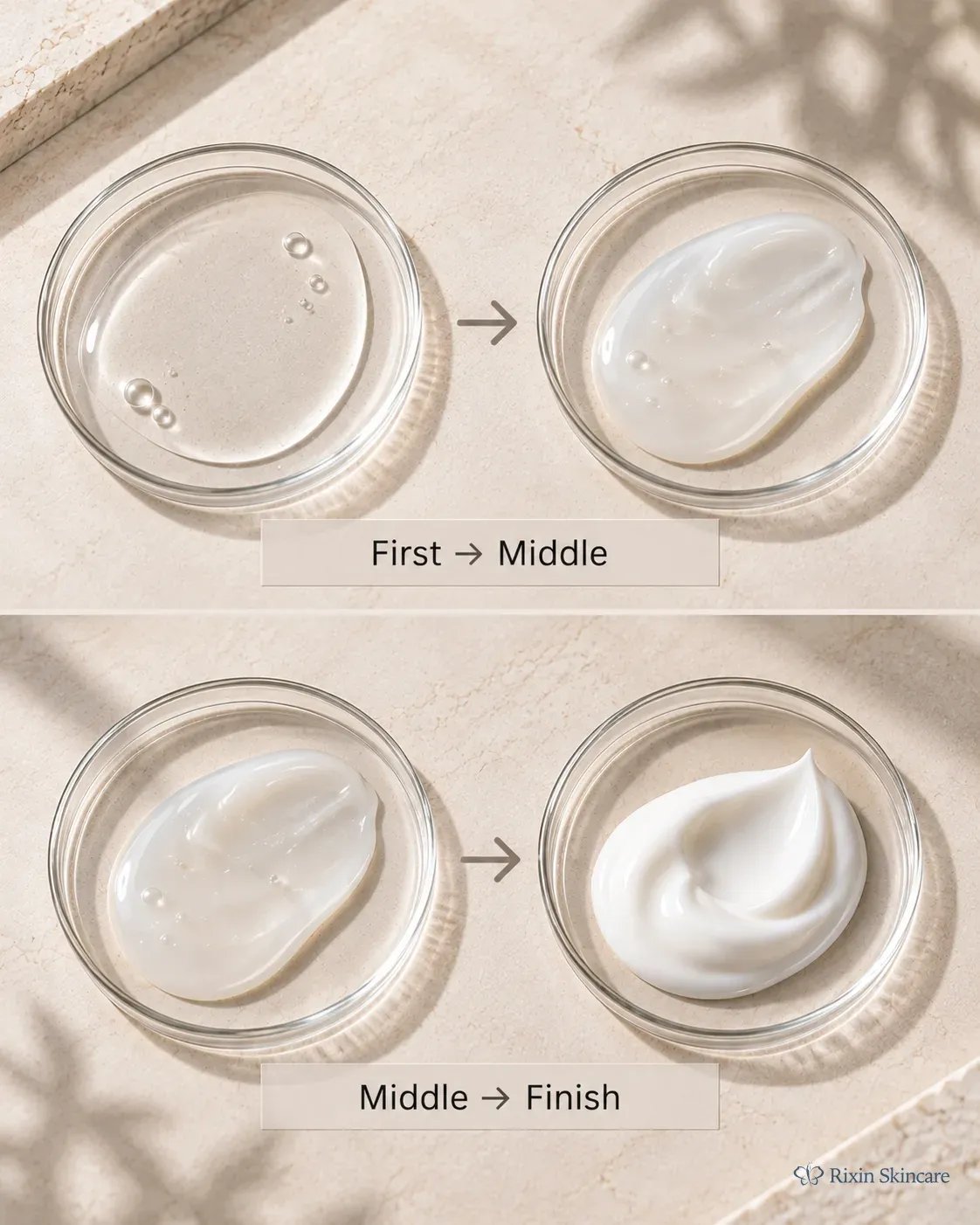
Instead of looking only at:
Product A
and:
Product B
look at:
Product A → Product B
Then ask what changes during that transition.
For example, between a first leave-on layer and a serum:
- Has the first layer settled enough for the serum to spread normally?
- Does the serum glide, or does it drag?
- Does the combination increase tack?
- Does the serum maintain its intended application feel over the first layer?
- Does the customer need an unrealistic pause before applying the next step?
Then review:
Serum → Moisturizer
The relevant questions may change:
- Does the moisturizer spread evenly over the serum?
- Does the combination create pilling or rolling?
- Does the moisturizer increase the total richness more than intended?
- Does the serum’s residue change the moisturizer’s finish?
- Does the final result still match the product-system brief?
This transition-based thinking helps prevent a common development problem:
approving several good standalone textures that do not form a good sequence.
The individual formulas still matter.
But the routine is experienced through the connections between them.
Watch for Cumulative Sensory Load
One of the main reasons to evaluate texture as a system is accumulation.
A small amount of tack, residue, or richness may be acceptable in one product but become much more noticeable when similar effects are repeated across several layers.
That does not mean every step needs to minimize those characteristics.
A richer routine may intentionally build more cushion or leave a more perceptible final film. A lightweight routine may need tighter control of residue and tack.
The system question is:
Is the combined sensory load intentional?
If the answer is no, the issue may not require changing every SKU. One product may simply be contributing too much tack, residue, or richness relative to the neighboring steps.
Different Routine Concepts Need Different Texture Progressions
There is no single ideal texture progression for every skincare line.
The progression should support the concept.
Lightweight system
A lightweight routine may prioritize:
- fast spread;
- low residue;
- limited tack;
- controlled build between steps;
- and a relatively light final finish.
The sensory differences may be subtle, but each step should still have a recognizable role.
Balanced system
A balanced routine may begin with a fluid first step, add more cushion in the middle, and finish with a moisturizer that provides clear comfort without becoming excessively heavy.
This is often the easiest progression to visualize, but it is still only one possible structure.
Richer system
A richer routine may intentionally use more cushion, slower settling, or a more noticeable final film.
The challenge is not simply to make every step heavier.
It is to decide where the richness should appear.
If every SKU delivers maximum body and residue, the full routine may become difficult to layer.
If the richer sensory experience is concentrated in the most appropriate step, the system may remain easier to understand.
Routine concepts based on multiple hydration layers require an additional system decision around how those layers differ from one another. The Skin Flooding product-development guide covers that trend-specific case in more detail.
Review Texture Progression During Sampling
Once representative samples are available, review them in the intended sequence rather than evaluating texture only one product at a time.
Use that sequence to evaluate the complete routine before manufacturing, while keeping the focus here on texture relationships.
The purpose here is narrow: check whether the planned texture relationships still hold after layering.
Look for texture-specific problems such as:
- unexpected drag between neighboring steps;
- tack or residue becoming more noticeable after layering;
- one product feeling too similar to the step before it;
- a finishing product becoming heavier than intended over the earlier layers;
- or pilling that appears only in the intended sequence.
If one transition feels wrong, the answer is not automatically to change every formula. The issue may be concentrated in one SKU or one relationship between neighboring steps.
The broader process for approving individual formulas belongs in Sampling and Formula Approval.
Texture progression adds a system-level check without replacing that process.
Turn Texture Progression Into a Development Brief
Brands can make texture development clearer by defining the relationships between the products before samples are finalized.
A compact texture-system brief can include:
| Field | What to define |
|---|---|
| Routine sequence | Which product comes before and after each SKU |
| Sensory role | What should feel distinct about each step |
| Relative body | Whether the SKU should feel lighter, similar, or more substantial than neighboring steps |
| Spread transition | How easily the product should apply over the previous step |
| Settling before next step | How readily the next intended product should be practical to apply |
| Combined tack | The acceptable tack after this product is layered with neighboring steps |
| Relative residue | Whether the product should leave more or less perceptible residue than the previous step |
| Final system feel | What the complete routine should feel like after all intended layers |
| Transition risks | Where drag, buildup, pilling, or heaviness should be reviewed |
This does not require numerical sensory specifications unless the project has an approved method for defining them.
The main objective is to stop texture from being described only with vague terms such as:
- light;
- rich;
- silky;
- fresh;
- luxurious.
Those words may still be useful as part of the brief.
But the development team also needs to understand what they mean relative to the other products in the system.
For example:
“Light serum” is ambiguous.
A more useful system direction is:
The serum should have more body than the first leave-on layer, spread easily over it, and add minimal extra tack before the finishing moisturizer.
That kind of relationship gives texture development a clearer job.
For projects where several formulas need to be coordinated as one product system, Custom Formulation & OEM can provide the broader development route.
A Strong Routine Has Distinct but Compatible Textures
The key question is not simply:
Is each product’s texture good?
It is:
Does each texture contribute something distinct without making the next step—or the complete routine—worse?
When that answer is clear, texture becomes part of the product-system architecture rather than a separate decision made formula by formula.