On this page
A toner, serum, and moisturizer can each seem acceptable when reviewed separately and still create a poor routine when used together.
The toner may leave a little tack, and the serum may add more residue. A moisturizer that spreads well on bare skin might then be harder to apply over both layers. Each formula may seem fine on its own, but the problem appears when they are used as a routine.
For a skincare brand developing several coordinated SKUs, that creates an additional question:
Do the products work only as individual formulas, or do they also work together in the sequence the customer is expected to use?
A useful product-system review therefore looks at three levels:
- each product individually;
- important adjacent product transitions;
- the complete intended routine.
This does not replace the normal approval or testing required for each formula.
It adds a system-level evaluation for problems that may only appear when otherwise acceptable products are combined.
For the broader framework behind coordinated routine development, see How to Plan a Skincare Routine as a Product System.
Why Separate and Combined Reviews Matter
A product can meet its own brief and still change the experience of the next step. A little tack from a toner may combine with serum residue, making the finishing moisturizer harder to spread. Some combinations may also pill or feel heavier than either product alone.
Review the intended sequence, not every possible combination. The next three checks help identify whether a concern starts with one formula, an adjacent pair, or the complete routine.
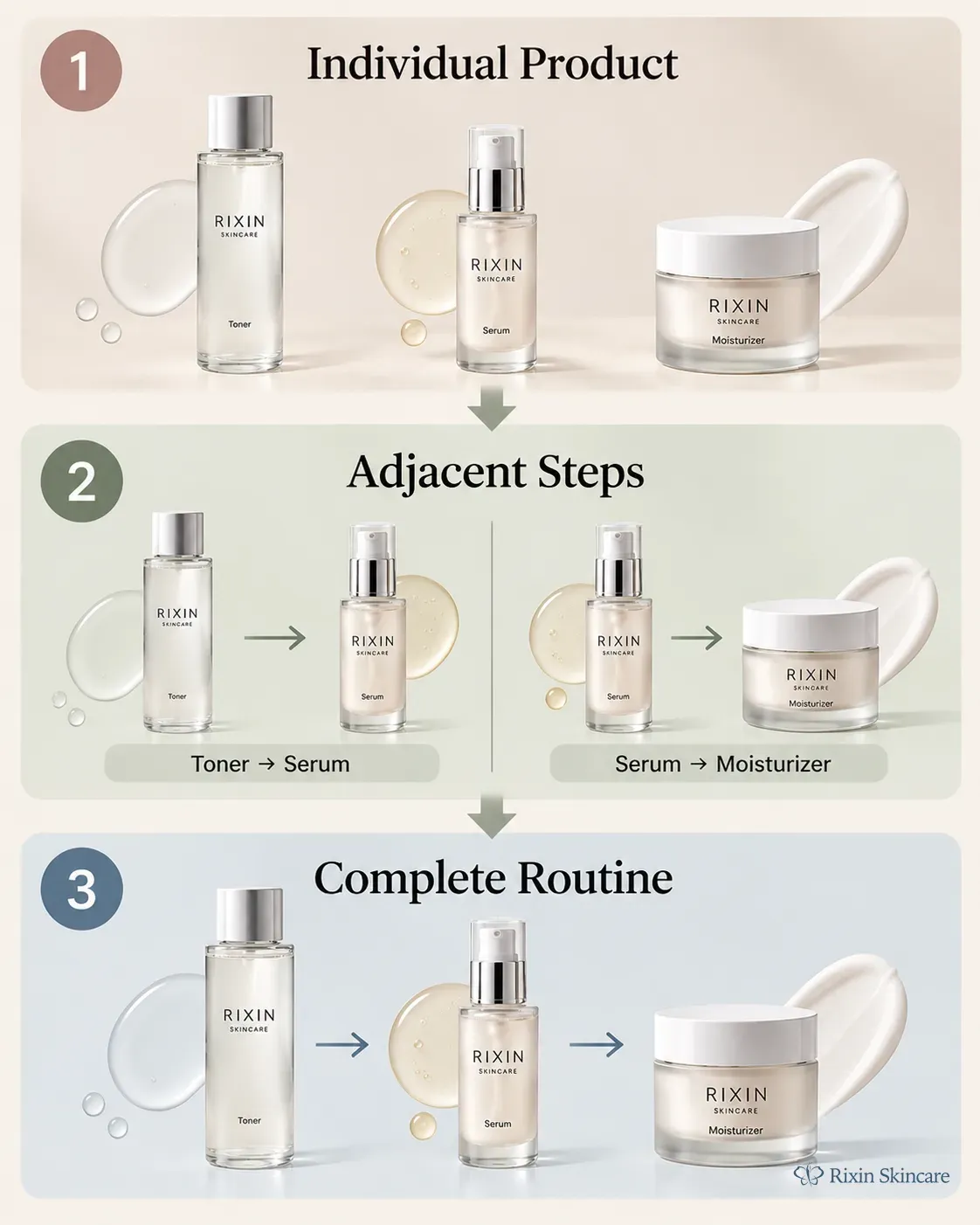
Evaluate the System at Three Levels
A practical review can separate the routine into three levels.
| Evaluation level | Main question |
|---|---|
| Individual product | Does each SKU meet its own intended product direction? |
| Adjacent steps | Does the next product still behave as intended over the previous step? |
| Complete routine | Does the full sequence remain coherent after all intended products are combined? |
Each level answers a different question.
1. Individual product
The brand establishes a baseline for each SKU.
If a serum already feels too sticky when used alone, that is primarily an individual-product issue.
2. Adjacent steps
The brand evaluates the relationship between neighboring products.
If the serum performs well alone but becomes difficult to spread over the toner, the problem appears in the transition.
3. Complete routine
The brand evaluates the cumulative result.
The toner and serum may work together.
The serum and moisturizer may also work together.
But all three products combined may still create more tack, residue, richness, or application time than the intended system should have.
These levels are not formal laboratory test categories.
They are a practical framework for locating where a product-system problem appears.
Start With Each Product on Its Own
Before any evaluation on human skin: Have a competent technical or safety reviewer confirm that each development sample and the proposed combined-use method are suitable for the intended human evaluation under an agreed process. Do not improvise on-person trials with unassessed prototypes. Until suitable use has been established, review appearance, packaging, dispensing, and other non-human-use observations with the technical team. Sensory feedback does not establish safety, product claims, or market readiness.
Before evaluating interaction between products, establish a clear baseline for each SKU.
The goal is not to repeat the entire formula approval process.
It is to understand how the product behaves before another layer changes the experience.
Relevant observations may include:
- appearance;
- dispensing behavior;
- application;
- spread;
- texture;
- finish;
- residue;
- and intended role in the routine.
For example, if a moisturizer feels unexpectedly heavy even when used by itself, the brand should not immediately blame the serum underneath it.
Likewise, if a pump is difficult to control during individual use, that issue already exists before the complete routine is considered.
A clear baseline makes later diagnosis easier.
Without it, the brand may see a problem during combined use but have difficulty determining whether the problem:
- existed in one SKU already;
- emerged between two products;
- or accumulated only across the complete system.
The broader process for approving individual formulas belongs in Sampling and Formula Approval.
System-level evaluation should build on that process, not replace it.
Review the Transitions Between Adjacent Steps
The most useful system-level unit is often not one product.
It is the transition between two products.
Instead of reviewing only:
Toner
and:
Serum
review:
Toner → Serum
Then do the same for:
Serum → Moisturizer
The purpose is not to repeat a full sensory review of each product.
It is to identify whether a problem appears only after one product is applied over another, and to locate the transition where that problem begins.
For a toner → serum transition, the brand might ask:
- Does the serum still apply as intended over the toner?
- Does a problem such as drag, excess tack, or an altered finish appear only after layering?
- If so, does the issue appear to come mainly from the toner, the serum, or their relationship?
For a serum → moisturizer transition, the same logic applies:
- Does the moisturizer still apply as intended over the serum?
- Does pilling, residue, or unexpected richness appear only in the combined step?
- Is the issue reproducible in that transition rather than in either product alone?
These observations should be interpreted against the intended product-system brief.
The goal is not to force every routine toward the same sensory result.
It is to confirm that each transition supports the system the brand intended to create.
For the deeper planning of sensory relationships, see How to Plan Texture Progression Across a Skincare Routine.
Use the Complete Routine in Its Intended Sequence
Adjacent-step review does not capture every system problem.
Some effects become visible only after the complete sequence is used.
For example:
- toner → serum may feel acceptable;
- serum → moisturizer may also feel acceptable;
- but toner → serum → moisturizer may still produce too much cumulative tack or residue.
That is why the full intended routine should also be reviewed as one sequence.
Use the products in the order the brand actually expects the customer to use them.
Then consider:
- whether the sequence remains easy to apply;
- whether cumulative tack or residue becomes noticeable;
- whether pilling appears after later layers;
- whether the total richness matches the concept;
- whether the final finish still matches the intended positioning;
- and whether the routine remains understandable as a complete system.
The point is not to imitate every possible consumer behavior.
The review should focus on the intended usage path defined by the product concept.
If the brand expects several different usage paths, those paths may need to be reviewed separately.
For example, the moisturizer may be intended to follow:
- toner only;
- or toner plus serum.
Those two sequences may not produce the same combined result.
Watch for Problems That Accumulate Across Products
A system can become problematic even when each individual effect looks acceptable on its own.
A small amount of tack in one product may be reasonable but become noticeable when several layers contribute similar tack.
The same can happen with:
- residue;
- richness;
- film;
- or application friction.
The important point is not the individual sensory category.
It is the cumulative load across the system.
A brand should ask:
Does the combined effect still match the intended product-system brief?
If not, identify where the accumulation begins and which product or transition contributes most strongly before changing the entire routine.
Include Packaging and Dose in the Evaluation
System-level evaluation should not treat formula texture as the only variable.
Packaging affects how much product is actually delivered and how the customer is likely to use each step.
That can materially change the combined routine.
A serum that feels light at a small application amount may contribute much more residue if the selected pump dispenses substantially more product per use.
A toner package that is difficult to control may lead to a larger first layer than the system was designed around.
A moisturizer pump may make the finishing step feel heavier if one full actuation provides more product than the intended usage concept assumes.
For system review, consider:
- how each product is dispensed;
- whether the amount is easy to control;
- whether one product tends to be over-applied;
- whether the combined amounts change the final feel;
- and whether the packaging supports the intended routine sequence.
This does not mean the article needs a fixed dose for each category.
The appropriate amount depends on the formula, packaging, product format, and project brief.
The important point is:
Evaluate the routine using realistic intended dispensing behavior, not an abstract formula amount that the customer is unlikely to reproduce.
Route Each Routine Problem to the Right Review
When a routine feels wrong, identify where the problem starts before requesting a formula change. Use the first three-level review to decide who should look at it next.
| Where the issue appears | Example | Next review |
|---|---|---|
| One product | A serum is sticky alone, or its dispenser gives too much product. | Ask the formulation or packaging team to review that SKU first. |
| An adjacent pair | A moisturizer pills only when used after the serum. | Ask the technical team to review the two formulas, their order, and the intended amounts. |
| The complete routine | Several individually acceptable layers create too much tack, residue, or weight together. | Ask the product and formulation teams to review the sequence, doses, and need for each step. |
Keep the observation tied to the exact sample versions. Changing every formula may be unnecessary when one product or transition is causing the problem.
Record System-Level Observations
Combined-use review is more useful when observations are documented rather than remembered informally.
A simple system evaluation record can include:
| Field | What to record |
|---|---|
| Sequence | Which products were used and in what order |
| Product state | Which sample or version was reviewed |
| Adjacent transition | Which product-to-product relationship was checked |
| Combined observation | What appeared only after layering |
| Final system feel | Overall result after the intended sequence |
| Suspected source | Individual SKU, transition, or cumulative system effect |
| Follow-up | What needs to be reviewed next |
The exact format can vary by project.
The purpose is not to create a formal laboratory protocol.
It is to make the development discussion more precise.
Instead of saying:
The routine feels wrong.
the team can record:
The serum spreads normally alone but drags when applied over the current toner sample.
Or:
The moisturizer performs normally over the serum, but cumulative residue becomes noticeable when toner, serum, and moisturizer are all used together.
Those observations are more useful because they identify where the issue appears.
They also make later comparisons between sample versions easier.
Define What Should Be Stable Before Manufacturing
Before the project moves further toward manufacturing, certain product-system decisions should be reasonably stable.
This is not a complete manufacturing-readiness, release, or approval gate.
Formula testing, packaging requirements, documentation, specifications, manufacturer procedures, and other project-specific requirements still need to be handled separately.
At the system level, the brand should have reasonable clarity on:
- the intended routine sequence;
- the role of each SKU;
- how neighboring products are expected to work together;
- the intended texture relationship;
- major ingredient and positioning differentiation;
- intended packaging and dispensing direction;
- whether representative products work acceptably together;
- and whether any known combined-use issue still requires further development.
This does not mean every project variable is permanently fixed.
Projects can still change as formula, packaging, testing, documentation, or production requirements are resolved.
The point is to avoid using manufacturing as the stage where the brand first discovers that:
- two products are difficult to layer;
- the complete sequence is much heavier than intended;
- one package causes systematic over-dosing;
- or several products do not function coherently as one routine.
If the review identifies a problem, return to the appropriate product, transition, or system decision before treating the routine as sufficiently defined for the next project stage.
Ingredient and positioning problems discovered during this review can be revisited using How to Avoid Unnecessary Ingredient Overlap Across a Skincare Product System.
Routine Evaluation Does Not Replace Product Testing
A system-level routine review answers one question:
Do the intended products work coherently when they are used together?
It does not replace the technical work required to evaluate each finished product.
Depending on the formula, packaging, target market, product type, manufacturer procedures, and project brief, separate product-level requirements may include areas such as:
- stability;
- preservation or microbiological evaluation;
- formula and packaging compatibility;
- specification review;
- market-specific requirements;
- and other finished-product testing.
The exact requirements depend on the project.
A successful combined-use review should therefore not be interpreted as:
- proof of compatibility;
- proof of stability;
- manufacturing approval;
- safety validation;
- or a finished-product testing result.
It is a different layer of product development.
The individual product still needs to meet its own requirements.
The product system also needs to make sense when those individually developed products are used together.
For brands coordinating several custom formulas as one routine, Custom Formulation & OEM provides the broader development route.
Evaluate the Routine as a System, Not Just a Product List
The final question is:
Do the products still work when they are used together in the intended system?
If a problem appears, identify where it begins before deciding what needs to change.
That makes it easier to preserve products that already work and focus development on the part of the system that does not.