On this page
A skincare brand can develop several individually strong products and still end up with a weak routine.
The toner may feel good on its own. The serum may have a clear ingredient story. The moisturizer may perform well as a standalone product.
But when customers use them together, new questions appear:
- Does each product have a distinct role?
- Does the texture become progressively heavier in a sensible way?
- Do several products repeat the same ingredient and positioning story?
- Does one layer make the next harder to spread?
- Does tack or residue build across the routine?
- Does the complete sequence still feel intentional?
That is why a coordinated skincare routine should be planned as a product system, not simply as a list of separate SKUs.
For a brand, the main development question is:
How should several products be designed so each one has a reason to exist and the complete routine works as a coherent experience?
This is different from deciding how many products a brand should launch.
If the main question is which SKUs belong in a first product line, start with How to Plan a Skincare Product Line for Manufacturing.
Once the product roles are reasonably clear, system development focuses on how those products work with one another.
A Skincare Routine Is a Product System, Not Just a Product List
Putting a cleanser, toner, serum, and moisturizer into matching packaging does not automatically make them a coordinated system.
A product system has relationships between the products.
Those relationships may include:
- application order;
- distinct product roles;
- texture progression;
- absorption between steps;
- ingredient and positioning differentiation;
- dispensing amount;
- combined skin feel;
- and the way one product affects the application of the next.
A useful system therefore needs two levels of development.
The first is the individual product level:
Does each SKU meet its own brief?
The second is the system level:
Do the products still make sense when used in the intended sequence?
Both matter.
An individual product should not have its intended role, formula brief, or product requirements compromised simply to make the collection appear more coordinated. A moisturizer should not be selected only because its package matches the toner.
But each product should be evaluated in the context of the routine it is expected to join.
Start With the Routine Goal, Not the Number of SKUs
Before deciding how the products should interact, define what the complete routine is supposed to provide.
This does not require every product to make the same claim.
The goal is to understand the logic of the sequence.
For example, a routine might be designed around a progression such as:
prepare → targeted step → finish
Another concept might use:
light hydration → concentrated treatment → moisture-sealing finish
The exact structure depends on the brand, product categories, target customer, positioning, and development brief.
The important point is that each step should contribute something understandable to the complete system.
A brand should be able to answer:
- What is the overall routine intended to help the customer do?
- What is the role of each product within that routine?
- Which products are essential to the system?
- Which products are optional extensions rather than necessary steps?
- Where would two SKUs become too similar?
These questions should be answered before trying to make every product share the same ingredient story, package style, or texture family.
Questions about total SKU count, MOQ, launch scope, inventory, and first-line size belong to broader product-line planning.
Here, the focus is what happens after the selected products are expected to work together.
Give Each Product a Distinct Role in the Sequence
A coordinated routine becomes difficult to understand when several products perform almost the same job.
Consider a simple leave-on sequence:
| Product | Possible system role | What should be distinct |
|---|---|---|
| Toner or essence | Lightweight first leave-on layer | Fluidity, spread, first-step sensory role |
| Serum | More focused treatment step | Formula direction, concentration of the product story, application feel |
| Moisturizer | Finishing layer | Richness, final skin feel, routine completion |
These are not fixed definitions.
A brand may use different product formats or assign different roles.
The table simply illustrates an important system principle:
Each SKU should make the routine easier to understand, not harder.
When two products have the same usage position, very similar texture, similar hero ingredients, similar claims, and similar after-feel, the distinction between them may become too weak.
That does not always mean one product must be removed.
But the brand should be able to explain why both belong in the system.
Useful differentiation may come from:
- product format;
- application stage;
- sensory profile;
- ingredient direction;
- intended use;
- finish;
- packaging and dispensing behavior;
- or another clear product-development decision.
If the only difference is the product name, the system may need to be reconsidered.
Plan Texture Progression Across the Routine
Texture should be reviewed across products, not only inside each formula.
A toner, serum, and moisturizer can each have an acceptable texture individually but create an unpleasant combined experience.
For example, several layers may each leave a small amount of tack.
Individually, that tack may be acceptable.
Together, it may become much more noticeable.
The same principle applies to:
- slip;
- cushion;
- residue;
- film formation;
- richness;
- absorption speed;
- and final skin feel.
A coordinated system therefore needs a deliberate texture progression across a skincare routine.
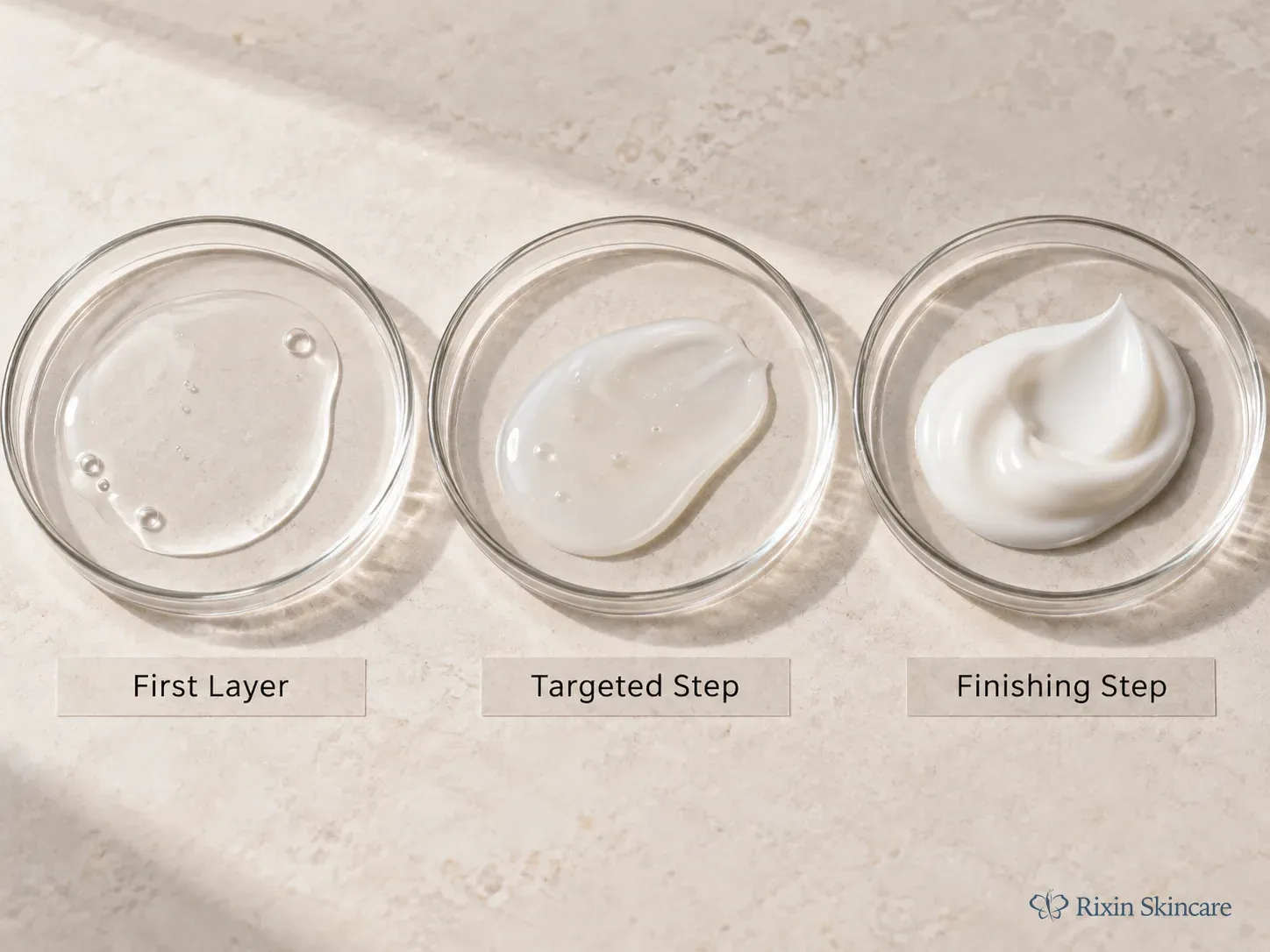
That progression does not have to follow a rigid rule such as “every step must be thicker than the previous one.”
Instead, ask whether each transition makes sense.
Questions may include:
- Does the first leave-on layer spread easily?
- Is the next product easy to apply over it?
- Does the serum add a different sensory role rather than repeating the toner?
- Does the moisturizer complete the routine without making the total system unnecessarily heavy?
- Does the finished sequence match the intended positioning?
A lightweight routine and a richer routine can both be valid.
The issue is whether the progression feels intentional.
Check Ingredient and Positioning Overlap Across Products
A coordinated skincare system may share ingredients across several products.
That is not automatically a problem.
Ingredient overlap also does not mean that two formulas are equivalent or that the combination is inherently unsuitable.
The more useful question is:
Does each SKU still have a clear product role and positioning story?
If a toner, serum, and moisturizer all use the same highlighted ingredients, similar benefit language, and similar sensory positioning, the customer may struggle to understand why all three products are necessary.
For product development, review:
- which ingredients are central to each SKU;
- which ingredients are supporting rather than defining;
- whether several products rely on the same primary positioning;
- whether one product has a clearer reason to carry a particular ingredient story;
- and whether proposed claims remain appropriate for the finished products.
Exact ingredient selection, concentration, supplied form, compatibility, and finished-product claims require project-level review.
For ingredient-specific development considerations, use the Rixin ingredient library separately. For system-level ingredient overlap across a skincare product system, review the dedicated guide.
A product-system brief should identify differentiation between the SKUs without turning the routine into an ingredient catalogue.
Evaluate How the Products Layer Together
One of the most important differences between single-product development and system development is that the sequence itself can change the user experience.
A formula may feel acceptable alone but behave differently when applied over or under another product.
During system design, pay particular attention to whether:
- one layer makes the next harder to spread;
- tack or residue begins to accumulate;
- the combined sequence becomes heavier than intended;
- or a product changes the apparent finish of the next step.
The goal at this stage is to identify where the relationship between products may need attention, rather than to complete the detailed process for evaluating a multi-product skincare routine before manufacturing inside this section.
The sequence also matters when a brand develops different usage paths.
For example, a moisturizer might be designed to follow both a toner-only routine and a toner-plus-serum routine.
Those two sequences may create different combined sensory results.
Where a routine is intentionally built around multiple hydration layers, Skin Flooding: What It Means for Skincare Product Development provides a more specific example of how product roles and layering can shape a coordinated system.
Packaging and Dose Can Change the Routine Experience
Packaging affects more than the visual identity of a coordinated line.
It can also change how much product is applied at each step.
That matters because the amount dispensed can affect the combined routine.
A lightweight formula delivered in an unnecessarily large dose may make the system feel heavier than intended.
A pump that dispenses too little may create a different usage experience.
A controlled-pour package may require different handling from a pump or dropper.
For system planning, consider:
- how the product is dispensed;
- the approximate intended amount per use;
- how easily the customer can control that amount;
- whether residue around the closure affects repeated use;
- and whether the dispensing behavior supports the product’s place in the sequence.
Package selection still needs to follow the actual formula and project requirements.
The system-level question is narrower:
Does the package help the customer use each step in a way that supports the complete routine?
Evaluate the Routine Together Before Manufacturing
Individual formula approval is necessary, but a coordinated routine also needs a combined-use review.
A practical evaluation can happen at three levels: each individual product, the transitions between adjacent steps, and the complete routine. This combined-use review helps confirm that individually acceptable products still work as one sequence.
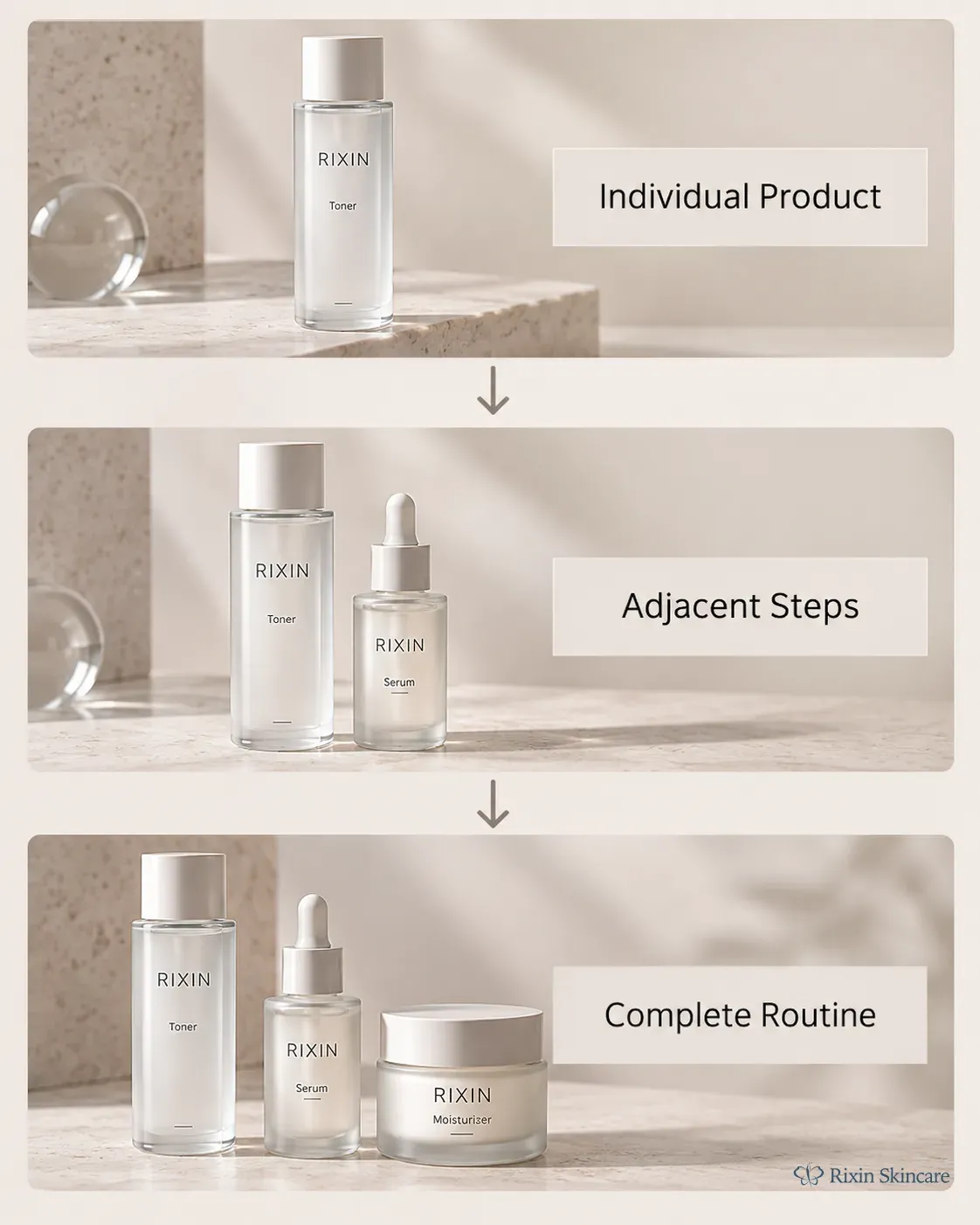
The exact evaluation and testing requirements depend on the products, formulas, packaging, target market, manufacturer procedures, and project brief.
A sequence review does not replace formula stability, compatibility, preservation, or other finished-product testing.
It answers a different question:
Does the intended routine still work when the products are used together?
For the broader individual formula approval process, see Sampling and Formula Approval.
Build a Product-System Brief for Development
Before a multi-product routine moves further into development or manufacturer discussion, the brand should be able to describe the system clearly.
A useful brief can include:
| Brief field | What to define |
|---|---|
| Routine goal | What the complete system is intended to provide |
| Product steps | Which products belong in the intended sequence |
| Product role | Why each SKU exists |
| Texture target | How each product should feel and how the sequence should progress |
| Ingredient direction | What should distinguish the products without unnecessary duplication |
| Layering expectation | What should happen when one product is applied after another |
| Packaging and dose | How each product is dispensed and used |
| Combined evaluation | What should be reviewed in adjacent steps and in the complete routine |
This brief should not attempt to replace the individual formula briefs.
Each product will still need its own development requirements.
The purpose of the system brief is to capture the relationships between them.
Those relationships are easy to miss when toner, serum, moisturizer, and other products are developed as separate projects.
For brands that need custom control over several coordinated formulas, Custom Formulation & OEM provides the broader development route.
Simplify the System When Products Do Not Have Distinct Jobs
More products do not automatically create a stronger routine.
Before finalizing a coordinated system, compare the SKUs again.
If two products have nearly the same:
- role;
- application stage;
- texture;
- ingredient story;
- positioning;
- and finished feel;
ask whether both are necessary.
Sometimes the solution is stronger differentiation.
Sometimes one product belongs in a later line extension.
Sometimes the routine is clearer with fewer steps.
The objective is not to maximize the number of products used together.
It is to create a system in which each product has a distinct job and the complete sequence remains understandable, usable, and practical to develop.
A coordinated skincare routine is strongest when the brand can explain both sides of the system:
why each product exists
and
why the products belong together.