
On this page
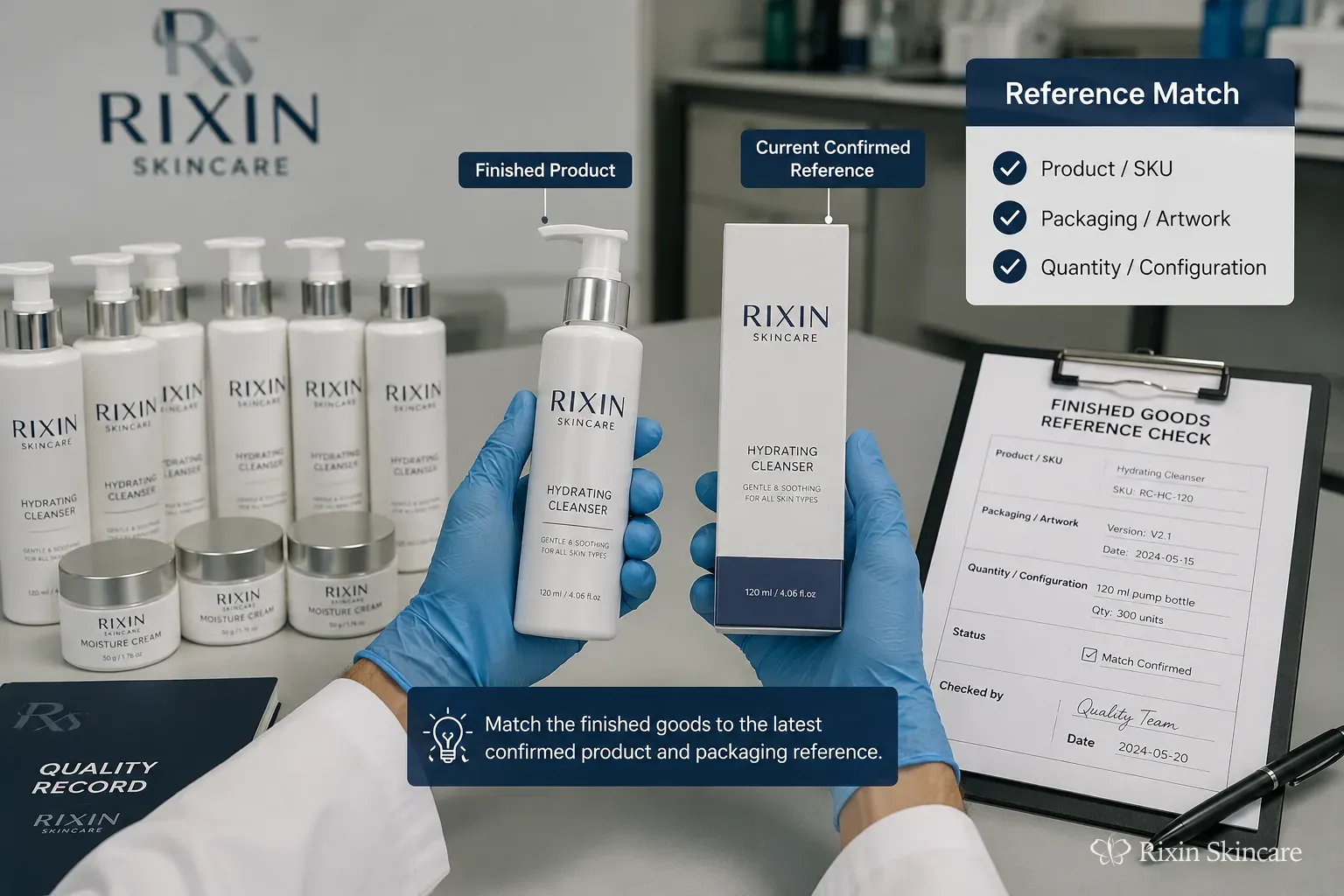
Production being complete does not, by itself, mean that a skincare order is ready for shipment. Before handoff, compare the finished goods with the latest confirmed product and order reference. Verify the agreed finished-product and document status, then resolve any open issue that could change what is shipped.
A useful buyer-side checklist is Match → Verify → Handoff. It is not a formal Rixin release procedure or a universal quality-control standard. It is a practical way for a brand buyer and manufacturer to confirm that the finished order still matches the project that was approved.
What Shipment-Ready Means
In this article, the confirmed project basis means the latest approved reference for the product and order. Depending on the project, that may include:
- the product or SKU version;
- the approved formula or product specification;
- packaging and artwork;
- quantity and order configuration;
- agreed quality-review or document requirements.
The pre-production version of this question is covered in What to Confirm Before Skincare Bulk Production Starts. At the pre-shipment stage, however, the question is different:
Do the finished goods still match the latest confirmed product and order?
This shipment handoff is one stage in the skincare production readiness and repeat-order guide, after production and before any next-order review.
| Step | Buyer question | Practical result |
|---|---|---|
| Match | Do the finished goods match the current confirmed product and order? | Identify any mismatch in SKU, package, artwork, quantity, or another agreed reference |
| Verify | Are the agreed finished-goods checks, documents, and open issues sufficiently resolved? | Confirm what is complete, pending, or still needs review |
| Handoff | Is the correct order ready to move into the agreed shipment arrangement? | Confirm shipment-blocking issues are resolved before handoff |
1. Confirm the Final Product and Order Basis
Start with the basic commercial and product question: What exact finished order is supposed to ship?
Confirm the SKU or product version, package format, artwork version, fill size, quantity, and any other order-specific reference that matters to the project.
A formula can be correct while the wrong carton version is used. A package can look right while the fill size or SKU configuration differs from the current order. An artwork revision may have been approved during production, but the finished goods still need to match that current version rather than an earlier file.
Detailed packaging execution belongs in Packaging and Label Design. Here, the buyer only needs to confirm that the finished product and order match the current approved references.
2. Match the Finished Goods to the Confirmed Reference
Once the correct reference is clear, check whether anything visible or order-specific differs from it.
The exact finished-goods checks depend on the product and the agreed review process. A project may define checks such as:
- finished-product appearance;
- pack condition;
- fill or weight;
- comparison with an approved specification;
- batch identification;
- traceability or documented handling of a nonconformity, meaning a result or condition that does not meet an agreed requirement.
These are examples, not a universal release checklist for every skincare order.
- What finished-goods review was agreed for this project?
- Is it complete?
- Was any difference or exception identified?
- Who is responsible for deciding whether that issue affects shipment?
If the finished product, package, artwork, quantity, or another input differs from the current confirmed basis, do not silently treat the difference as approved. Use the separate guide on what happens when a skincare project changes after approval for the deeper change-and-reapproval process.
3. Verify Finished-Goods Review and Document Status
Quality checks and project documents answer the same late-stage question: what is complete, what is still open, and does anything block the handoff?
Depending on the product, market, project scope, and agreed responsibilities, relevant evidence may include available specifications, completed reports, selected batch or quality records, approved packaging or artwork information, manufacturer-side technical information, or other agreed project documents.
Do not assume that every order includes the same document package. For example, a project may or may not include a certificate of analysis (COA), retained sample, release certificate, independent inspection report, or other record. Confirm what was actually agreed for this project.
For each expected item, record:
- what was agreed;
- whether it is complete, pending, or unavailable;
- who owns the next decision;
- whether the open item affects shipment;
- what file, written confirmation, or other record documents the decision.
One document does not automatically prove universal product, batch, or market compliance. It should be understood within the scope it was created to support.
Detailed test selection, specifications, reports, records, and evidence boundaries belong in Quality Testing and Documentation.
4. Resolve Deviations Before Handoff
A deviation here simply means the finished order differs from the latest confirmed product, package, artwork, quantity, or another agreed reference.
When that happens, record four things:
- what is different;
- which part of the finished order could be affected;
- who owns the decision;
- whether the previous approval still applies.
Not every small difference needs to stop shipment. But an unresolved difference should not be ignored when it could change what the buyer receives or leave an agreed project review incomplete.
Responsibility varies by issue: packaging differences may go to a packaging or technical contact, quality results to the designated quality contact, and label or market questions to the appropriate regulatory or market reviewer.
5. Separate Shipment Readiness From Market Readiness
Three milestones should remain separate:
- Production complete means the manufacturing process has reached the finished-goods stage.
- Shipment-ready means the agreed order and project-specific handoff conditions are sufficiently resolved.
- Market-ready depends on the product, claims, labeling, documentation, destination market, and the responsibilities of the relevant parties.
A facility certification or registration does not, by itself, establish that a specific finished product meets all applicable product-level and target-market requirements. Product-specific and market-specific obligations need to be confirmed separately.
This article stays focused on the manufacturing handoff. Detailed market requirements belong on the relevant market-specific compliance resources.
6. Record the Handoff Decision
| Field | What to record |
|---|---|
| Product / SKU | Which finished product or version is being shipped? |
| Package / artwork reference | Which current package and artwork version applies? |
| Quantity / configuration | What finished order is being handed over? |
| Finished-goods review status | What agreed review is complete or still open? |
| Testing / document status | What agreed evidence is complete, pending, or unavailable? |
| Open issue | What still requires a decision or resolution? |
| Owner | Who is responsible for closing the issue? |
| Handoff status | Ready, open, or needs resolution |
This is a buyer-side tracking tool, not a formal Rixin quality-assurance or release form.
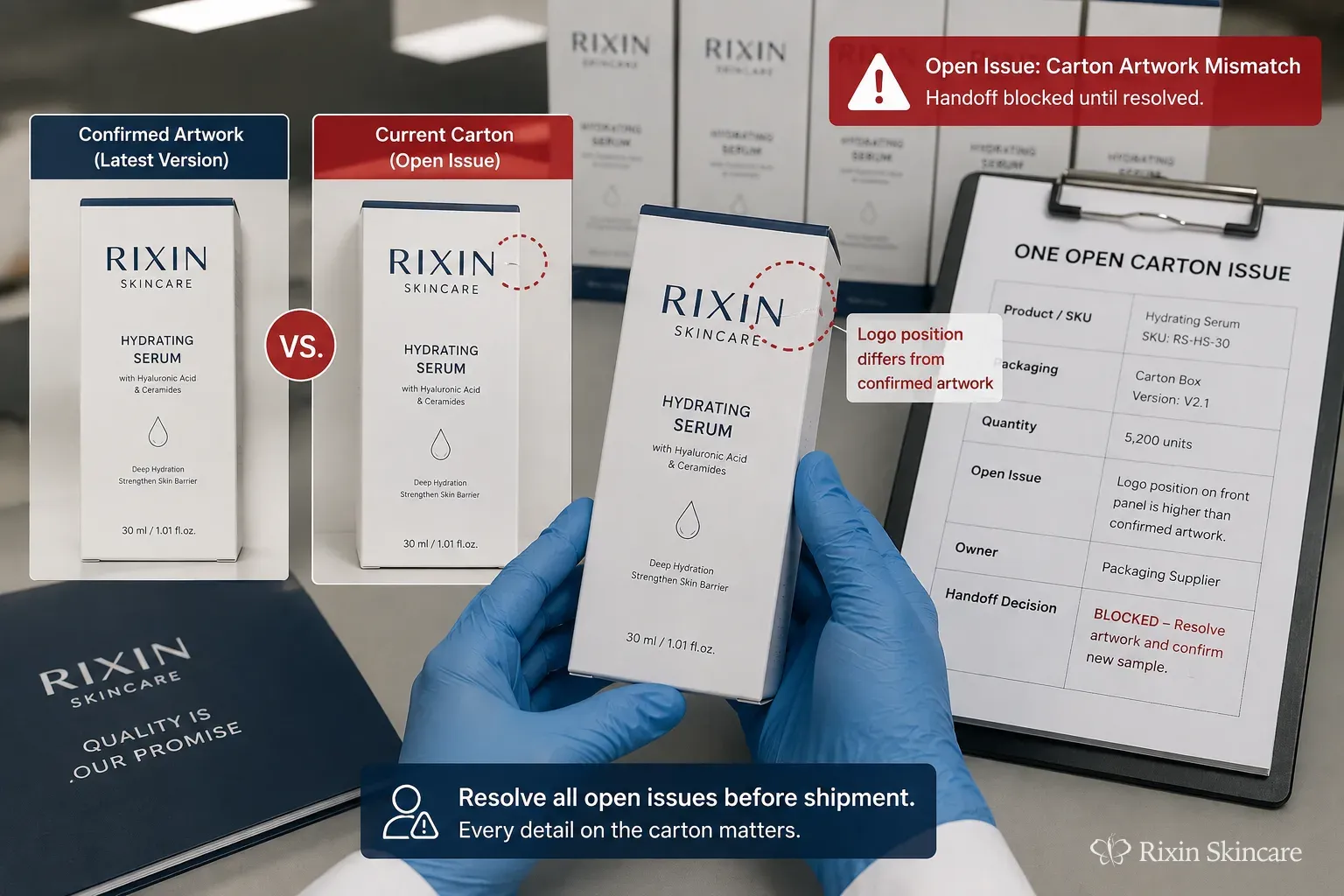
Example: One Open Carton Issue
Suppose the product, bottle, pump, quantity, and finished-product review are all confirmed, but a final carton print differs from the approved artwork.
A simple record could show:
- Product / SKU: confirmed;
- Bottle and pump: confirmed;
- Quantity: confirmed;
- Finished-goods review: complete for the agreed scope;
- Open issue: carton artwork mismatch;
- Owner: packaging/artwork contact, with regulatory or market review if the changed content requires it;
- Handoff status: needs resolution.
If the designated owner documents that the difference is acceptable and the current artwork approval still applies, the handoff status can be updated. If the difference changes required product information or another shipment-critical reference, the issue remains open until it is resolved.
Final Rule Before Shipment Handoff
Treat an issue as shipment-blocking when it could mean the finished goods do not match the confirmed product or order, or when an agreed project-specific review remains unresolved.
If an unresolved issue could change what is being shipped, or leave a required project review open, do not treat the order as shipment-ready until the designated owner documents the resolution.
If the designated quality, technical, regulatory, or other responsible owner documents that an issue does not affect the finished order or required handoff—and no contract or applicable market requirement requires a hold—the shipment does not need to be delayed solely for an internal process step.
The objective is simple: before the goods move into shipment handoff, make sure the finished product, package, artwork, order, and agreed evidence still describe the same project.