On this page
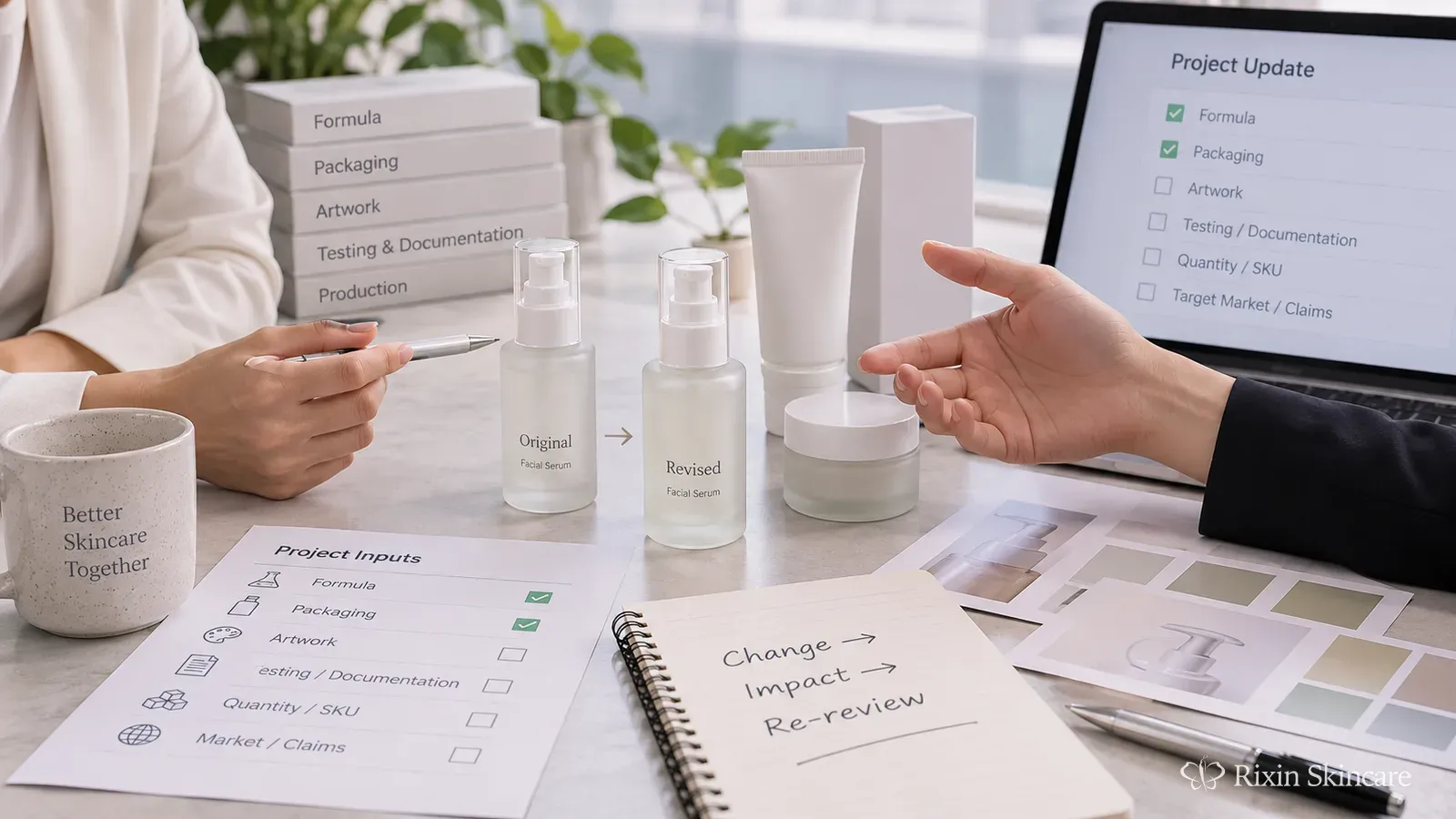
If a skincare formula, package, artwork file, order detail, claim, or target market changes after approval, do not assume every previous approval is automatically invalid—but do not assume it still covers the new version either. Start with the exact project version that was last approved or confirmed, then check which formula, packaging, artwork, order, evidence, or market decisions may also be affected.
A useful buyer-side framework is Change → Impact → Re-review. It is not a formal Rixin SOP or regulatory change-control system. It is a practical way to reopen only the decisions affected by a change before bulk production moves forward.
This change-review step is part of the full skincare production-readiness guide, while the focus here remains on identifying only the decisions affected after approval.
Start With the Last Approved Project Basis
The project basis is the exact version you are comparing against. Depending on the project, it can include the current formula or approved product reference, packaging, artwork, SKU quantities, order scope, and relevant testing or documentation status.
The previous article on what to confirm before skincare bulk production explains these production-readiness inputs in more detail.
Instead of asking, “Did we change the project?”, ask:
“What changed from the exact version that was last approved or confirmed?”
Changing one artwork color is not the same as changing the formula, primary package, fill size, claims, and target market at the same time. Define the change precisely before deciding what to reopen.
Use Change → Impact → Re-review
| Step | Buyer question | Output |
|---|---|---|
| Change | What is different from the last confirmed version? | Clear old-versus-new reference |
| Impact | Which connected areas could be affected? | Short impact list |
| Re-review | Who confirms whether the previous approval still applies? | Confirmed, needs re-review, or open |
Typical owners vary by project:
- formula or product reference → formulation or technical owner;
- packaging or dispensing → packaging or technical owner;
- tests, specifications, or documents → quality or technical reviewer;
- claims or market requirements → appropriate regulatory or market reviewer;
- quantity, timing, or quotation → commercial or manufacturing-project owner.
This avoids two opposite mistakes: restarting the entire project for every change, or continuing with an old approval that no longer matches the current version.
Example: The Pump Changes
Suppose a serum package was confirmed, but the brand later changes the pump.
Change: the pump differs from the confirmed component.
Impact: dispensing, component fit, filling, artwork dimensions, MOQ, timing, or quotation may need another look.
Re-review: the packaging or technical owner identifies which physical-package decisions need to reopen. Commercial or manufacturing-project review is added only if MOQ, timing, or quotation assumptions are affected.
The point is to reopen affected decisions, not every approval.

If the Formula Changes
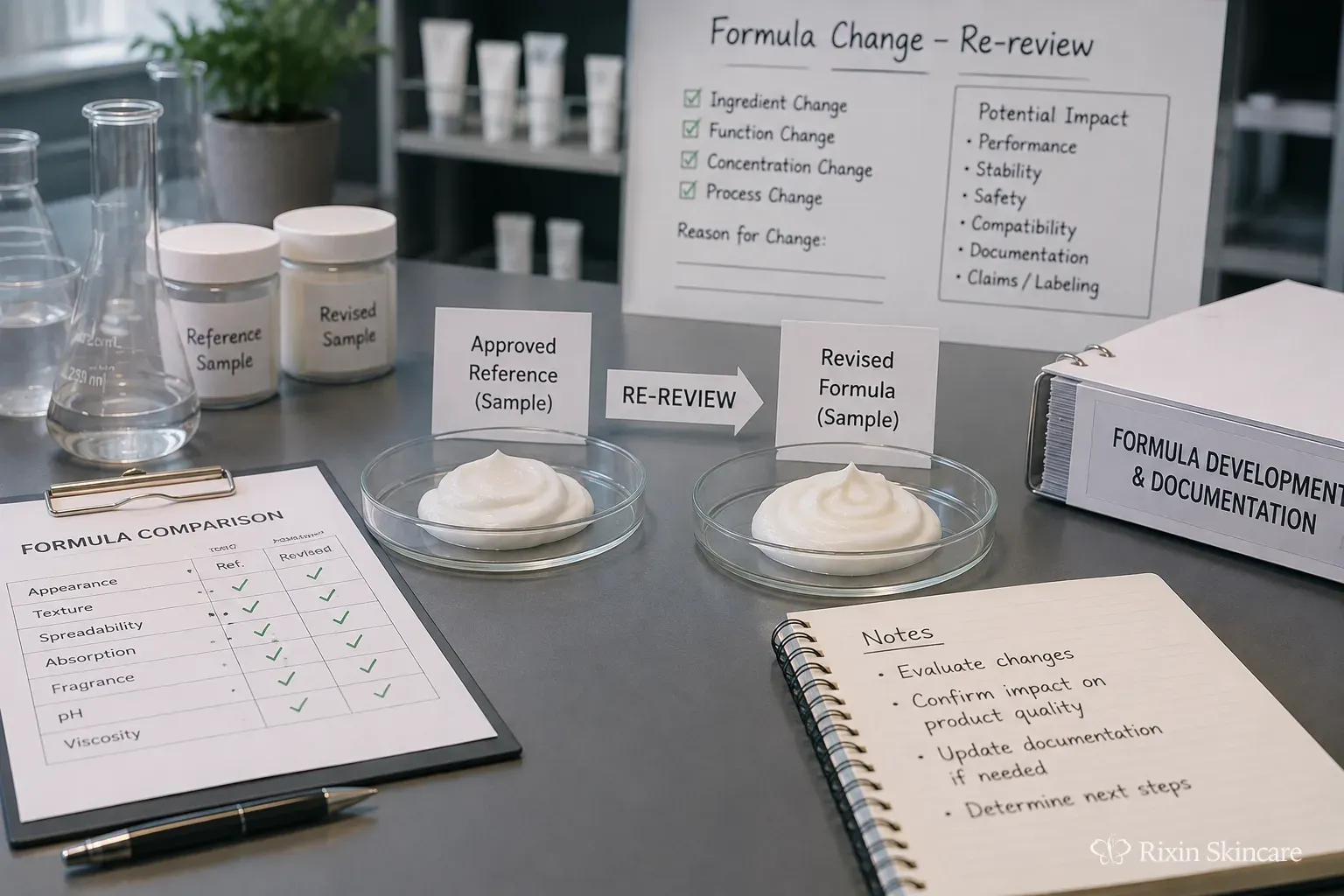
A formula change can range from a limited adjustment to a larger change in the approved formula plan.
Identify exactly what changed: an ingredient, concentration, texture target, fragrance, sensory direction, or another formula decision. If the formula has changed materially, the previously accepted sample or product reference may no longer represent the version intended for production.
Depending on the change, another review may be needed for:
- formula development or sample reference;
- whether the formula and packaging still work together as intended;
- testing or documentation;
- artwork or ingredient information;
- MOQ or production timing;
- the current quotation.
This does not mean every formula change automatically requires a new stability test, microbiological test, pilot batch, or complete restart. The appropriate technical, quality, or regulatory reviewer should determine what remains applicable.
If another development cycle is needed, return to Sampling and Formula Approval and Formula Development.
If the Packaging Changes
Packaging changes can affect more than appearance.
A new bottle, jar, tube, pump, closure, dropper, fill size, carton, or decoration direction may affect filling, dispensing, protection, presentation, or printing. Identify which relationship actually changed.
Replacing a pump may require a further review of dispensing or component fit. Changing the primary container may reopen questions about whether the formula and package work together as intended. Changing carton dimensions may require updated artwork or dielines.
A packaging change does not automatically mean every compatibility or packaging test must be repeated. The relevant packaging, technical, quality, or regulatory reviewer should determine which previous results or approvals still apply.
Detailed execution belongs in Packaging and Label Design. This article only identifies when a changed package may reopen one of those decisions.
If the Artwork Changes
First confirm which artwork version is current. Then ask whether the revision affects:
- package dimensions or print area;
- product name or net content;
- ingredient or formula-related information;
- claims or marketing wording;
- target-market language or required information;
- label, carton, or decoration execution.
A color adjustment may have a different impact from changing claims, ingredient information, or the market where the product will be sold.
If market-facing label requirements change, send that question to the appropriate regulatory or market reviewer before treating the revised artwork as final. For U.S./EU projects, the U.S. vs EU cosmetic labeling guide owns that deeper comparison.
If Quantity, SKU, Fill Size, Claims, or Market Changes
A change in SKU count, quantity, fill size, or order scope may affect component planning, MOQ, production timing, or quotation. Reconfirm the relevant order assumptions rather than assuming the original inputs still apply.
Keep the handoff clear:
- MOQ and timing → MOQ and Lead Time
- quotation effects → Why Skincare Manufacturing Quotes Change
A claim or target-market change can also affect artwork, supporting evidence, documentation, or market review even when the physical formula remains unchanged.
That does not mean a new market always requires reformulation. The appropriate regulatory or market reviewer should confirm whether the current formula, evidence, and artwork remain suitable for the changed market or claim.
Check Whether Existing Tests and Documents Still Apply
A project change can affect existing evidence, but there is no universal rule that every previous test or document must be repeated—or that everything can always be reused.
Instead, review applicability:
- What changed?
- What product, package, claim, market, or version did the previous evidence cover?
- Does the changed project still match that basis?
- Who is responsible for confirming continued applicability?
- What approved file, technical review, document, or written confirmation records the decision?
Requirements depend on the product, packaging, claims, market, project scope, and agreed responsibilities.
For deeper boundaries around testing, specifications, reports, and project documentation, use Quality Testing and Documentation.
Record the Change and Assign an Owner
| Field | What to record |
|---|---|
| Changed input | What changed? |
| Previous reference | What was approved or confirmed? |
| New reference | What is proposed now? |
| Possible affected areas | Formula, package, artwork, evidence, MOQ/timing, quote, or market review |
| Owner | Who reviews the affected area? |
| Re-review status | Confirmed, needs re-review, or open |
| Decision evidence | What records the decision? |
This is a buyer-side tracking aid, not a formal quality-management-system record.
For planning purposes, treat an unresolved change as production-blocking when it could alter what will be manufactured, packaged, printed, ordered, or supported by required project evidence and the responsible owner has not confirmed whether the previous approval still applies.
Final Rule Before Production Continues
If a change can alter what is manufactured, packaged, printed, ordered, or supported by required project evidence, do not rely on the old approval until the affected owner confirms whether the previous approval still applies.
If the responsible reviewer confirms that a particular area is unaffected, there is no reason to reopen it simply for the sake of process.
The goal is not to restart everything. It is to make sure the current formula, package, artwork, order, and supporting evidence still describe the same project before production moves forward.