On this page
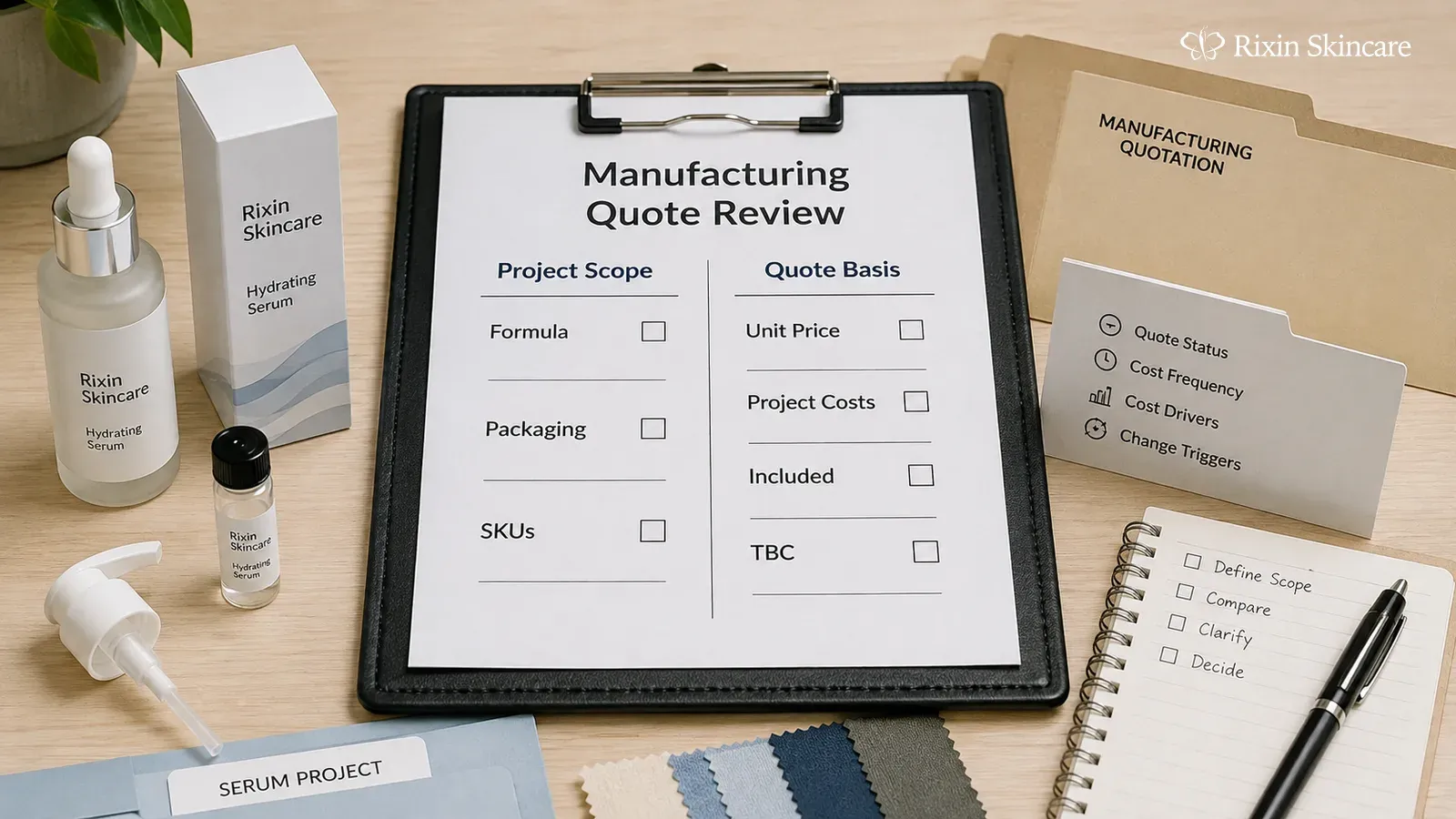
A skincare manufacturing quotation should not be approved from unit price alone. First define one scope, then compare formula, packaging, SKUs, quantity, testing, documents, delivery terms, and project-level costs on the same basis.
Record whether each item is included, separately charged, optional, excluded, or TBC, and identify the assumptions that can trigger a revised quote. Then decide whether to approve, approve with conditions, request clarification, revise the scope and re-quote, hold, or reject.
This guide helps B2B skincare buyers assess a quote, not find universal price ranges; project scope and supplier terms differ. It is commercial planning guidance, not accounting, tax, customs, legal, or financial advice.
Start With One Project Scope
A quotation becomes useful only when the scope is specific enough to price. Before comparing suppliers, define the formula route, SKUs, package and decoration, quantity, testing, documentation, target-market assumptions, delivery basis, and approval responsibilities.
Use one scope version and quotation date. If the formula, package, market, or quantity changes, ask for a revised quote on the new scope.
Record unresolved details as TBC, meaning to be confirmed. Do not treat them as free or included.
The detailed method for normalizing two or more supplier quotations belongs in compare skincare manufacturing quotes. This Hub explains why comparison matters and which scope fields must be aligned; use the spoke for the worksheet, like-for-like criteria, examples, and decision questions. Check quantity and timing assumptions against MOQ and lead time.
Separate Unit Price From Project-Level Costs
Unit price is the price for one finished unit under the stated quantity and scope. It may include formula, filling, packaging, decoration, or packing—but only when the quotation says so.
Project-level costs sit outside or alongside unit price. They may include formula samples, package proofs, tooling, decoration setup, testing, documentation, or other development work.
Also record how often a cost can occur:
- Shared project-level: may support several SKUs within the approved scope.
- Per SKU: may repeat for each sellable product configuration.
- Per package or artwork version: may repeat when a component, size, label, carton, or decoration changes.
- Per order or production run: may recur with each order.
- Change-triggered: arises when an approved specification or assumption changes.
These labels describe how often a cost may occur; they do not show whether it is included. For example, an artwork proof may be a separate charge and repeat for each artwork version.
The quotation controls the project-specific answer. See sampling, tooling, testing, and documentation costs for detail.
Confirm What the Quotation Includes
At Hub level, mark every important line as Included, Separate charge, Optional, Excluded, or TBC. “Packaging included” may still leave the components, decoration, assembly, freight, or supplier coordination unresolved, and TBC does not mean zero cost.
For the detailed scope ledger, examples, and approval questions, use what is included in a skincare manufacturing quote. Keep the Hub focused on the role of scope status in the complete quotation decision.
Identify the Cost Drivers and Change Triggers
A cost driver is a project choice that helps explain the quoted price. Group the main drivers as formula and materials; batch and quantity; packaging and decoration; SKU and market complexity; and testing, documentation, delivery, and timing.
A change trigger is an approved assumption or specification that, when changed, may require revised pricing. Examples include moving to another pump, increasing the number of artwork versions, adding a market, changing quantity, revising the formula, or adding tests or documents.
The same factor can be both a cost driver and a change trigger, but the two questions are different:
Cost driver
→ What approved choice helps explain the current quote?

Change trigger
→ What future change may require a new quote?
Use skincare manufacturing cost factors to review the drivers and why manufacturing quotes change to record re-quote conditions. Do not assign universal percentage effects.
Compare Quotes on the Same Basis
Comparison is a decision stage, not a second cost model. At Hub level, make sure formula route, SKUs, packaging and decoration, quantity, sampling, testing and documentation, target-market assumptions, currency, delivery, payment, and quotation version are defined on one project basis.
Then ask what the unit price covers, which charges sit outside it, which costs are shared or repeated, which items remain TBC, and which assumptions could trigger a revision. The lowest unit price is not automatically the lowest total project budget; compare the defined scope rather than the headline number.
For the detailed normalization method, comparison worksheet, practical examples, and decision questions, use how to compare skincare manufacturing quotes. The Hub owns why the comparison is necessary and how it fits the wider cost-and-quotation framework.
Review Packaging Decoration and SKU Complexity
Packaging can change both unit price and project-level work. Bottle or jar selection, pumps, caps, cartons, labels, coatings, printing, foil, embossing, proofs, setup, artwork, and component sourcing may each affect the quotation.
Use the packaging and label design capability as context, but confirm the exact scope in the quotation. See how packaging decoration affects a skincare quote for the detailed questions.
SKU count also affects budget structure. A new size, formula, shade, fragrance, package, artwork, or market version may create another SKU or repeat part of the work. Some costs may be shared; others may repeat per SKU or version.
Use the guide on how SKU count affects the manufacturing budget to separate shared work from repeated work. Do not assume every additional SKU repeats every cost.
Review Sampling, Tooling, Testing, and Documentation Costs
For each project-level item, record:
Trigger
Responsible party
Deliverable
Covered scope
Quote status
Cost frequency
Ownership or access
Reuse condition
Timing dependency
Sampling costs depend on purpose, scope, and repeat triggers. Tooling questions include control, storage, reuse, and packaging changes. Testing and documentation depend on the product, package, claims, target market, supplier, and project.
Do not assume a test or document is universally required, or that a tooling charge automatically means buyer ownership. The quotation should state whether each item is included, separately charged, optional, excluded, or TBC.
Rixin’s quality testing and documentation capability provides company-level context, not a promise that every test, document, or market review is included in every quote.
Use One Manufacturing Quote Review Matrix
Use one matrix to keep scope, status, frequency, and change conditions on the same basis. Detailed questions remain in the linked child guides.
| Review area | Main buyer question | Status to record | Detailed guide |
|---|---|---|---|
| Project scope | Are formula, packaging, decoration, SKUs, quantity, testing, documents, and delivery assumptions defined? | Confirmed / inconsistent / TBC | Quote comparison |
| Unit price | What exactly does the unit price cover? | Included / separate / optional / excluded / TBC | Quote inclusions |
| Cost drivers | Which approved project choices explain the price? | Confirmed driver / unclear / TBC | Cost factors |
| Quote changes | Which assumption or specification can trigger a revision? | Stable / change-triggered / TBC | Why quotes change |
| Packaging decoration | Which component, artwork, proof, setup, or decoration work affects the quote? | Included / separate / optional / excluded / TBC | Decoration costs |
| SKU count | Which costs are shared and which repeat by SKU or version? | Shared / per SKU / per version / TBC | SKU budget |
| Project-level costs | How are sampling, tooling, testing, and documentation priced and repeated? | Shared / repeated / one-off / ongoing / TBC | Project-level costs |
Do not combine these labels into one score. Quote status shows how an item is charged; frequency shows how often it may recur; driver and trigger labels explain the current price and re-quote risk.
Approve, Clarify, Revise, Hold, or Reject the Quotation
Maintain one Manufacturing Quote Review Record:
Supplier and quotation ID
Quotation date and version
Project scope version
Product and formula route
SKU count
Packaging and decoration scope
Quantity basis
Currency and delivery basis
Unit price
Included items
Separate charges
Optional and excluded items
TBC items
Shared, per-SKU, per-version, and repeated costs
Change-triggered costs
Testing and documentation assumptions
Quotation review date
Open clarification
Responsible owner and due date
Decision and decision date
Re-quote trigger
Then choose one outcome:
- Approve: the scope, price basis, charges, assumptions, and change triggers are sufficiently clear.
- Approve with conditions: named conditions must be completed by a defined date.
- Request clarification: the scope remains, but one or more quote items need a clear answer.
- Revise scope and re-quote: a formula, package, SKU, quantity, testing, documentation, delivery, or other assumption changes.
- Hold: a material cost, scope, supplier, timing, or commercial item remains uncertain.
- Reject: the quotation, unresolved scope, or project fit is unacceptable.
Do not approve until the scope, unit-price basis, statuses, frequencies, assumptions, and change triggers are recorded together. This is a buyer-control method, not accounting, tax, customs, legal, financial, or contractual advice.
Choose the Detailed Guide for Your Next Question
Use the Hub first, then open the guide that matches the immediate issue:
- Quotes cannot be compared → compare skincare manufacturing quotes.
- The price drivers are unclear → skincare manufacturing cost factors.
- Inclusions or exclusions are unclear → what is included in the quote.
- The price changed → why manufacturing quotes change.
- Decoration cost is unclear → packaging decoration and quotation cost.
- SKU budget is unclear → how SKU count affects the budget.
- Project-level costs are unclear → sampling, tooling, testing, and documentation costs.
Keep every unresolved item visible, assign the next action, and request a revised quotation when the approved scope changes.