On this page
A brightening skincare formula can be technically workable and still create a claim problem.
A brand may begin with a familiar active, select a serum or moisturizer format, approve the texture, and move toward formula lock—only to ask later:
What can we actually say about this product?
Can we use the ingredient study?
Do we need finished-product testing?
Can we say it reduces dark spots?
Does the same wording work in the U.S. and EU?
Those questions should not begin after the formula is finished.
They should be part of product development before formula lock.
The practical sequence is:
intended claim → available evidence → formula implications → testing decision → formula lock
That does not mean every cosmetic claim requires the same type of study. It means the brand should know what it wants the finished product to communicate before the formula becomes expensive or difficult to change.
If the wider product role, target market, format, and ingredient strategy are still unresolved, start with the Brightening Skincare Product Development Hub.
Decide the Claim Before You Lock the Formula
A product formula and its market-facing claims should not be developed as two unrelated projects.
The intended wording affects decisions around:
- ingredient selection;
- active levels;
- supporting ingredients;
- target market;
- testing;
- documentation;
- packaging communication;
- and the evidence the brand may need before launch.
Consider the difference between these directions:
- brighter-looking skin;
- improved radiance;
- a more even-looking complexion;
- improvement in the appearance of visible dark spots;
- a quantified performance statement;
- or treatment-style language about a skin condition.
They are not automatically the same claim with different wording.
They can create different evidence and regulatory questions.
The brand does not necessarily need final marketing copy before formulation starts. But it should know the type and strength of claim it intends to pursue.
A useful early question is:
What do we want a reasonable customer to believe this finished product does?
That is the claim the evidence plan ultimately needs to address.
Separate Ingredient Evidence From Finished-Product Evidence
One of the most important distinctions in brightening product development is:
Evidence about an ingredient is not automatically evidence about the finished product.
A supplier may provide research, technical information, literature references, or other documentation relating to a particular raw material.
That information can be useful.
It may help the development team understand:
- why the ingredient was shortlisted;
- what type of cosmetic positioning may be relevant;
- what material was studied;
- what conditions were used;
- and what questions should be investigated during formulation.
But the finished product contains more than an isolated ingredient.
It has:
- a particular ingredient grade or supplied material;
- a selected concentration;
- a complete formula base;
- other actives and supporting ingredients;
- a pH and processing history;
- packaging;
- directions for use;
- and a real consumer-use pattern.
Those differences matter.
A study involving an ingredient does not automatically establish that a different finished formula will deliver the same result.
For brands still deciding which active direction to use, the Brightening & Uneven Tone ingredient collection is the better starting point. Once a material is shortlisted, its individual Ingredient page should handle material-level questions such as formulation fit, specification, stability, supplier documentation, and evidence limitations.
This article owns the next question:
How should that ingredient evidence be used when deciding what the finished product can claim?
Match Claim Strength to Evidence Strength
Not every brightening claim carries the same evidentiary burden.
A useful development principle is:
The more specific the promised result becomes, the more specifically the supporting evidence needs to match that result.
That does not create a universal testing formula. The exact requirement depends on the wording, product, evidence, market, and how consumers are likely to understand the claim.
But the distinction can be illustrated like this:
| Claim direction | Main evidence or review question | Development implication |
|---|---|---|
| Radiance or brighter-looking skin | Does the evidence reasonably support the cosmetic appearance message being communicated? | Keep wording aligned with what the formula and available support can justify. |
| More even-looking tone or visible dark-spot appearance | Does the support relate closely enough to the finished product and claimed benefit? | Review whether ingredient evidence is sufficient or finished-product substantiation is appropriate. |
| Quantified or highly specific performance statement | Can the stated magnitude, timeframe, or result actually be demonstrated? | Define the substantiation method before using exact performance language. |
| Treatment, disease, or body structure/function language | Does the wording raise a product-classification or other regulatory issue in the target market? | Treat this as a market-specific regulatory question, not simply the strongest step on an evidence ladder. Do not assume the wording is an ordinary cosmetic claim pending review. |
The final row is deliberately different from the first three.
A treatment-style or structure/function statement is not simply a cosmetic claim that needs “more evidence.” Depending on the target market and wording, it can change the regulatory question itself.
The broader principle still holds:
claim wording and evidence planning must move together, but evidence strength does not replace product-classification review.
Know What Supplier Data Can—and Cannot—Do
Supplier documentation is important in ingredient-led product development, but it should be used for the job it actually performs.
Depending on the selected material and documentation available, supplier information may help with questions such as:
- material identity;
- specification;
- recommended formulation conditions;
- supplier-described use levels;
- technical compatibility considerations;
- stability or handling information;
- ingredient-level research;
- and the rationale for considering the material.
That can be very useful for formulation.
But several questions still need to be asked before using supplier evidence in a finished-product claim strategy:
Is It the Same Material?
Research on one grade, proprietary blend, delivery system, or supplied form may not automatically describe another material sold under a similar familiar ingredient name.
Is the Formula Using It Under Comparable Conditions?
Concentration, formula environment, product format, use frequency, and other variables may differ from the conditions behind the original evidence.
What Exactly Did the Evidence Measure?
A mechanism discussion, laboratory result, ingredient study, consumer-perception study, instrumental measurement, and finished-product performance study do not answer the same question.
What Claim Does the Brand Want to Make?
The evidence needs to be assessed against the actual market-facing message—not merely against the presence of a recognizable ingredient.
Supplier documentation can therefore support the evidence review.
It should not be treated as an automatic finished-product claim certificate.
Do Not Turn a Mechanism Into a Consumer Result
Ingredient-led skincare marketing often moves too quickly from:
how an ingredient may work
to:
what the finished product definitely does.
Those are different layers of evidence.
Research may discuss a biological or chemical mechanism associated with an ingredient.
That does not, by itself, establish:
- the magnitude of a visible result;
- how quickly a consumer will see it;
- whether the same result occurs in the finished formula;
- or whether the commercial product can use a particular performance claim.
Mechanistic evidence can be useful context.
It can help explain why a material is interesting.
But mechanism should not silently become a stronger finished-product promise.
This distinction is especially important for brightening products because ingredient stories can easily drift toward treatment-like language when the original commercial goal was simply cosmetic appearance positioning.
Why the Exact Formula Changes the Evidence Question
Even when the hero ingredient stays the same, changing the formula can change what evidence is relevant.
Suppose a brand starts with a selected active and then changes:
- the active level;
- the supplier material;
- the supporting active system;
- the pH;
- the formula base;
- the delivery format;
- the packaging;
- or the directions for use.
The product being evaluated is no longer exactly the same development concept.
That does not mean every formulation adjustment invalidates every piece of ingredient information.
It means evidence needs to be reviewed for relevance, not merely existence.
This is one reason the claim strategy should be discussed while the formula still has room to change.
If a desired claim depends on a formula characteristic that has not yet been established, that question belongs inside formulation development rather than being left entirely to post-launch marketing.
For the ingredient-system decision itself, see Brightening Skincare Formulation: Hero Active vs Multi-Active System.
When Finished-Product Testing Becomes Relevant
There is no universal rule that every brightening cosmetic needs the same finished-product test.
Testing should follow the intended claim.
The useful question is:
What evidence would be appropriate for the exact statement the brand wants to make about this finished product?
Finished-product testing becomes particularly relevant to review when the brand wants to communicate a result that depends on the complete formula rather than merely identifying an ingredient.
That may include situations where the proposed marketing becomes:
- more specific;
- more quantitative;
- tied to a particular visible outcome;
- tied to a defined use period;
- or dependent on the performance of an active system rather than one ingredient story.
The appropriate method cannot be selected from the claim category alone.
It may depend on:
- the final wording;
- the product format;
- the target population;
- the market;
- the type of outcome being evaluated;
- the evidence already available;
- and the intended marketing channels.
Testing method, provider, scope, responsibility, timing, and quotation status therefore need to be reviewed at project level.
Those detailed decisions belong in the project’s Quality, Testing & Documentation scope rather than being assumed from the word “brightening.”
Testing Should Answer a Claim Question
A useful testing plan begins with a defined question.
For example:
What statement are we trying to support?
That should come before:
Which test should we buy?
Starting with a testing method and searching afterward for marketing language can create the wrong sequence.
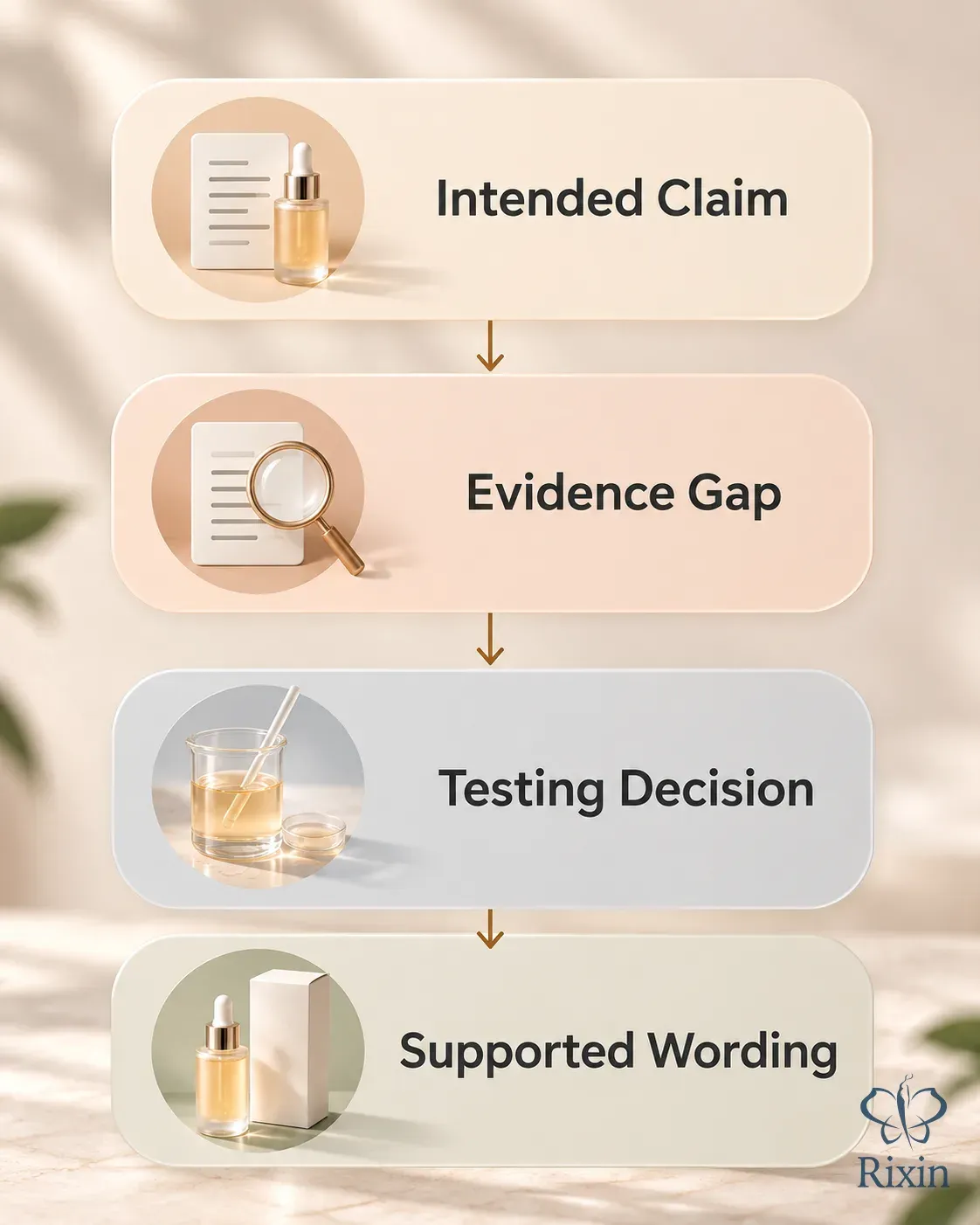
The better sequence is:
- Define the intended cosmetic claim.
- Identify what the available ingredient or product evidence already supports.
- Identify the evidence gap.
- Decide whether additional finished-product substantiation is needed.
- Select an appropriate evaluation method for that gap.
- Review whether the result can actually support the proposed wording.
This keeps evidence planning connected to the product rather than turning testing into a box-checking exercise.
It also reduces the risk of paying for a study that does not answer the question marketing eventually wants to ask.
U.S. Labeling and Advertising: Distinct Questions, Overlapping Responsibilities
For products intended for the U.S., two different questions can matter.
FDA: What Is the Product Being Presented as?
FDA’s Cosmetics Labeling Claims page explains that information on cosmetic labeling, including claims, must be truthful and not misleading.
FDA also explains that if a product is marketed for purposes such as treating or preventing disease, or affecting the structure or function of the body—including the skin—it is a drug under U.S. law and must meet applicable drug requirements.
For a brightening project, that means the team should be cautious about allowing appearance-focused language to drift into treatment or physiological-effect language without reviewing the classification consequences.
The important development question is not:
Which brightening words has FDA approved?
FDA does not maintain a pre-approved list of ordinary cosmetic claims.
The question is:
What intended use does the complete labeling and presentation communicate?
FTC: What Does the Advertising Communicate, and Is It Supported?
The FTC’s Health Products Compliance Guidance is FTC staff guidance explaining advertising law, not a rule with independent force of law. FDA and FTC have different primary responsibilities, but their jurisdiction can overlap, including for marketing claims on packaging and labeling.
The FTC guidance explains that advertisers should identify the express and implied objective claims communicated to reasonable consumers and possess adequate substantiation for those claims before the advertising is disseminated.
That means the claim is not limited to one headline sentence.
Images, context, demonstrations, ingredient references, qualifiers, and the overall advertising message can affect what consumers reasonably understand the product to promise.
The development implication is simple:
Do not plan the evidence only around one line of package copy if the broader marketing will communicate a stronger performance message.
For the wider market-readiness questions beyond claim substantiation, use the U.S. and EU Skincare Market Entry Readiness Guide.
EU Claims Require Evidence That Matches the Finished Product Claim
Commission Regulation (EU) No 655/2013 establishes common criteria for cosmetic claims. Its Annex, section 3(1), requires cosmetic claims—whether explicit or implicit—to be supported by adequate and verifiable evidence.
The Annex also states that studies used as evidence should be relevant to the product and benefit claimed (section 3(3)), and that the level of substantiation should be consistent with the type of claim (section 3(4)).
The Regulation is particularly relevant to ingredient-led brightening products because Annex section 3(6) specifically addresses extrapolation from ingredient properties to the finished product.
A claim that extrapolates an ingredient’s properties to the finished product requires adequate and verifiable support.
This does not mean ingredient evidence has no value.
It means the brand needs to ask:
What does the ingredient evidence establish, and what additional support is needed to justify the finished-product communication?
That distinction should be resolved before the final packaging and marketing claim architecture is locked.
Do Not Assume the Same Claim Package Works in Every Market
A brand developing one formula for several markets may want one universal set of claims.
Commercially, that is understandable.
But claims should be reviewed against the market where they will actually be used.
The same core cosmetic positioning may sometimes be adaptable across markets, but the brand should not assume that:
- the same wording;
- the same evidence package;
- the same disclaimer or qualification;
- the same advertising execution;
- or the same supporting documentation
will automatically satisfy every market and every channel.
This article does not replace a full regulatory or market-readiness review.
Its role is narrower:
identify the claim direction early enough that market-specific review can happen before packaging, formula, evidence, and launch decisions become difficult to change.
Build a Claim-and-Evidence Brief Before Formula Lock
A useful brightening claim brief does not need to be a legal document.
It needs to make the decisions visible.
Before formula lock, record:
-
Primary cosmetic positioning What should the customer understand the product is designed to do?
-
Draft claim direction Is the intended wording about radiance, brighter-looking skin, more even-looking tone, visible dark-spot appearance, or another cosmetic benefit?
-
Target markets Where will the claim be used?
-
Hero ingredient and supporting system Which materials are central to the story?
-
Available ingredient evidence What research, supplier information, or other support is actually available for the selected material?
-
Evidence limitations Does the existing support relate to another grade, concentration, format, study condition, or ingredient rather than the finished product?
-
Finished-product claim Is the brand making a statement about the ingredient or about the performance of the completed formula?
-
Evidence gap What important part of the intended claim is not yet supported?
-
Testing question Does the proposed finished-product communication justify reviewing additional substantiation?
-
Open regulatory questions Is any wording close enough to treatment, disease, structure/function, or another higher-risk area that market-specific review is needed?
For each proposed claim, keep a versioned decision record with the draft wording, intended market and channel, evidence source, relevant finished-formula version, responsible reviewer, and a status such as supported, revise, open, or hold. Record the evidence gap or next review action where the claim is not yet supported. These are internal review statuses, not regulatory approvals.
The manufacturer does not need to write the final advertising campaign at this stage.
But the development team does need enough information to identify when the requested formula, claim, and evidence plan are moving in different directions.
Formula Lock Should Not Be the End of the Evidence Conversation
Formula lock means the core formula has reached an agreed development point.
It should not be the first time anyone asks whether the claims are supportable.
By that stage, the brand should already understand:
- what it wants the product to communicate;
- which evidence relates to the selected ingredients;
- which statements concern the finished product;
- where the current evidence has limitations;
- whether additional substantiation needs review;
- and which market-specific claim questions remain open.
The stronger or more specific the commercial promise becomes, the more deliberately the evidence should be matched to that promise.
That is the central principle:
Do not start with the strongest claim you want to print and work backward looking for evidence.
Start with the product you are actually developing, identify what you can support, and decide what additional evidence would be needed before making the claim stronger.
For the broader development sequence—from product positioning and target market through ingredient system, format, manufacturing route, and future line planning—return to the Brightening Skincare Product Development Hub.