On this page
A brightening skincare brief often arrives with an ingredient already chosen.
A brand may say it wants a tranexamic acid serum, a niacinamide moisturizer, an alpha-arbutin product, or a formula built around a Vitamin C derivative. Then the ingredient list starts growing.
Can we add another brightening active? What about niacinamide too? Should we include something for hydration? Would adding more recognizable ingredients make the product stronger?
Sometimes the answer is yes.
Sometimes the better formula is the simpler one.
The useful question is not “How many actives should a brightening product contain?”
It is:
Does every ingredient in the system have a clear role, fit the same formula, and support the positioning the brand is actually trying to build?
In practice, stay focused when one hero active already gives the product a clear role and additional actives do not add a distinct necessary function. Use a multi-active system when each additional active has a specific, non-duplicative role and the complete system remains technically, commercially, and evidentially workable.
If the overall product role, target market, or format is still unclear, start with the Brightening Skincare Product Development guide. Once those decisions are defined, the next step is deciding whether the finished formula should stay focused around one hero active or use a deliberately designed active system.
Start With the Job of the Formula
Before adding a second or third active, define what the finished product needs to do.
A brand may be trying to create:
- a serum with one highly recognizable hero ingredient;
- a formula that combines several complementary cosmetic benefits;
- a moisturizer where brightening positioning needs to coexist with daily comfort;
- or a more differentiated formula for a crowded product category.
These are different formulation problems.
If the product story is already strong with one hero active, additional actives need to justify their presence.
If the intended positioning genuinely requires several different formulation roles, a multi-active system may make more sense.
The number of actives should come after the product role—not before it.
When a Focused Hero-Active Formula Makes Sense
A focused formula does not necessarily mean the product contains only one active ingredient.
It means one ingredient clearly leads the positioning, while the rest of the formula supports that product concept rather than competing with it.
This approach can make sense when the hero ingredient already gives the product a clear reason to exist.
For example, the brand may have selected an ingredient because:
- its customers already recognize it;
- it fits an established product story;
- the brand wants one clear ingredient message on the product page or packaging;
- it has a useful place in the existing assortment;
- or the brand wants to reduce unnecessary formulation complexity.
A focused brief also gives the formulation team more room to optimize the complete product around that direction.
That can include texture, solvent system, pH, preservation, packaging, sensory feel, and other supporting ingredients that may not appear in the headline marketing story.
The important distinction is:
Focused does not mean simplistic.
A technically well-designed formula may contain many materials while still presenting one clear hero-active story.
When a Multi-Active System Makes Sense
A multi-active system is justified when several ingredients are doing different, deliberate jobs inside the same finished formula.
The goal is not to create the longest possible ingredient list.
A useful active system might include:
- one ingredient that leads the market-facing story;
- another ingredient selected for a complementary cosmetic role;
- supporting ingredients that improve the overall product experience;
- and a base formula designed to keep the full system technically workable.
The word system matters.
It implies that the ingredients were selected together because they make sense inside one product—not because each ingredient is independently popular.
For a brightening concept, that means asking questions such as:
- Does the second active add a distinct role, or does it mainly duplicate the first?
- Does the additional ingredient improve the intended product concept enough to justify extra complexity?
- Can the selected materials work inside the same pH, phase, process, and packaging environment?
- Does the evidence available actually support the story the brand wants to tell?
- Is the finished formula still realistic at the target cost and product format?
If those questions have good answers, a multi-active system can be a rational formulation direction.
If the only reason for adding another ingredient is “customers have heard of it,” that is usually not enough.
Give Every Supporting Ingredient a Reason to Be There
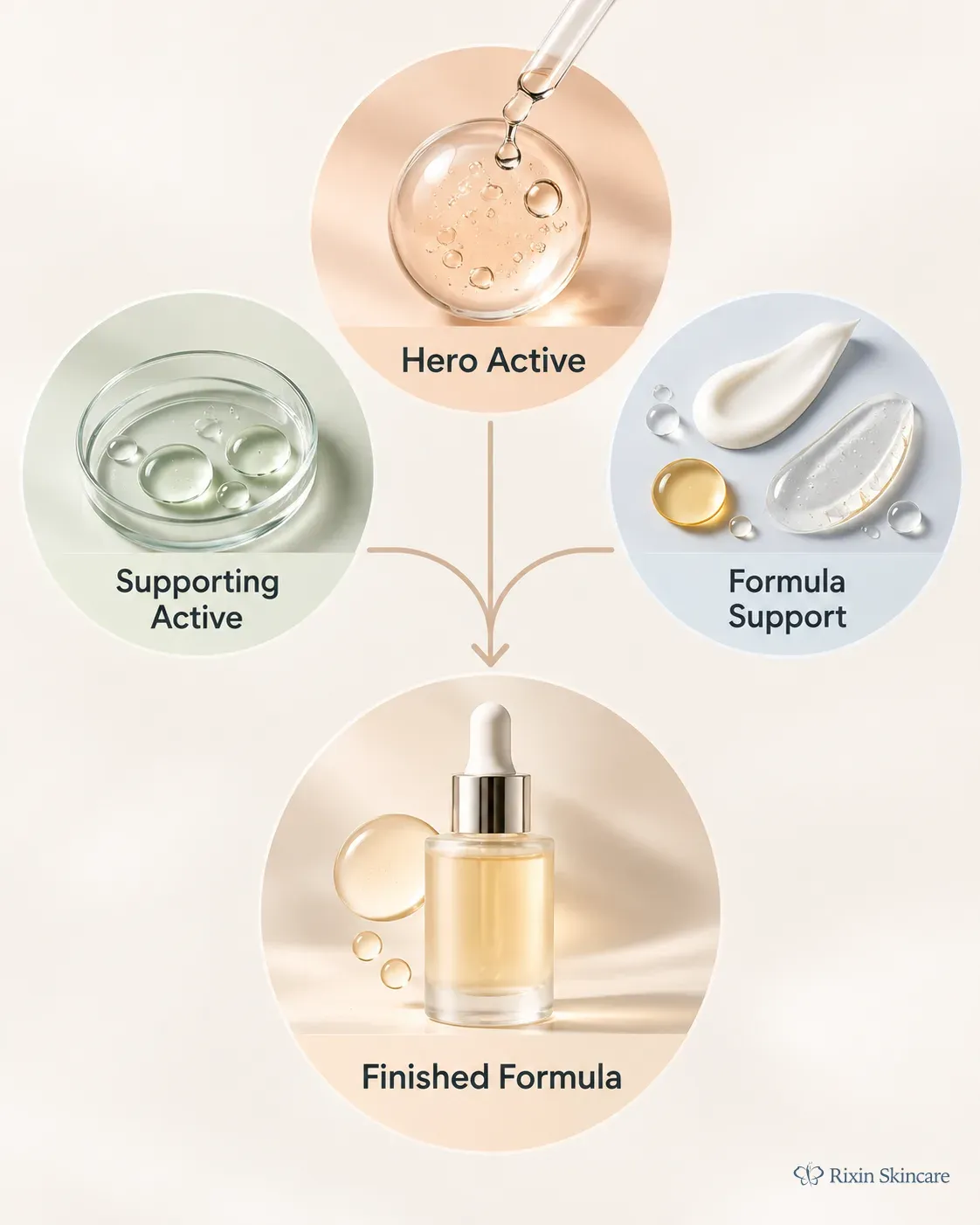
One useful way to review a formula brief is to assign each important ingredient a job.
The exact categories will vary by formula, but the logic can look like this:
Hero Active
This is the ingredient that leads the product concept.
It may be the ingredient the customer originally requested, the ingredient with the strongest recognition in the target market, or the material around which the formula was commercially positioned.
Supporting Active
A supporting active should add something meaningfully different to the product concept.
It should not be included merely to create another callout.
Its role should be explainable in one sentence.
Formula-Supporting Ingredients
Not every important material needs to become a marketing claim.
Humectants, emollients, rheology modifiers, chelating agents, antioxidants, soothing ingredients, preservation components, and other formulation materials may be important because they help create the texture, stability, sensory experience, or technical environment the finished product requires.
That distinction matters.
A good formulation brief does not force every useful ingredient into the consumer-facing hero story.
Do Not Build the Formula From Marketing Percentages Backward
One common briefing problem is starting with a list of ingredient percentages collected from competitor packaging, social media, supplier marketing, or other products.
That can produce a brief like:
We want Ingredient A at this percentage, Ingredient B at this percentage, and Ingredient C at this percentage because those levels appear in other products.
Those numbers may not transfer cleanly into a different formula.
The usable level of a material can depend on factors such as:
- the exact supplier material or grade;
- whether the supplied material is a powder, solution, dispersion, premix, or another form;
- active-content basis;
- solubility;
- formula pH;
- phase;
- processing conditions;
- interactions with other ingredients;
- target texture;
- packaging;
- stability;
- and market or claim requirements.
Two materials with the same familiar ingredient name may not necessarily be supplied in the same form or specification.
That is why concentration decisions should be reviewed against the actual selected material and the complete formula, rather than treated as standalone marketing numbers.
Use the Brightening & Uneven Tone ingredient collection to compare possible ingredient directions. Once a specific active is selected, its individual Ingredient page should own the material-level questions such as supplied form, specification, formulation fit, stability, processing considerations, supplier documentation, and evidence limitations.
Check Whether the Ingredients Can Live in the Same Formula
A multi-active concept can look excellent on a marketing brief and still create technical conflicts when formulation begins.
Before committing to the full ingredient stack, review the system across several layers.
1. Exact Material Identity
Confirm what material is actually being evaluated.
The ingredient name alone may not tell you the supplier, grade, carrier system, active basis, supplied form, or technical specification.
Those details can change how the material behaves in formulation.
2. Solubility and Phase
Determine where each selected material needs to go in the formula and whether the intended format can accommodate it.
Adding several actives with different solubility requirements can place constraints on the base system.
3. pH
Some materials have practical pH requirements or preferred environments.
The important question is not whether two ingredient names commonly appear together online. It is whether the selected materials can work within one realistic finished-product pH range.
4. Processing
The manufacturer may need to review addition stage, temperature exposure, mixing conditions, order of addition, or other process requirements.
A formula that works only under incompatible processing conditions may need to be redesigned.
5. Stability
More actives can introduce more possible causes of:
- color change;
- odor change;
- precipitation;
- crystallization;
- viscosity drift;
- phase instability;
- or degradation of sensitive materials.
That does not mean a multi-active system is inherently unstable.
It means the completed system needs to be evaluated as a formula.
6. Packaging
The package is part of the formulation decision.
A formula containing sensitive materials may require the development team to review light exposure, air exposure, dispensing system, headspace, material compatibility, and the way the consumer repeatedly opens or uses the package.
When these questions become material to the project, they belong in a proper Formula Development review rather than being resolved through ingredient-list planning alone.
More Actives Can Create More Evidence Problems
Adding another marketable ingredient also adds another question:
What exactly is the brand going to say about it?
Ingredient research may help explain why a material was considered.
But evidence relating to an ingredient is not automatically proof of the performance of a finished multi-active product.
That distinction becomes more important when a formula includes several actives and the brand wants to make broader claims based on the combined system.
The team should therefore separate:
- why each ingredient was selected;
- what evidence exists for the selected material;
- what the finished product is intended to claim;
- and what additional finished-product evidence may be needed.
This article is not the place to resolve the complete claim-substantiation process. For the detailed process of planning claims, evidence, and finished-product substantiation before formula lock, see Brightening Skincare Claims and Evidence. The formula should not be finalized without knowing what level of evidence the commercial positioning may require.
More Actives Can Also Reduce Commercial Flexibility
Formula complexity is not only a technical issue.
Additional actives can affect raw-material cost, sourcing flexibility, minimum purchase requirements for particular materials, development work, testing needs, and the options available if the brand later needs to reduce cost.
That does not mean a multi-active system is commercially unsuitable. It means each added requirement should contribute enough to the product concept to justify the added constraint.
Detailed costing belongs in the Skincare Manufacturing Cost and Quotation Guide. At this stage, the relevant question is simply whether another active improves the product enough to justify its technical and commercial consequences.
Do Not Confuse “More Differentiated” With “More Ingredients”
Brands often want the new SKU to feel different from what competitors already sell.
Adding more actives is one way to change a formula brief, but it is not the only way to create differentiation.
A product can also be differentiated through:
- texture;
- format;
- sensory profile;
- packaging;
- active delivery approach;
- product role within the brand’s assortment;
- target user;
- usage experience;
- or a clearer, more disciplined ingredient story.
This is particularly important when several competitors already use the same recognizable ingredient.
The solution does not automatically need to be:
Use the same hero ingredient, then add three more popular actives.
Sometimes a more focused formula with better positioning is more distinctive than a crowded formula trying to communicate five ingredient stories at once.
Use Sampling to Check Whether the System Still Works as One Product
Once the active system moves into sampling, evaluate whether the ingredients still make sense together as a finished product—not only whether the ingredient list looks strong on paper.
That includes practical observations such as texture, color and odor, absorption or layering, package dispensing, and any obvious separation, precipitation, or other visible issues.
Sampling is one development checkpoint. A good sample does not by itself prove long-term stability or finished-product efficacy.
The purpose here is to determine whether the active system remains worth developing, needs adjustment, or should be simplified.
Know When to Remove an Active
One of the most useful formulation decisions can be deciding not to add something.
Consider removing or deprioritizing an active when:
- it duplicates a role already covered by the formula;
- the technical complexity is disproportionate to its contribution;
- it creates a pH, solubility, process, or stability conflict;
- it pushes the cost beyond the intended product position;
- the brand cannot clearly explain why it is present;
- the evidence does not support the intended marketing role;
- or it was added mainly because the ingredient is currently popular.
Removing an ingredient does not automatically make a formula weaker.
Sometimes it creates more room to optimize the ingredients that remain.
A Practical Decision Framework
Before deciding between a focused hero-active formula and a broader active system, review the project across these questions:
| Decision | Focused Hero-Active Direction | Multi-Active System Direction |
|---|---|---|
| Product story | One ingredient clearly leads | Several ingredients have distinct planned roles |
| Formula complexity | Brand wants tighter scope | Added complexity has a clear purpose |
| Supporting actives | Optional or limited | Needed to support the intended concept |
| Technical review | Fewer major active interactions to resolve | Compatibility of the full system must be reviewed |
| Evidence | Hero story can be explained clearly | Evidence and claims must be considered across the system |
| Cost flexibility | Easier to prioritize one major active direction | More materials may reduce flexibility |
| Sampling | Optimize one focused concept | Confirm the combined system still meets the brief |
Neither side is automatically better.
The correct choice depends on the specific brief.
Give the Manufacturer Clear Ingredient-System Priorities
For this decision, the manufacturer needs to know which parts of the active system are fixed and which can change.
Clarify:
-
Hero ingredient Which ingredient, if any, must remain central to the product?
-
Must-have supporting actives Which additional ingredients have a defined role and must remain?
-
Optional actives Which ingredients can be removed or substituted if they create unnecessary formulation constraints?
-
Target format Serum, toner, moisturizer, mask, or another format?
-
Target market Where will the finished product be sold?
-
Intended positioning What is the active system supposed to help communicate about the finished cosmetic product?
That is enough to make the ingredient-system discussion productive without turning this article into a general project-intake checklist.
Packaging direction, quantities, target budget, timing, reference products, delivery information, and other broader project inputs belong in the Project Requirements process.
The Better Formula Is the One With Clearer Roles
A hero-active formula and a multi-active system can both be valid approaches to brightening skincare development.
The difference is discipline.
In a focused formula, one active leads and the rest of the product supports that direction.
In a multi-active system, several ingredients may matter, but each one needs a defined role and must fit the same technical, commercial, and evidence framework.
The decision should not be driven by the number of ingredient callouts the brand can place on a product page.
It should be driven by whether the finished formula makes sense as one product.
If the brief is turning into a long list of popular actives, return to the product role, identify what each ingredient is supposed to contribute, and remove anything that cannot justify its place.
For the wider sequence from product positioning through format, claims, manufacturing route, and future line expansion, return to the Brightening Skincare Product Development Hub.