On this page
A brightening skincare project often starts with an ingredient.
A brand sees growing interest in tranexamic acid, niacinamide, alpha-arbutin, a Vitamin C derivative, or another active and decides it wants a serum, cream, toner, or mask built around that story.
That is a useful starting point. It is not yet a product brief.
Before formulation begins, the brand still needs to answer several connected questions: What role should the new SKU play in the existing line? Which market is it intended for? Is the requested active level and combination realistic? Does the selected format fit the formula? What claims should the product support? And what evidence will those claims require?
The strongest brightening product development strategy therefore starts with the product positioning and target market, then works backward to the ingredient system—not the other way around.
Start With the Product Role, Not the Ingredient List
For an established brand, a new brightening SKU should fill a defined gap in the existing assortment.
That gap might be a concentrated serum positioned around a hero active, a moisturizer that combines tone-focused positioning with daily comfort, or a mask designed as a distinct treatment-style step within the brand’s cosmetic range.
Before discussing percentages or adding supporting actives, define:
- what job this SKU needs to perform in the current line;
- who the intended customer is;
- what cosmetic concern the product will address;
- which market or markets the brand plans to sell in;
- what format the brand already has in mind;
- how the product should differ from existing SKUs;
- and what the customer should understand about the product after seeing the formula, packaging, and claims together.
This step prevents a common problem: building a formula around a popular ingredient and only later trying to decide what the finished product is supposed to be.
If the project will be sold in both the U.S. and EU, market planning should also start early. The broader category, labeling, claims, and documentation questions belong in the U.S. and EU market-readiness guide, rather than being treated as an afterthought once the formula is finished.
Give the Hero Ingredient a Clear Job
A hero ingredient can be commercially useful because consumers may already recognize its name and associate it with a particular skincare direction.
But popularity alone does not tell you whether the selected material fits the product you want to manufacture.
The important question is:
What role does this ingredient need to play in this specific product?
For example, a brand may come to a manufacturer asking for a product centered on tranexamic acid, niacinamide, alpha-arbutin, or a Vitamin C derivative. The next step is not automatically to add all of them.
Instead, the project team needs to review the selected material, intended positioning, target format, formulation environment, market, and evidence available for the exact product direction.
If the brand has not selected an active yet, the Brightening & Uneven Tone ingredient collection is the better place to compare ingredient directions.
Once an ingredient has been shortlisted, its individual Ingredient page should own the material-level questions such as identity, formulation fit, stability, processing considerations, supplier documentation, and evidence limitations.
The Blog’s job is different: deciding how that ingredient fits into the product strategy.
Check Formula Realism Before Adding More Actives
One of the easiest ways to make a brightening brief harder to execute is to keep adding ingredients because each one has a recognizable marketing story.
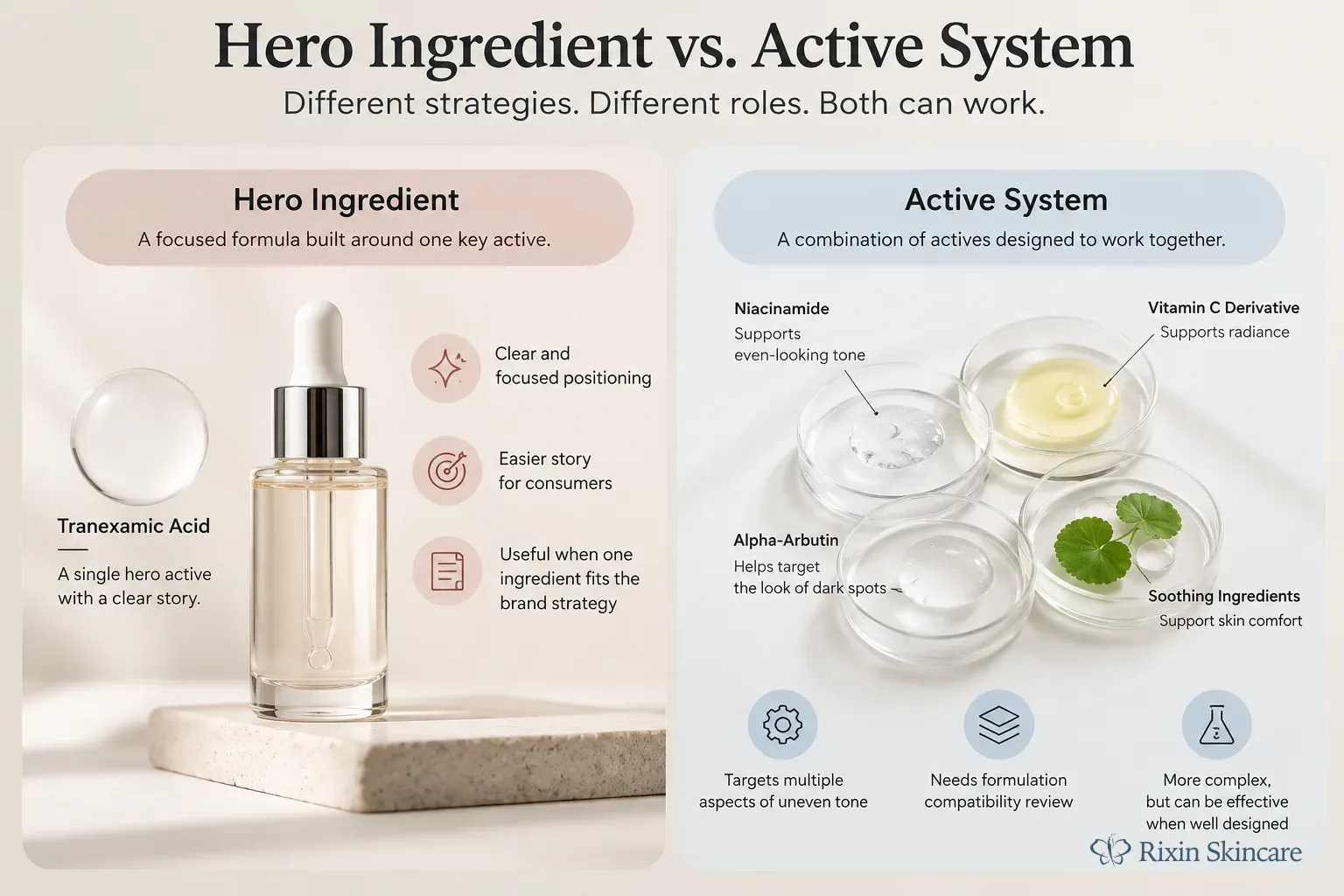
A focused hero-active formula may be right when one active already gives the product a clear role. A multi-active system may be right when each additional active adds a distinct, necessary role and the complete formula remains realistic.
There is no universal rule.
The decision should depend on the product goal, selected materials, formula environment, available evidence, and commercial fit. A longer ingredient list is not the same thing as a better formulation strategy.
For the detailed hero-active vs multi-active formulation strategy, see the dedicated Cluster 8 Spoke.
If the decision depends on pH, solubility, compatibility, processing, stability, package behavior, or scale-up, those questions belong in a Formula Development review rather than being resolved by adding or removing actives for marketing reasons alone.
Make Sure the Format Fits the Concept
Many brands already know the format they want before contacting a manufacturer.
That is useful. It still needs to be checked against the formula strategy.
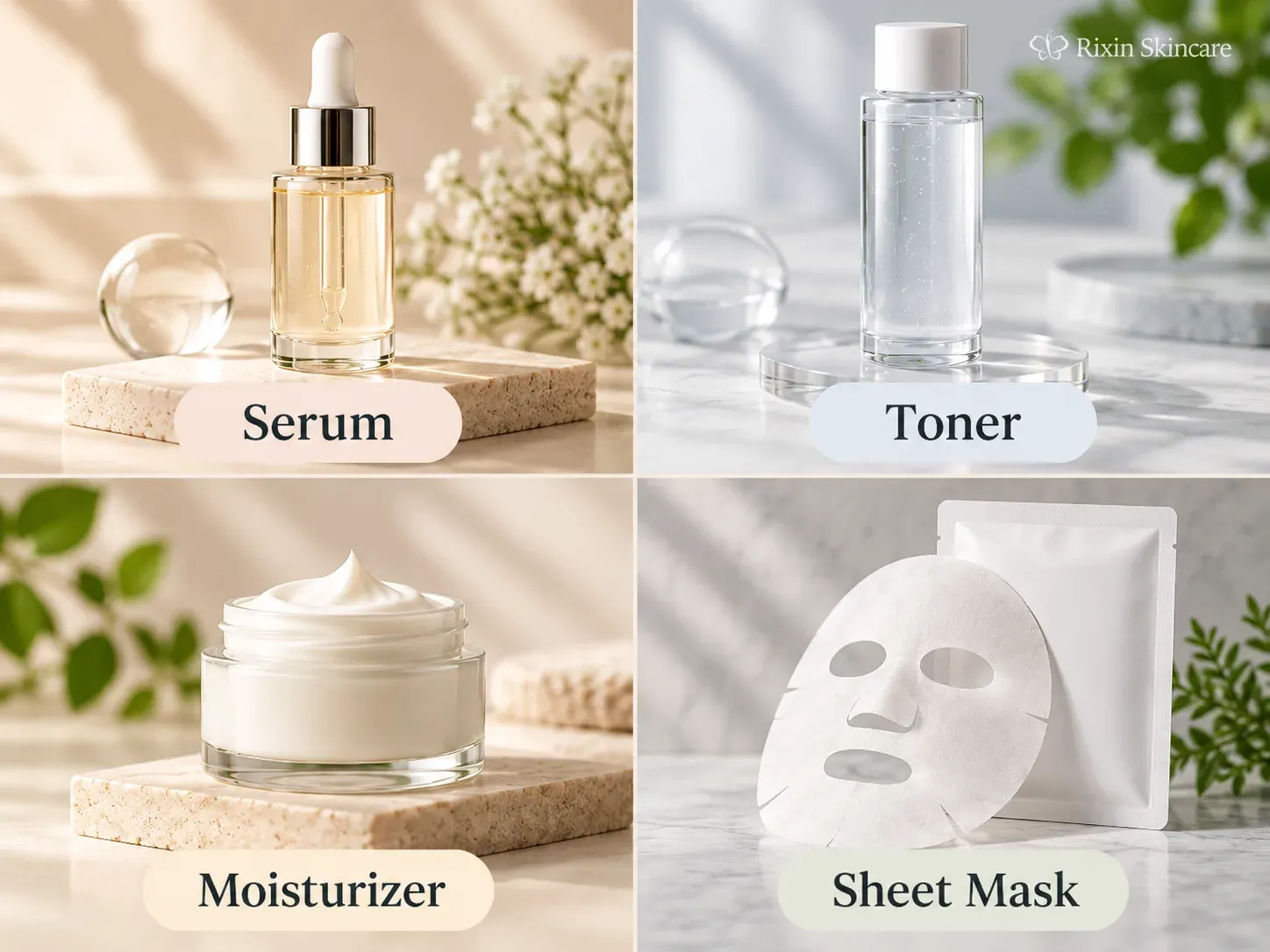
A serum may make sense when the brand wants a concentrated hero-active story and a lightweight leave-on format. A moisturizer may be more appropriate when the new SKU needs to combine tone-focused positioning with emulsion texture and daily conditioning. A toner or essence may serve a different application and sensory role. A sheet mask can make sense when the brand wants a separate use occasion rather than another daily leave-on SKU.
The question is not:
Which format is best for brightening?
It is:
Which format best fits this product’s role, ingredient system, use pattern, sensory target, packaging, and position in the existing line?
Once the format is defined, the detailed manufacturing questions belong on the relevant commercial page:
The Hub only needs to help the brand make the decision.
Decide What You Want to Claim Before the Formula Is Locked
Claims should not be something the marketing team invents after the product has already been formulated.
If a brand wants to position a product around brighter-looking skin, a more even-looking complexion, radiance, or the appearance of visible dark spots, that intended positioning should be discussed before formula lock.
That discussion affects the formula direction, evidence plan, testing scope, packaging communication, and target-market review. Ingredient research can help explain why an ingredient was selected, but it does not automatically prove that the finished product delivers the same result.
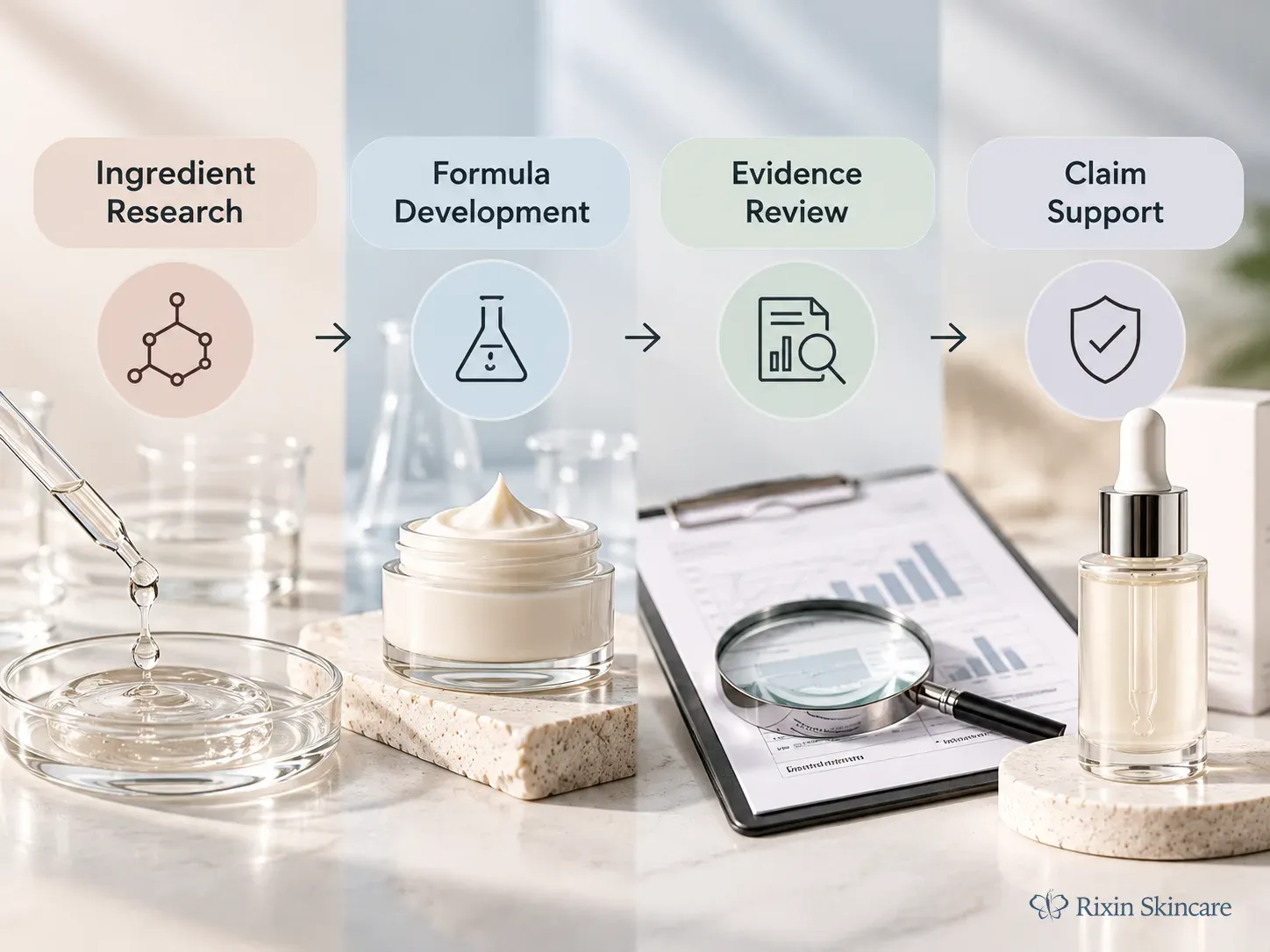
At Hub level, the decision is to define the intended claim strength early and flag whether finished-product testing or market-specific review may be needed. For the detailed process, see how to plan brightening claims and evidence before formula lock.
The appropriate testing method, provider, scope, responsibility, timing, and quotation status still depend on the finished product, intended claims, target market, and evidence already available.
Choose the Development Route That Matches the Brief
Not every brightening concept requires a completely new formula.
An established brand adding a new SKU may have two broad routes.
Start From an Existing Formula
A private-label skincare route can make sense when an existing formula already fits the intended product type and the required level of customization is limited.
The project still needs to review the selected formula against the brand’s target market, packaging, positioning, ingredient story, and commercial requirements.
Develop or Substantially Modify the Formula
A custom formulation route is more appropriate when the brand needs a specific active system, distinctive sensory target, different delivery system, or a formula that cannot be reached through reasonable customization of an existing option.
The decision should come after the brief is clear.
Starting with “custom” before defining what is actually unique about the product can create unnecessary development work. Starting with an existing formula when the desired active system does not fit it can create the opposite problem.
The formula route should serve the product brief.
Include Cost and MOQ in the Decision—Without Letting Them Drive Everything
A brightening project does not have one universal cost or MOQ.
Commercial feasibility can change with:
- the selected ingredient system;
- raw-material requirements;
- formula complexity;
- product format;
- packaging;
- testing and documentation scope;
- and the number of SKUs being launched.
That means cost and MOQ should be reviewed while the concept is being narrowed, not only after every technical decision has already been made.
However, the brightening Hub should not duplicate the site’s full manufacturing-cost guidance.
For detailed budget logic, use the Skincare Manufacturing Cost and Quotation Guide. For project-level minimums and schedule dependencies, review MOQ and Lead Time.
The goal here is simpler: make sure the proposed formula and format are commercially realistic before they become expensive to change.
Design the First SKU So It Can Fit a Future Line
For an established brand, one successful brightening SKU may eventually lead to a broader product line.
That does not mean the first project should immediately become four or five products.
A more useful question is:
If we expand this concept later, what role should this first product own?
A hero serum, for example, might carry the main active story. A future moisturizer could have a different role around daily support and sensory comfort. A mask might create a separate use occasion. Another SKU may not need to repeat the same hero ingredient at all.
Different products should have distinct jobs.
If the project starts moving from one SKU into a broader assortment, the detailed decisions around product roles, launch scope, packaging, quantities, and phased expansion belong in the Skincare Product Line Planning guide.
If several products are intended to work together as a coordinated routine, the relevant next step is How to Plan a Skincare Routine as a Product System.
Cluster 8 should help define the brightening concern strategy. It should not duplicate general product-line or routine architecture.
Turn the Idea Into a Manufacturer-Ready Brief
Before asking for samples or a final quotation, a brightening product brief should be clear enough for the manufacturer to understand what is fixed, what is flexible, and what still needs review.
For this type of project, clarify the decisions that are specific to the brightening concept:
-
The role of the new SKU What gap does it fill in the current product line?
-
The intended cosmetic positioning Brightening, radiance, more even-looking tone, visible dark-spot appearance, or another defined direction?
-
The target market Where does the brand plan to sell the finished product?
-
The preferred format Serum, moisturizer, toner/essence, mask, or another product type?
-
The hero ingredient or ingredient direction Is a specific material required, or is the manufacturer being asked to review possible active directions?
-
The supporting-active strategy Are additional actives essential to the product concept, optional, or still open for formulation review?
-
The intended claims and evidence expectations What does the brand want to say about the finished product, and what supporting evidence or testing still needs to be reviewed?
A useful brief does not need to contain a finished formula.
It needs to make the important brightening-specific decisions visible so the manufacturer can identify conflicts, missing information, and realistic development routes before unnecessary sampling begins.
Packaging direction, quantities, target budget, timing, reference products, delivery information, and other general intake requirements still matter, but they belong in the site’s broader Project Requirements checklist rather than being repeated in full here.
A Strong Brightening Product Starts With Fewer Assumptions
A hero ingredient can be a strong commercial starting point.
But the product becomes manufacturable only when that ingredient is placed inside a clear product strategy.
For an established brand adding a brightening SKU, the sequence should usually be:
product role → target market → positioning → hero ingredient → formula strategy → format → claims and evidence → development route → commercial review
That sequence gives the formulation team room to challenge unrealistic concentrations, unnecessary active stacking, mismatched formats, and claims that the available evidence cannot support.
The result is not necessarily the formula with the most active ingredients.
It is the formula brief in which every major decision has a reason.
If you are preparing a new brightening or uneven-tone SKU, start by defining the product role, target market, preferred format, hero ingredient direction, and intended claims before requesting formula development.