
On this page
A repeat skincare manufacturing order should start with the last confirmed production basis, not with the assumption that everything from the previous batch still applies automatically. Before the next batch begins, separate what is genuinely unchanged from what has changed, then reconfirm the items affected by those changes.
A useful buyer-side framework is Same → Changed → Reconfirm.
- Same: What is still identical to the last confirmed production basis?
- Changed: What is different in the product, packaging, artwork, quantity, scope, or project requirements?
- Reconfirm: Which differences need a new decision, approval, quotation, document, or project review before production starts again?
A repeat order does not normally mean restarting the entire development process from zero. But it also should not be treated as an automatic copy of the previous production run.
What Counts as a Repeat Skincare Manufacturing Order?
A repeat manufacturing order usually starts from a skincare product or SKU that has already completed a previous production run. The buyer and manufacturer already have a working product basis, such as the formula or specification, packaging system, artwork, fill size, SKU configuration, and agreed project requirements.
The key question is not simply:
Have we made this product before?
It is:
Are we still making the same confirmed product and order?
A straightforward repeat order is easier to identify when the important product and order inputs remain unchanged. If one or more inputs have changed, the project may still be based on the previous product, but the affected areas need to be reviewed before the next batch proceeds.
For a first production run, use What to Confirm Before Skincare Bulk Production Starts. A repeat order starts one step later: with the version that was actually confirmed and produced previously.
The production readiness and repeat-order guide connects this repeat-order review with the earlier production and change checkpoints.
Start With the Last Confirmed Production Basis
Before sending a new purchase order or approving another production run, establish what the previous batch was actually based on.
Depending on the project, that reference may include:
- the product or SKU version;
- the formula or product specification;
- fill size;
- primary packaging and closure;
- carton or secondary packaging;
- artwork or label version;
- quantity and SKU configuration;
- agreed quality-review or document scope.
Separately, note any relevant issue from the previous batch that still needs to be carried forward, resolved, or reconfirmed. Those issues are not part of the production basis itself; they are a second check before the next run.
The purpose is not to recreate every historical email or document. It is to identify the current reference that defines the product and order you intend to repeat.
A useful first question is:
What exactly are we repeating?
If the buyer and manufacturer are working from different versions of the previous project, even a supposedly simple reorder can create avoidable confusion.

Separate What Is the Same From What Has Changed
Once the previous production basis is clear, compare the new order against it.
| Status | Buyer question | Practical result |
|---|---|---|
| Same | Is this item genuinely unchanged from the last confirmed production basis? | Keep the current confirmed reference where it still applies |
| Changed | What differs from the previous order? | Identify the affected product, packaging, artwork, quantity, or project requirement |
| Reconfirm | Does the difference require a new decision or review? | Close the affected issue before the next production run |
This comparison should focus on actual project inputs rather than the general statement that the product is a repeat order.
For example, the formula may be unchanged while the carton artwork has been revised. The bottle may be unchanged while the quantity and SKU mix are different. The product may look identical while the agreed document scope or destination market has changed.
A repeat order can therefore contain both unchanged and changed elements at the same time.
Reconfirm the Product, Formula, and SKU Basis
Start with the product itself.
Confirm whether the next order uses the same:
- product or SKU version;
- formula or specification basis;
- fill size;
- SKU identity and configuration.
If these are unchanged, the previous confirmed basis may continue to be the correct working reference.
If the formula, specification, fill size, claims, or another approved product input has changed, do not treat the difference as automatically covered by the previous approval. Identify what changed and whether the earlier approval still applies.
The deeper review process belongs in What Happens When a Skincare Project Changes After Approval?. The role of the repeat-order review is to detect the change early enough that it can be handled before production restarts.
Reconfirm Packaging and Artwork
Packaging is another common area where a repeat order may not be completely identical to the previous run.
Check whether the current order still uses the same:
- bottle, jar, tube, or other primary package;
- pump, cap, closure, or applicator;
- carton or secondary package;
- decoration method;
- label or artwork version.
A package that looks similar is not necessarily the same current reference. A supplier may be using a revised component, artwork may have been corrected, or the buyer may have changed a design detail after the previous batch.
The repeat-order check does not need to reproduce the full packaging-development process. It only needs to establish whether the packaging and artwork basis is still the same.
Detailed component, artwork, decoration, and packaging coordination belongs in Packaging and Label Design.
Reconfirm Quantity, SKU Mix, and Order Scope
A repeat product does not always mean a repeat order quantity.
Before the next batch, confirm:
- total quantity;
- quantity by SKU;
- fill-size mix;
- packaging configuration;
- any order-specific scope that differs from the previous run.
A change in quantity or SKU mix may affect supplier requirements, production planning, timing, or commercial terms. Those effects should be reconfirmed rather than assumed from the previous order.
Detailed MOQ and timing considerations belong in MOQ and Lead Time. If a changed scope requires a new commercial review, the relevant Cost & Quotation guidance should handle that detail rather than turning the repeat-order article into a pricing guide.
Carry Forward Lessons From the Previous Batch
One of the most useful parts of a repeat order is that the previous production run already produced real project experience.
Before repeating the order, ask whether the last batch revealed anything that should be addressed in the next one.
Examples may include:
- a packaging or artwork correction;
- a finished-goods observation;
- a handling issue;
- a document gap;
- a shipment-handoff issue;
- a buyer-side note that should affect the next production run;
- an unresolved dependency that was temporarily accepted but should not simply carry forward.
Previous issues should not disappear simply because the next purchase order is called a repeat order.
This does not mean every observation requires a formal corrective-action process or that every small difference must stop production. The point is to make the previous issue visible and confirm whether it has been resolved, remains acceptable, or changes what should happen in the next batch.
The end of the previous production cycle is covered in What to Check Before Shipping Skincare Finished Goods. A repeat-order review should carry forward any relevant decision from that handoff instead of starting with a blank record.
Reconfirm Quality and Document Expectations
The next order should also confirm whether the agreed quality-review and document scope is still current.
Depending on the product, project, market, and responsibilities of the parties, ask:
- Does the previous agreed review scope still apply?
- Are the same specifications or document expectations still relevant?
- Has the destination market changed?
- Has the buyer requested different evidence?
- Have responsibilities changed since the previous run?
- Is any previously open document or quality issue still unresolved?
Do not assume that every repeat order requires the same document package or the same testing. A certificate of analysis, retained sample, independent inspection, specific laboratory test, or other record may or may not be part of a particular project.
Detailed testing, specifications, reports, records, and evidence boundaries belong in Quality Testing and Documentation.
The repeat-order question is narrower: is the previously agreed scope still the right scope for this next production run?
When Is It No Longer a Simple Repeat Order?
A repeat order becomes more than a simple “same as last time” instruction when a meaningful input has changed or an important requirement remains unresolved.
That may include a change to:
- formula or specification;
- packaging component;
- artwork or label;
- fill size;
- claims;
- SKU configuration;
- quantity or order scope;
- target market;
- agreed quality or document requirements;
- an unresolved issue from the previous batch.
A change does not automatically mean the whole project must restart. The correct response is to identify the affected area, determine what the change could influence, and confirm which previous decisions still apply.
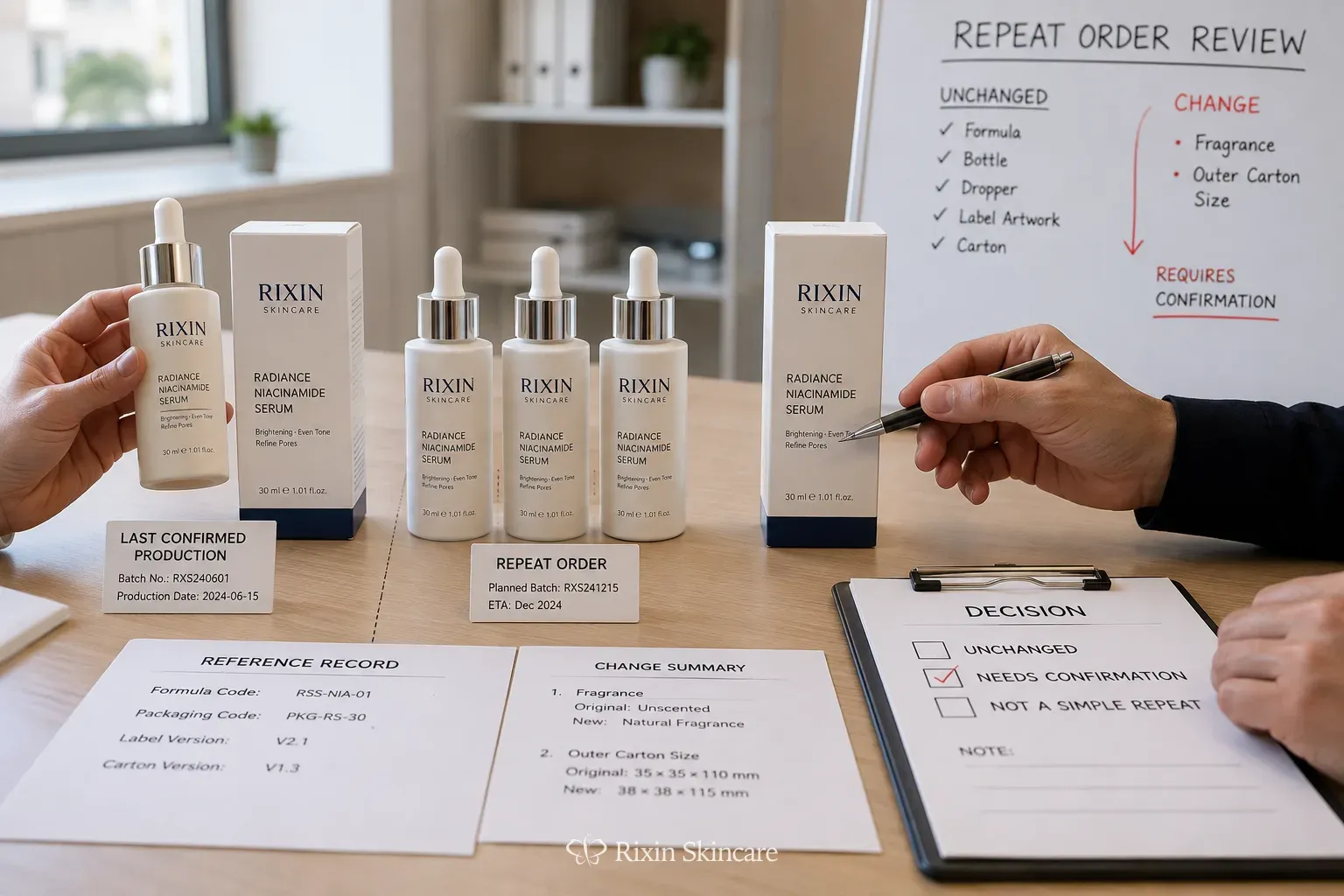
If the difference affects an already approved project input, use the change-review logic in What Happens When a Skincare Project Changes After Approval? rather than relying on the words “repeat order” as approval.
Record the Repeat-Order Decision
A simple buyer-side record can keep the repeat-order review clear.
| Field | What to confirm |
|---|---|
| Product / SKU | Which previous product version is being repeated? |
| Formula / specification | Same or changed? |
| Packaging | Same components and configuration? |
| Artwork | Same approved version or revised? |
| Quantity | Same or changed? |
| SKU mix | Same or changed? |
| Previous issue | Anything from the last batch that must be addressed? |
| Quality / documents | Same agreed scope or updated? |
| Market / claim basis | Any change that requires another review? |
| Open decision | What still needs confirmation? |
| Owner | Who is responsible for closing it? |
| Repeat-order status | Ready, needs confirmation, or changed project |
Use the final status as a simple buyer-side decision:
- Ready — the important repeat-order inputs are confirmed unchanged, or any affected differences have been resolved.
- Needs confirmation — one or more relevant inputs, responsibilities, or open decisions still need to be closed.
- Changed project — a material input has changed and should go through the relevant change or review path before the order is treated as a straightforward repeat.
This is a buyer-side tracking tool, not a formal Rixin quality-assurance, production-release, or contractual form.
The manufacturing context behind the next production run belongs in Manufacturing Facility. The purpose of this record is simply to make sure the buyer and manufacturer are referring to the same current project basis before production proceeds.
Final Rule Before a Repeat Order Proceeds
A repeat order should carry forward what is still valid without carrying forward outdated assumptions.
If the product, packaging, artwork, order scope, or agreed project requirements have changed, identify and reconfirm those differences before treating the next batch as a straightforward repeat order.
If the important inputs are unchanged and confirmed, the next order can proceed from the current confirmed production basis. If something material has changed, resolve that change through the appropriate project review before the next batch begins.
The practical objective is simple: know what you are repeating, know what changed, and make sure both sides are working from the same current version.